
Vincent van Gogh arrived in Paris in 1886 to live with his brother Theo and was transfixed by the revolutionary steps being taken in the world of art. Used to the somber canvases of the Realists and the Old Masters, the artist witnessed a whole new world of possibilities in the canvases of the Impressionists. Soon after his arrival, he found out about two important figures, the French artists Georges Seurat and Paul Signac, pioneers of the Neo-Impressionist movement.
The Scientific Dot of Neo-Impressionism
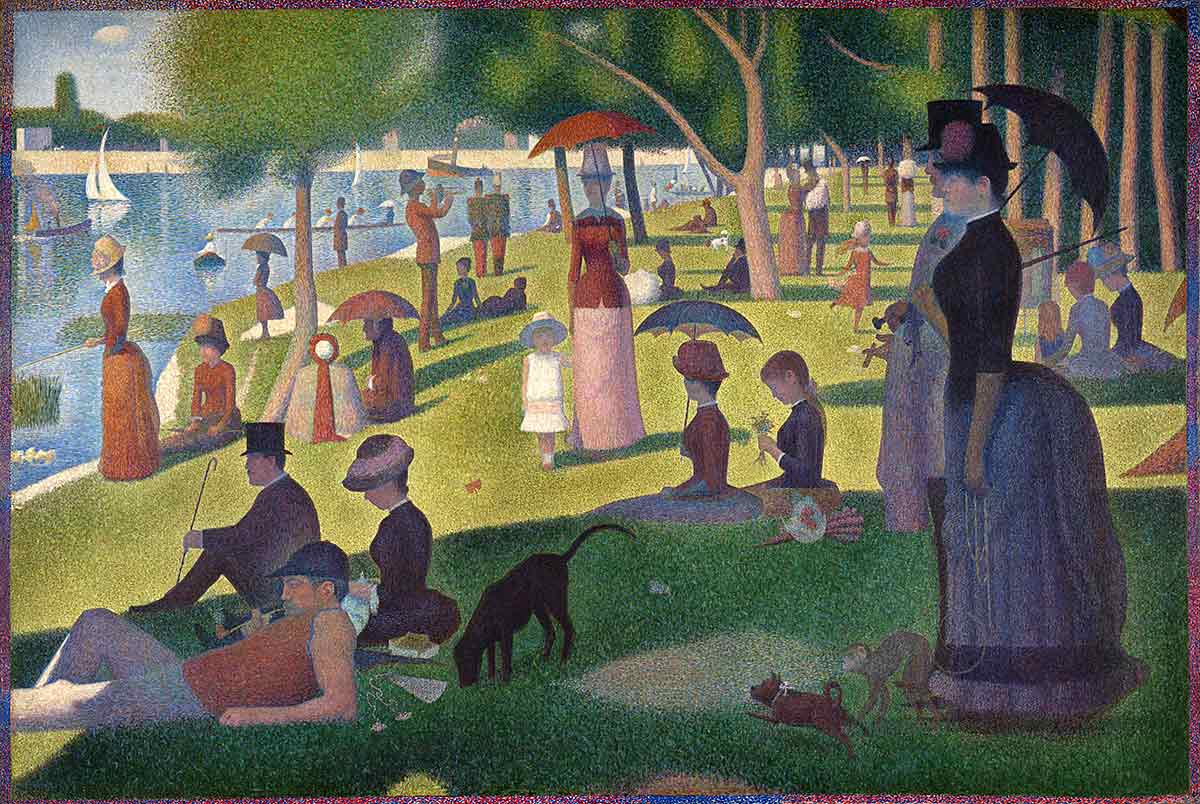
Among the numerous stylistic movements burgeoning in late-19th century Paris, Neo-Impressionism soon gained center stage. Its founder, Georges Seurat, who was soon joined by Paul Signac, proposed the Pointillist technique of painting (though Seurat himself preferred the term Divisionism), in which pure, unmixed colors are applied to a canvas in the form of small dots and dashes to compose a painting. The foundation of this technique and the Neo-Impressionist movement at large was an emphasis on scientific accuracy in order to achieve a visually balanced painting. Seurat’s work A Sunday on La Grande Jatte, which was exhibited at the eighth Impressionist exhibition in 1886, was a major step toward the acceptance of Neo-Impressionism. Van Gogh was introduced to this movement through Signac and began experimenting with it in early 1887.
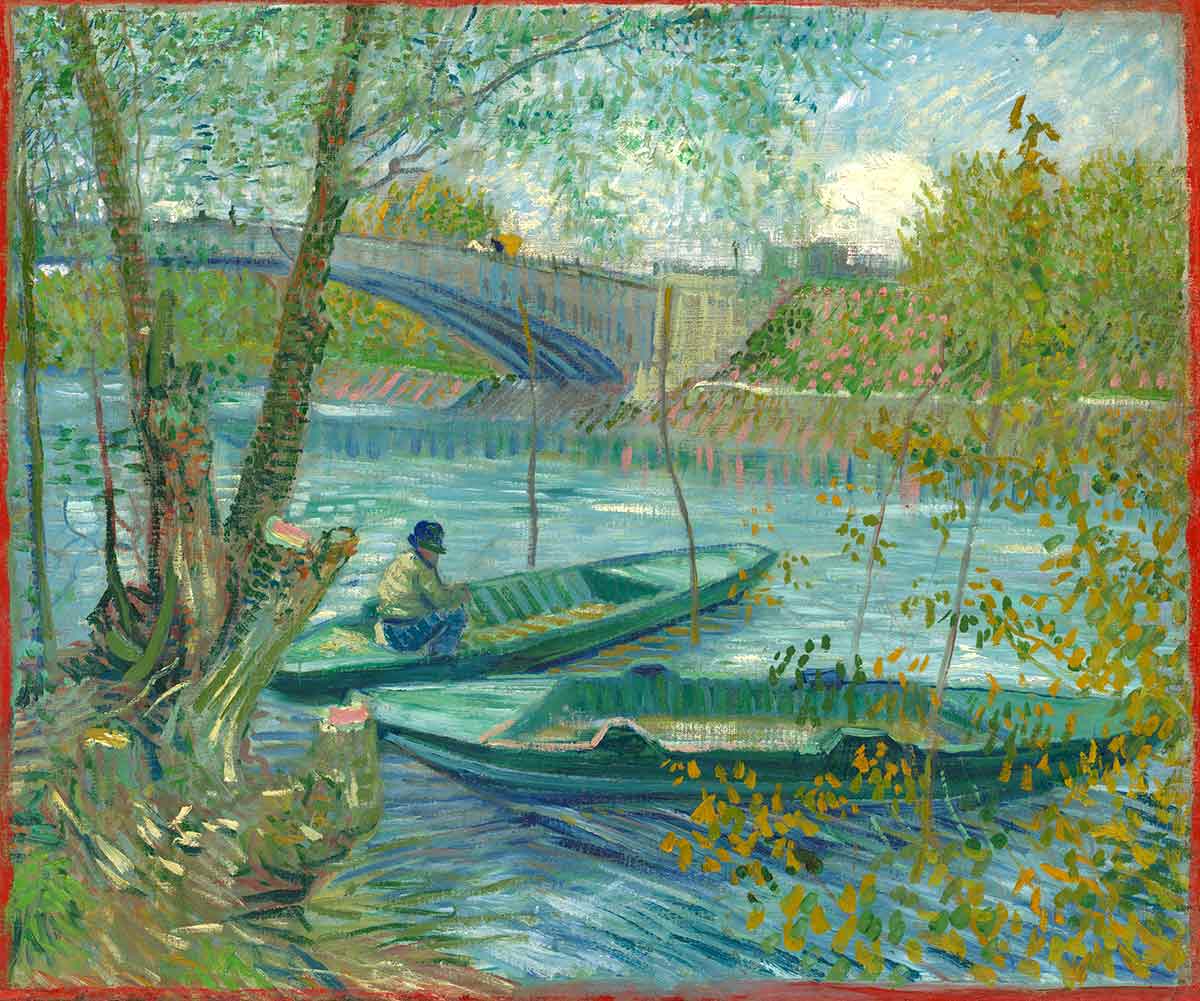
The two often painted together in Asnières, a suburban region of Paris, and Van Gogh immersed himself in practicing the Pointillist technique, as can be seen in the painting Fishing in Spring, the Pont de Clichy (Asnières). Toward the end of 1887, however, Van Gogh’s style shifted as he inclined toward Japanese prints and the cloisonnist style of Émile Bernard. Nevertheless, as the eight paintings listed below demonstrate, Neo-Impressionism formed a significant part of his stylistic evolution and Van Gogh continued implementing his own rendition of it throughout his mature years.
1. View From Theo’s Apartment (1887)
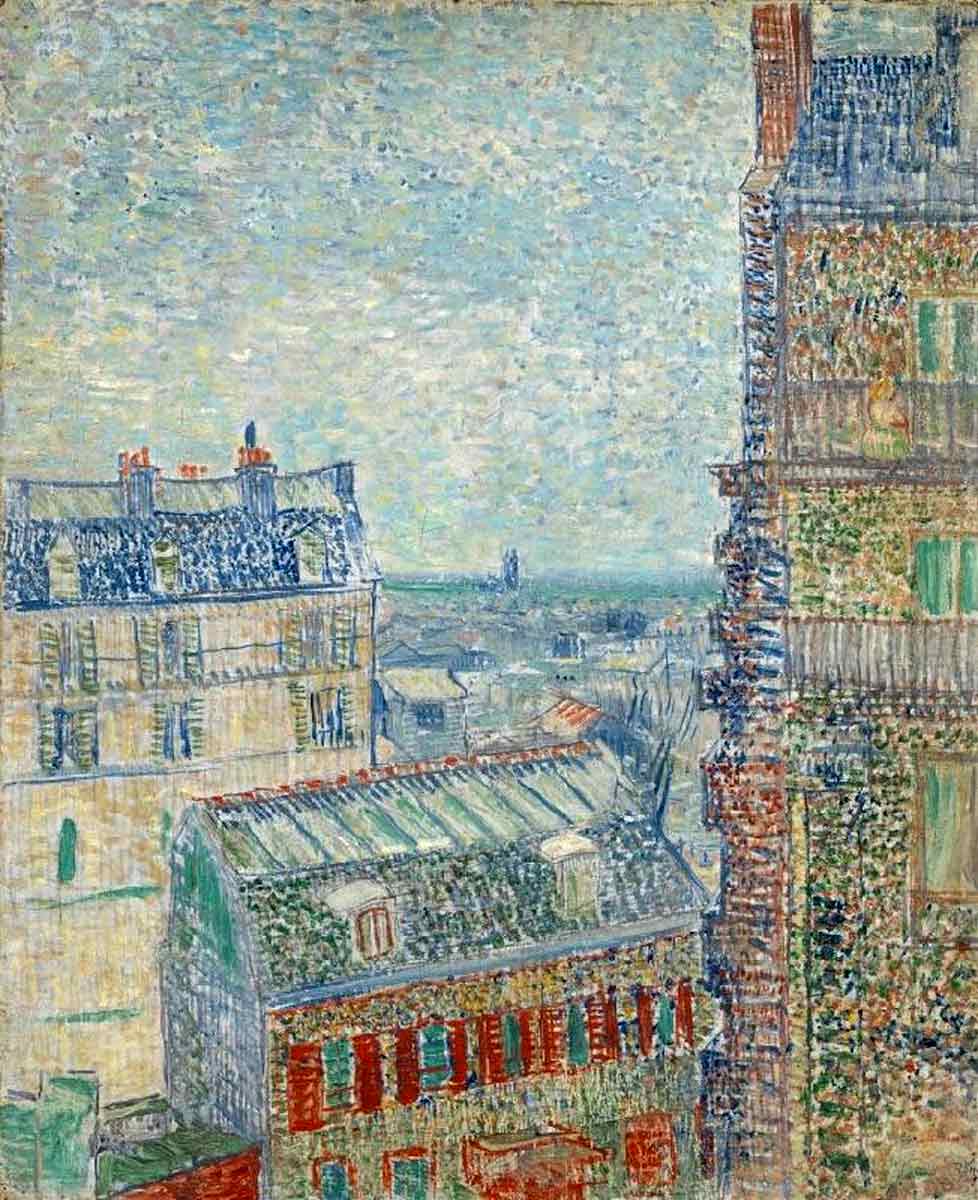
Theo lived in an apartment on Rue Lepic that looked out into a beautiful view of the city. Van Gogh made several paintings and drawings of this view, with this particular painting being an interesting experiment in Pointillism. The work employs a broad color palette, featuring shades of blue, green, orange, red, and yellow. The two buildings in the front are composed with dots and small brushstrokes of different colors, although this technique fades out in the rest of the composition.
During this period, Van Gogh was beginning to implement the Pointillist technique in his work and had not yet integrated it into his own stylistic repertoire. Later paintings by the artist show a much more confident handling of this technique that deviates from the strict scientific methods of Seurat and Signac and is more spontaneous, contributing to the unique character of Van Gogh’s style.
2. Interior of a Restaurant (1887)
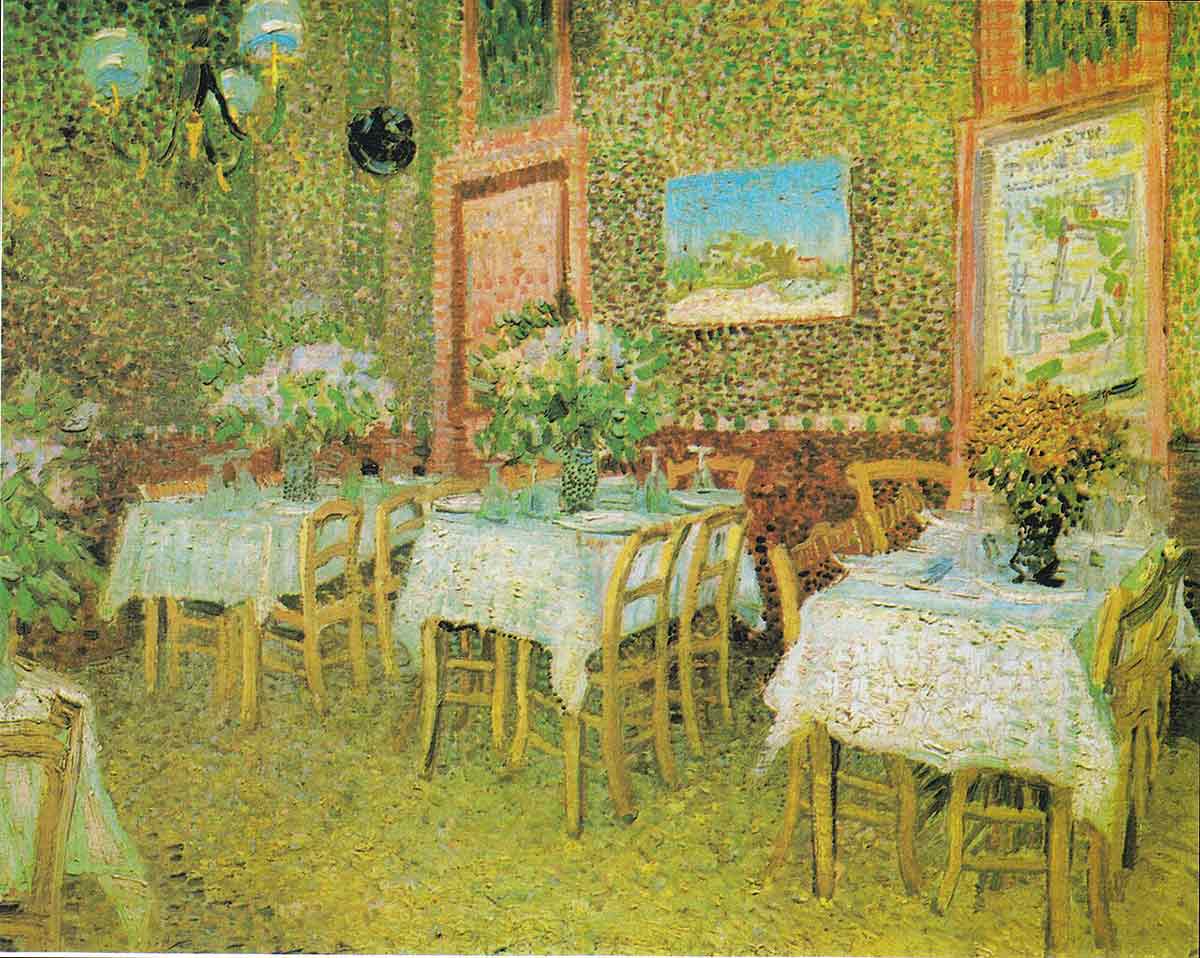
Also from his Paris period, Interior of a Restaurant is an unreserved adoption of the Pointillist technique by Van Gogh. This work was made in the summer of 1887, during the early days of his experiments with Neo-Impressionism. He uses a myriad of small dots packed together to depict the back walls and the floor of this interior scene, but switches to dashes in the depiction of the tables and chairs.
The painting is composed of a bright palette as per the ideals of Neo-Impressionism, although Van Gogh added the effect of shadows under the table by using darker colors, moving away from the modernist example that emphasized flatness. Interior of a Restaurant is one of the very few paintings by Van Gogh that are composed of small dots, as later works that feature a Neo-Impressionist style are dominated by carefully placed small dashes.
3. Self-Portrait With Gray Felt Hat (1887)
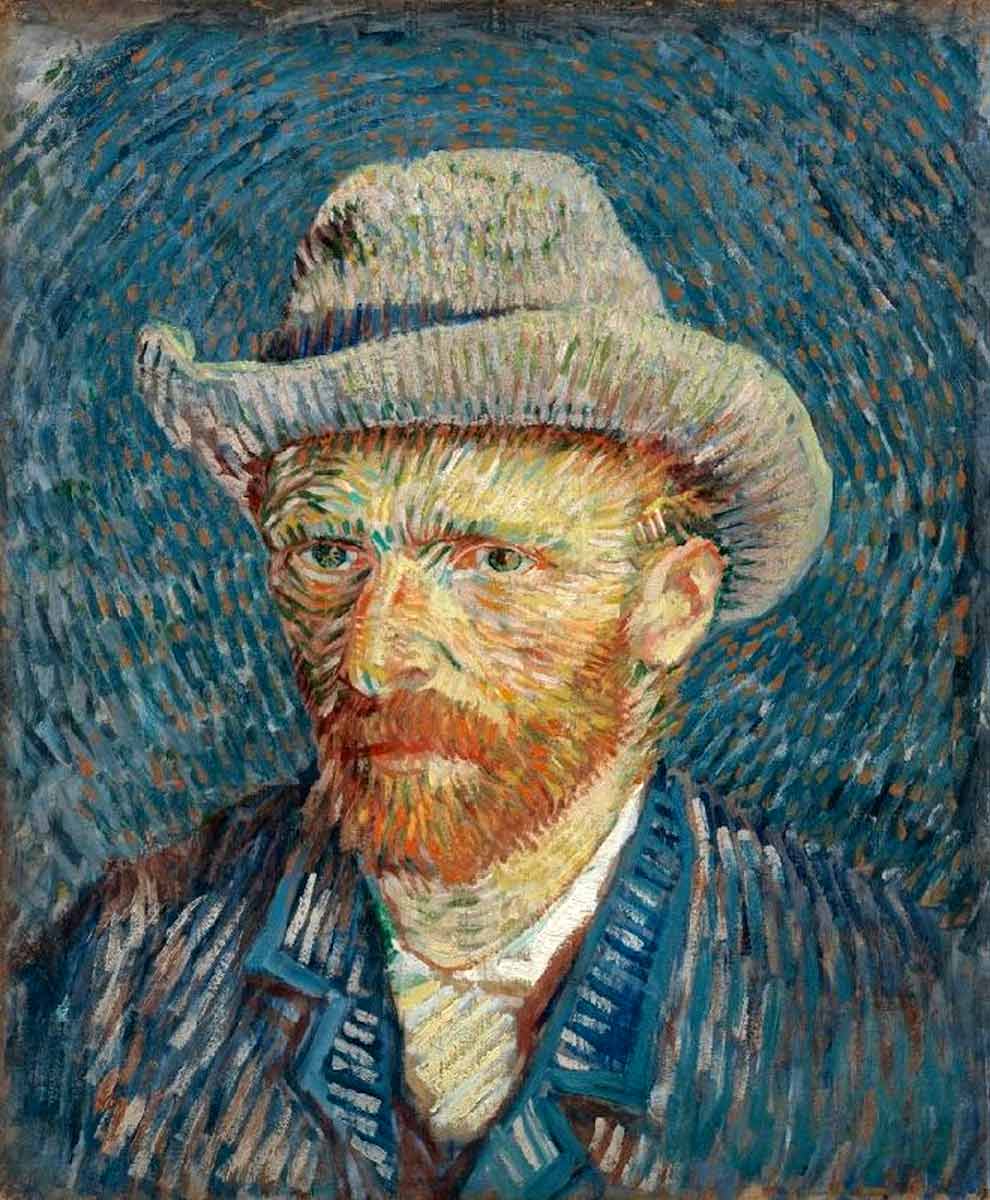
This self-portrait signaled a major shift in Van Gogh’s style, particularly in terms of portraiture. It was made in the winter of 1887 and resulted from almost two years of education in modernist painting and around one year of experimentation alongside the Neo-Impressionists. Van Gogh adopted the tenets of the Pointillist technique and color theory in this painting by using small dashes of complementary colors, such as blue and orange in the background and red and green in the face. The dashes in the background form a circular shape around his head, resembling a halo, and move outward from the center of his face. The dashes of unmixed colors give the composition an illuminating effect and form a visually pleasing image when viewed all together, showing Van Gogh’s grasp of the Pointillist technique toward the end of his time in Paris.
4. Trees and Undergrowth (1887)
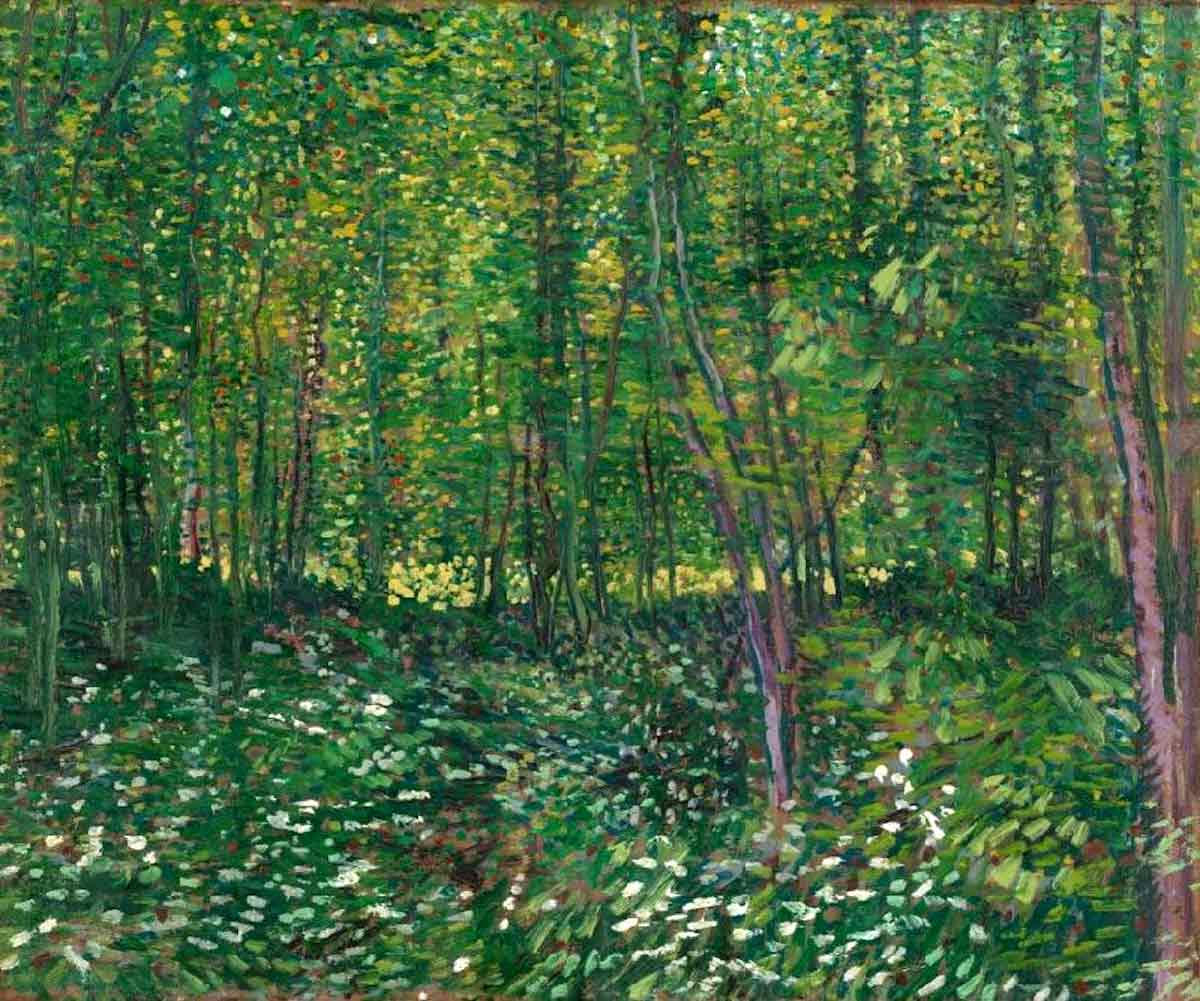
An incredibly luminous scene of dense undergrowth and trees, this painting captures lush greenery. Also made during the summer of 1887, Trees and Undergrowth shows Van Gogh’s technical mastery of stippling. The artist composed this painting by placing countless small dots in greens, yellows, red, and white, all across the canvas, making careful decisions regarding color and placement in order to create a visually cohesive composition. While there is a use of the Pointillist technique in this work, Van Gogh used his brush more spontaneously, as the colors are often mixed due to overlapping application, suggesting that this canvas was painted wet-on-wet.
He adds a contrasting effect in the colors by including yellow dots next to the violet of the tree trunks as well as red dots scattered across the green foliage. A scene brimming with vivid colors, this painting of a natural subject is a valuable predecessor to the radiant landscapes that Van Gogh made during the following year under the light of the blazing Provençal sun.
5. Sower With Setting Sun (1888)
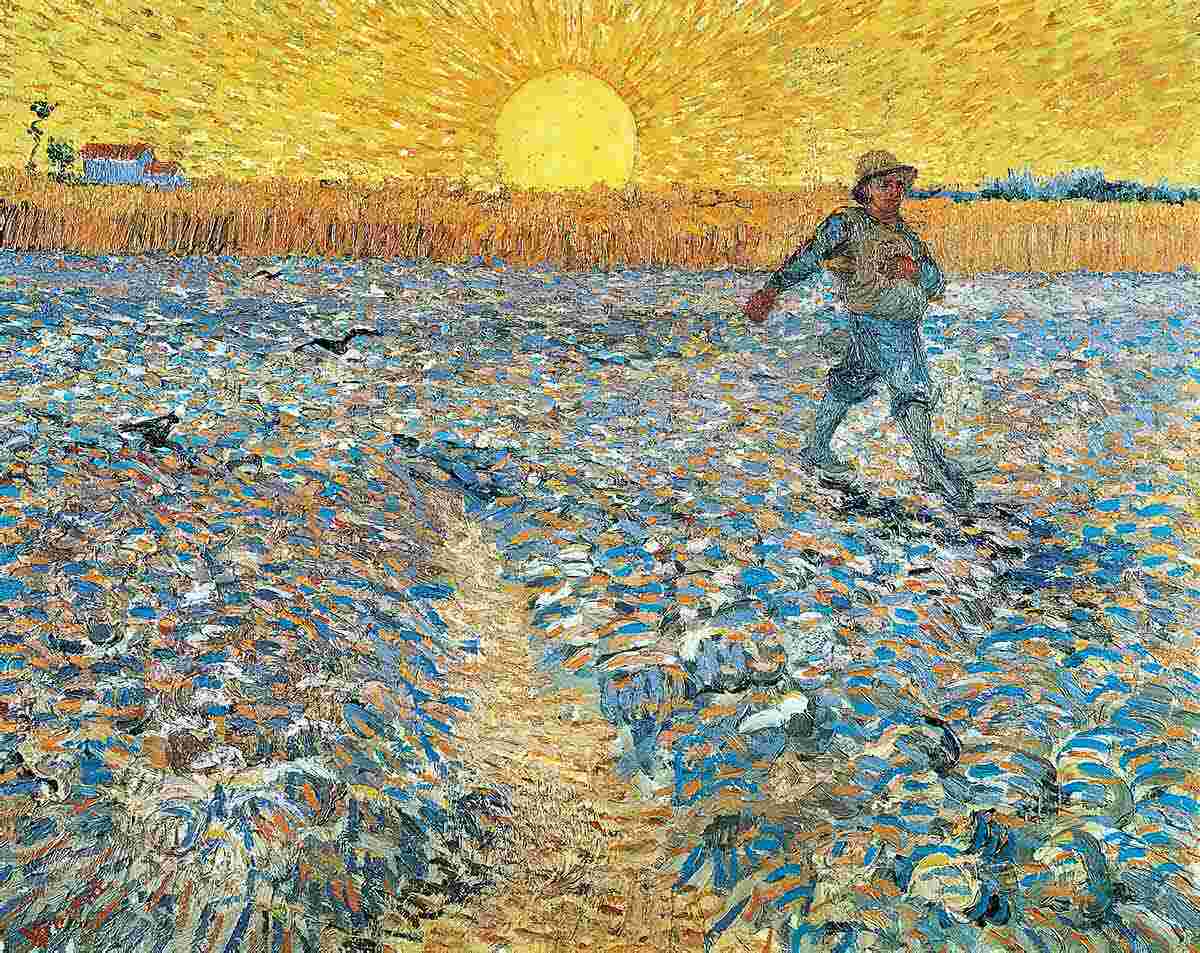
One of his more popular works, Sower with Setting Sun demonstrates Van Gogh’s embracing of his own version of Pointillism. This subject had fascinated Van Gogh ever since he started painting, particularly because of the painting The Sower by Jean-François Millet.
After describing the color palette of this work in a letter to Theo, Van Gogh added, “You can sense from the mere nomenclature of the tonalities that color plays a very important role in this composition.” This emphasis on the role of color is clearly visible from the very first look at this painting. The composition is bursting with violet, blue, white, and most of all yellow, all placed on the canvas in the form of numerous small dashes. The implementation of stippling in this painting gives it a dynamic effect, particularly as small yellow dashes move outward from the sun, illuminating the entire scene.
6. Garden of the Asylum (1889)
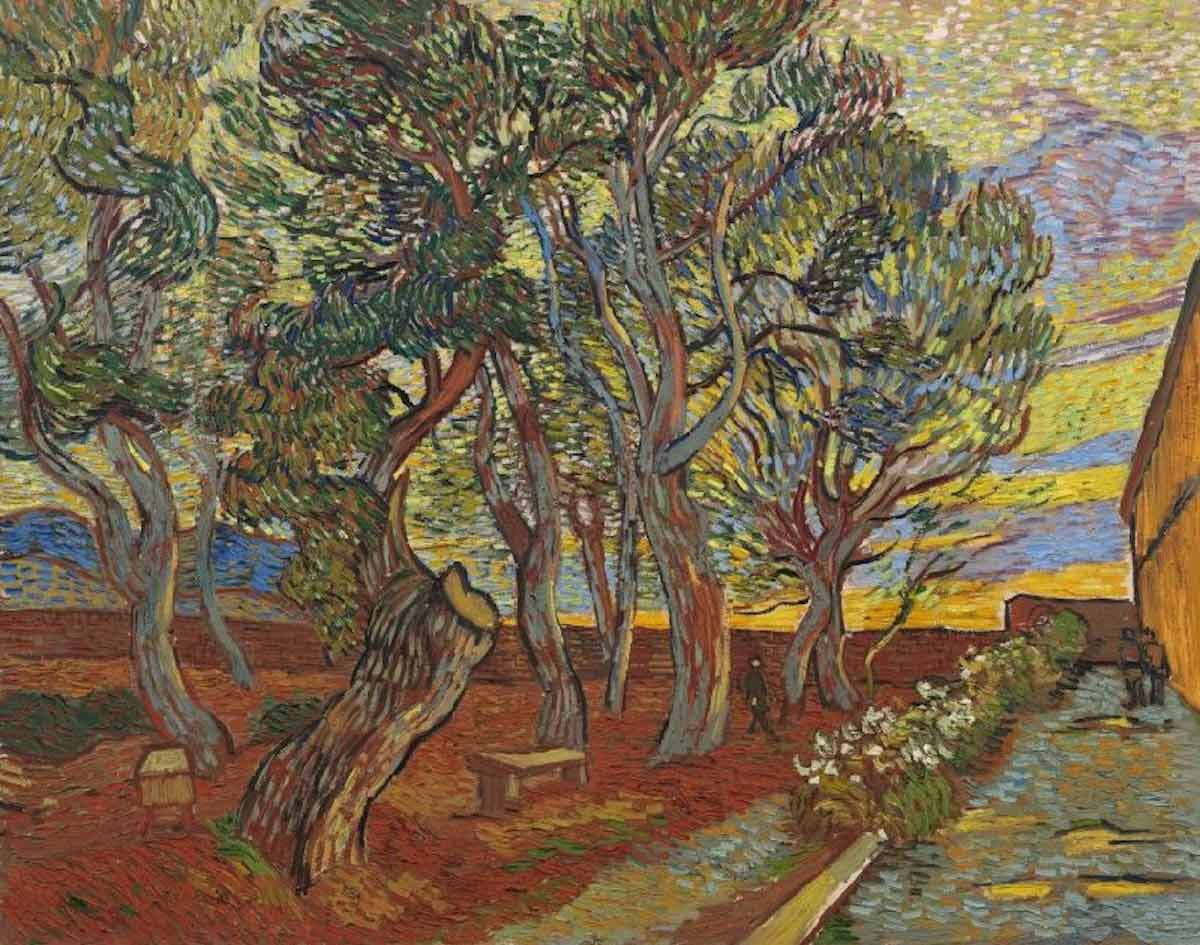
Van Gogh was admitted into a psychological hospital in May 1889 after suffering multiple mental breakdowns from December 1888 onward. The rules of the asylum were strict, and the artist was not allowed to leave the premises, which resulted in numerous paintings depicting the walled garden of the hospital. Despite being away from Paris for almost two years, Van Gogh continued experimenting with Pointillism, as is visible in this painting of the asylum garden.
The entire composition features small dashes in overlapping colors that begin to undulate in the foliage of the pine trees as well as the sky in the background. The colors also begin to diversify toward the top of the painting with an intense contrast of violet and yellow in the sky and the branches featuring reds and greens. This painting is not one of Van Gogh’s most popular paintings, but it is an excellent example of the artist’s unique interpretation of the Pointillist technique.
7. Olive Trees (1889)
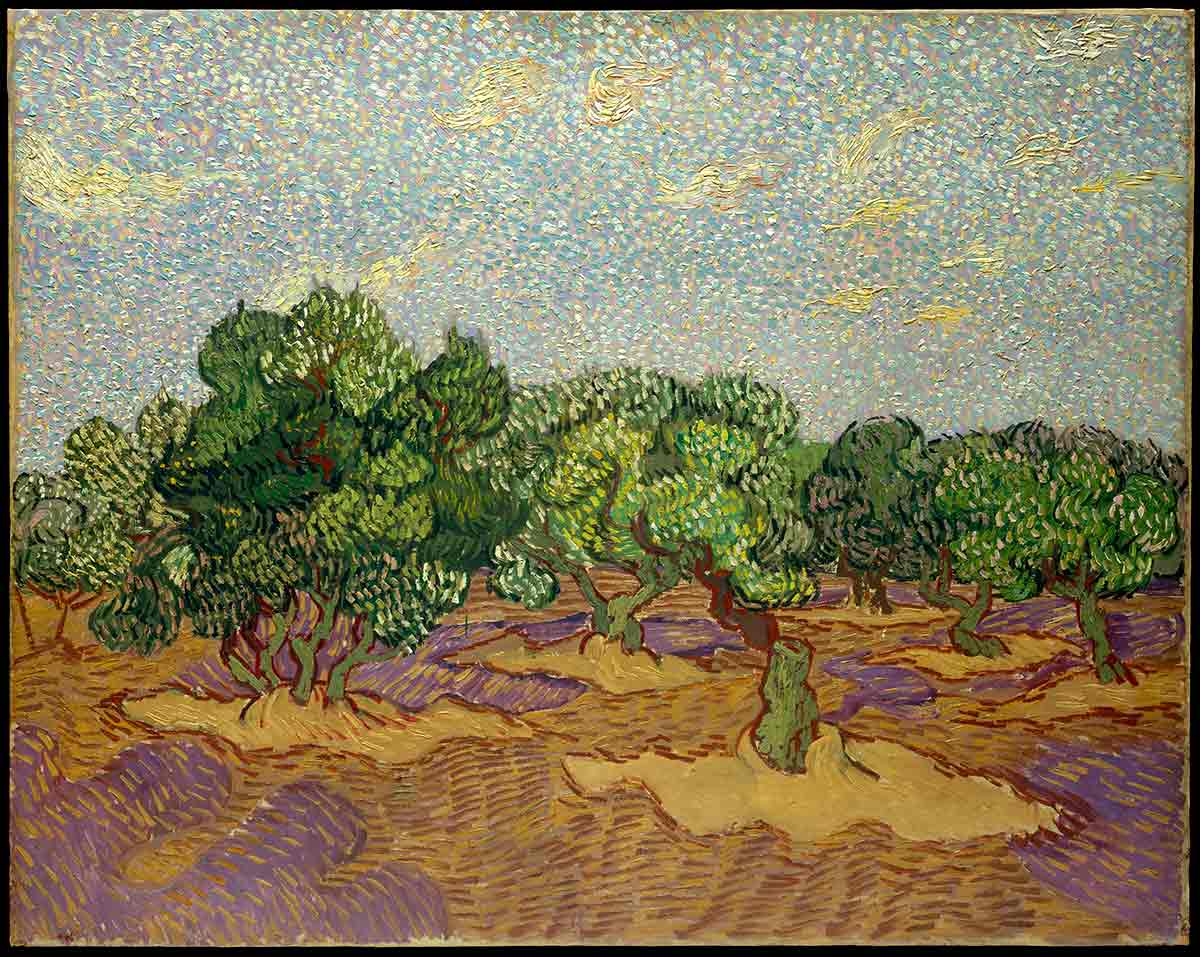
Van Gogh made an entire series of paintings dedicated to the subject of olive trees in 1889. He found these trees to capture the essence of the Provençal region and described the difficulty in capturing their changing nature in a letter to Theo from September, writing, “On the other hand the olive trees are very characteristic, and I’m struggling to capture that. It’s silver, sometimes more blue, sometimes greenish, bronzed, whitening on ground that is yellow, pink, purplish or orangeish to dull red ochre.”
While not composed entirely of stippling, this version of the subject clearly shows the influence of Seurat on Van Gogh. The sky is stylized with blue, yellow, violet and pink dots and the foliage of the trees is composed of small dashes consisting of shades of green, yellow and violet. The ochre ground below features longer undulating dashes. This painting shows how Van Gogh captured the effect of the changing light on these trees with precise use of his brush along with the knowledge of color theory that culminated from his Neo-Impressionist experiments in the previous two years.
8. Starry Night (1889)
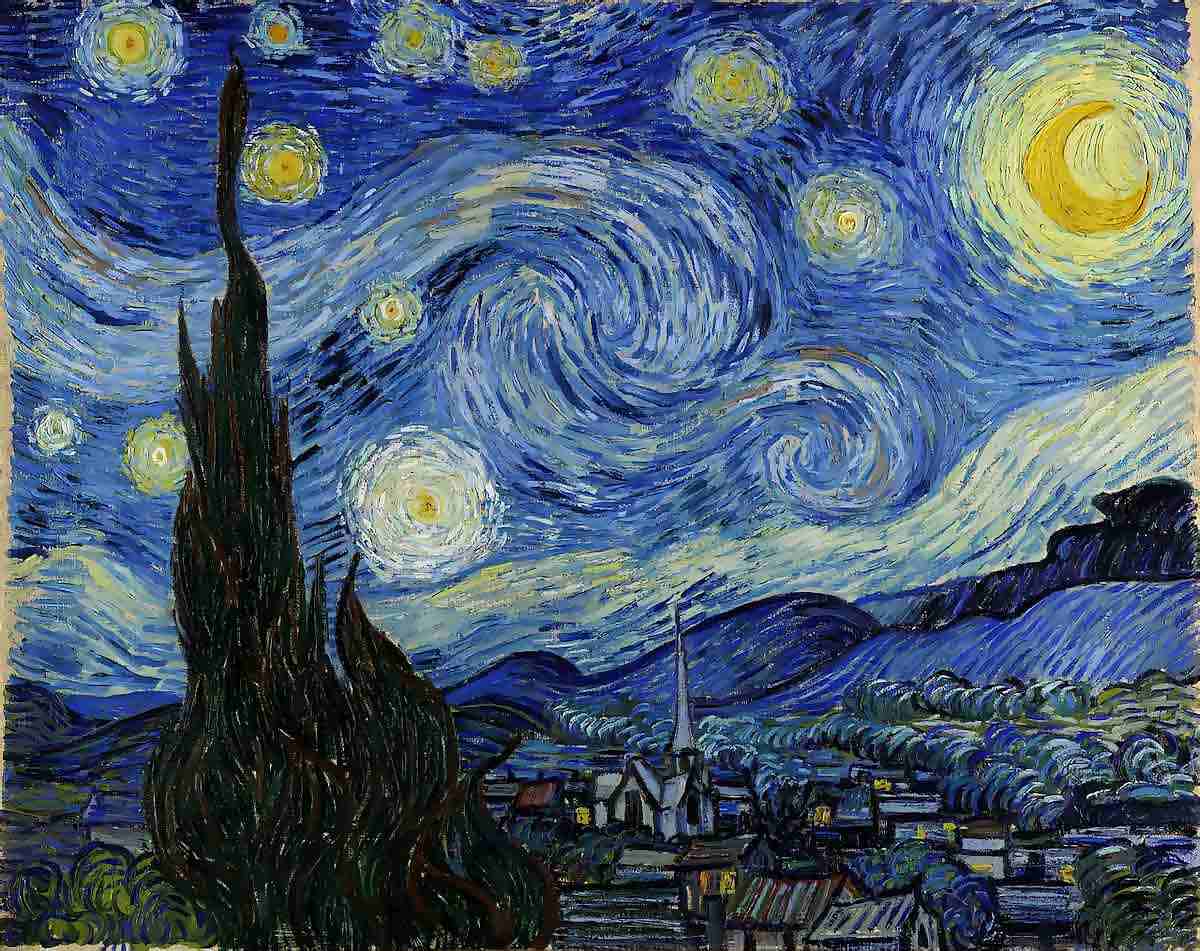
The most famous painting by Vincent van Gogh, Starry Night, shows the ultimate example of the artist’s unique take on Neo-Impressionism. The painting is characterized by the undulating brushstrokes in the sky that create the effect of movement. The dashes overlap throughout the composition, dominated by blue, violet, and yellow, and move in different directions in different parts of the composition. They form a circular shape around the crescent moon and the stars, swirl in tandem across the rest of the sky as well as the hills in the background, and rise up like flames in the foliage of the cypress tree in the foreground.
Despite popular belief, this exact scene was not visible from Van Gogh’s window in the asylum, but resulted from his imagination conjuring different images of the night sky, the cypress, and an idealized town viewed from above. Nevertheless, Starry Night is a culmination of the influence of Seurat and Signac on the artist, as well as the evolution of his own artistic vision after years of painting.