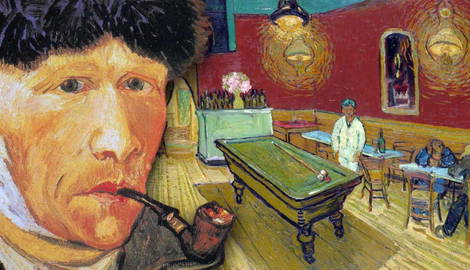

In September 1888, Vincent van Gogh made a painting that captured the “terrible passions of humanity.” This work, titled The Night Café, is one of the most significant paintings the artist made in his career. Instead of focusing on the beauty of nature or the honesty of peasant labor, this painting brings attention to the ruin and self-destruction that human beings indulge in. Through its sharply contrasting colors and converging perspective, The Night Café evokes a feeling of uneasiness that characterized Van Gogh’s experience of this cafe.
Painting in Arles
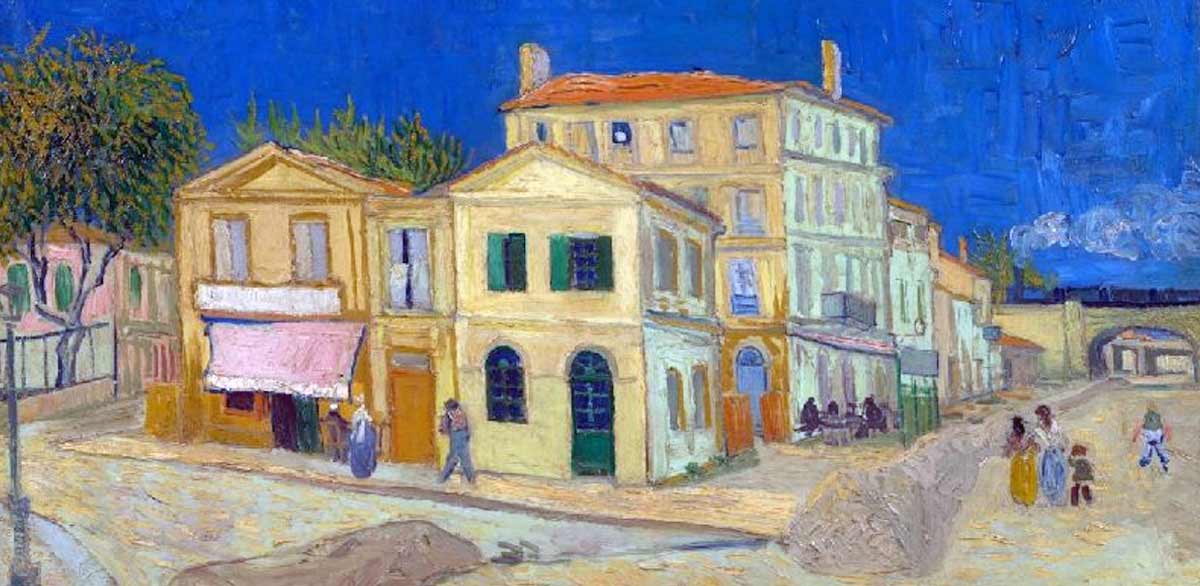
Van Gogh moved to Arles, a city in southern France, in February 1888 after spending nearly two years living with his younger brother Theo in Paris. He spent this time modernizing his style and technique alongside his peers, discovering new ways to implement form, line, and color to create harmonious compositions. Van Gogh arrived in Arles with a fresh perspective on painting and color, ready to take on the job to capture the south of France on his canvases. The city provided him with a number of vistas and natural subjects to paint, such as wheatfields, orchards, hills and gardens, and the fifteen months he spent in Arles are recognized as Van Gogh’s most productive period. The artist wished to settle down in Arles and rented a small house with two floors and four rooms on 2 Place Lamartine.
He called this The Yellow House and hoped to establish it as an artists’ community where painters could share expenses and studio space. Before moving into this house in mid-September 1888, Van Gogh rented a small room in Café de la Gare located on 30 Place Lamartine and lived there between May and September. The café was run by the couple Joseph-Michel and Marie Ginoux, both of whom later posed for Van Gogh. The artist spent a good amount of time in the café and was intrigued by its atmosphere and character, which eventually led him to paint a night scene of its interior titled The Night Café.
The Night Café
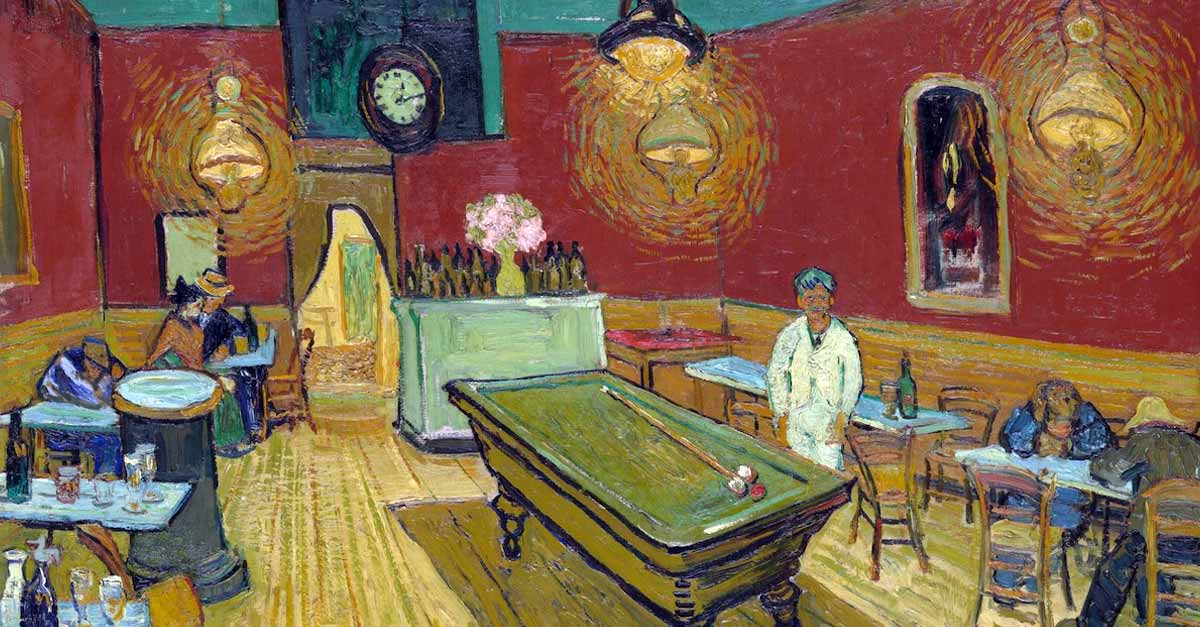
Painted in September 1888, The Night Café depicts the interior of a café de nuit, which referred to a café that was open throughout the night. There is a billiard table in the middle of the room and several tables lined up against the wall, and the door lies on the opposite end of the room next to a small bar lined with bottles and a vase with a pink and green bouquet. The entire room is lit up with four gas lamps hanging from the ceiling, casting a large shadow directly underneath the billiard table. The cafe is populated by six people, including the landlord who stands next to the billiard table and five customers who appear to be drinking or sleeping.
The walls are painted a solid red, contrasting with the green ceiling. A clock hangs above the door and shows the time to be roughly quarter past midnight. Van Gogh used a converging perspective and the vivid contrast between the yellow, red, and green in The Night Café to create an atmosphere of uneasiness and restlessness that was characteristic of this space during the late hours. He described his deliberate choice of color in this painting in detail in a letter to his brother, writing,
“I’ve tried to express the terrible human passions with the red and the green. The room is blood-red and dull yellow, a green billiard table in the center, 4 lemon yellow lamps with an orange and green glow. Everywhere it’s a battle and an antithesis of the most different greens and reds; in the characters of the sleeping ruffians, small in the empty, high room, some purple and blue.”
The Night Café portrays the dark underbelly of society during the evening hours in Arles. His letter from September 9th shows his intentions with this painting. In it, he wrote, “In my picture of the Night Café I have tried to express the idea that the café is a place where one can ruin oneself, go mad or commit a crime. . . To express something of the power of the dark corners of a grog-shop.” This café was a hotspot for drinking and prostitution, and the customers who would spend their nights here usually had nowhere else to go, usually due to a lack of money or excessive drinking.
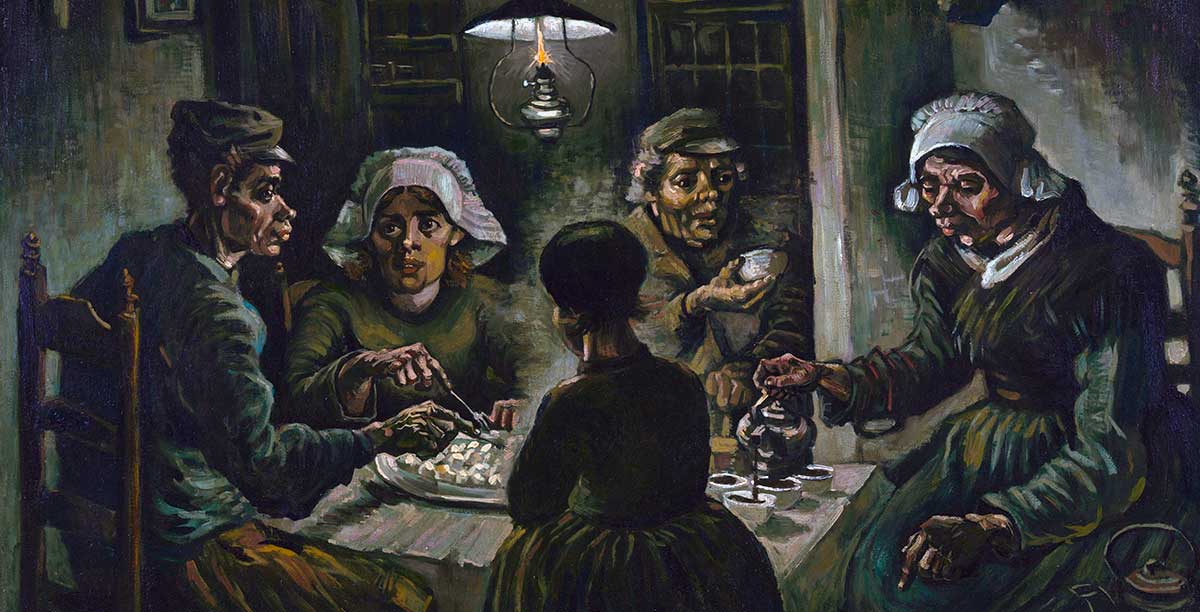
As Van Gogh spent many evenings in the establishment, he possibly witnessed many such scenes at night and considered it meaningful to portray this side of Arles on canvas. The Night Café was certainly an important work for Van Gogh as the artist worked on this painting over the course of three nights. He described the painting as “one of the ugliest I’ve done” and suggested that it was a counterpart to The Potato Eaters that he made in Nuenen in 1885. The Night Café was called “the equivalent, though different” of the painting of Brabant peasants, and both canvases illustrate completely different sides of society and human life. While The Night Café centers on addiction and ruin that people indulge in to escape their circumstances, The Potato Eaters portrays honest work and the simplicity of peasant life that perseveres despite material struggles.
The Night Café is also one of two prominent paintings by Van Gogh that feature a cafe setting. The other work, Café Terrace at Night, was also painted in Arles in September but depicts a different establishment on Place du Forum under a different light. This painting was inspired by Van Gogh’s fascination with night scenes and was intended to capture the effect of light and colors at night, while The Night Café presents a darker side of such establishments.
A Premonition to Personal Struggles?
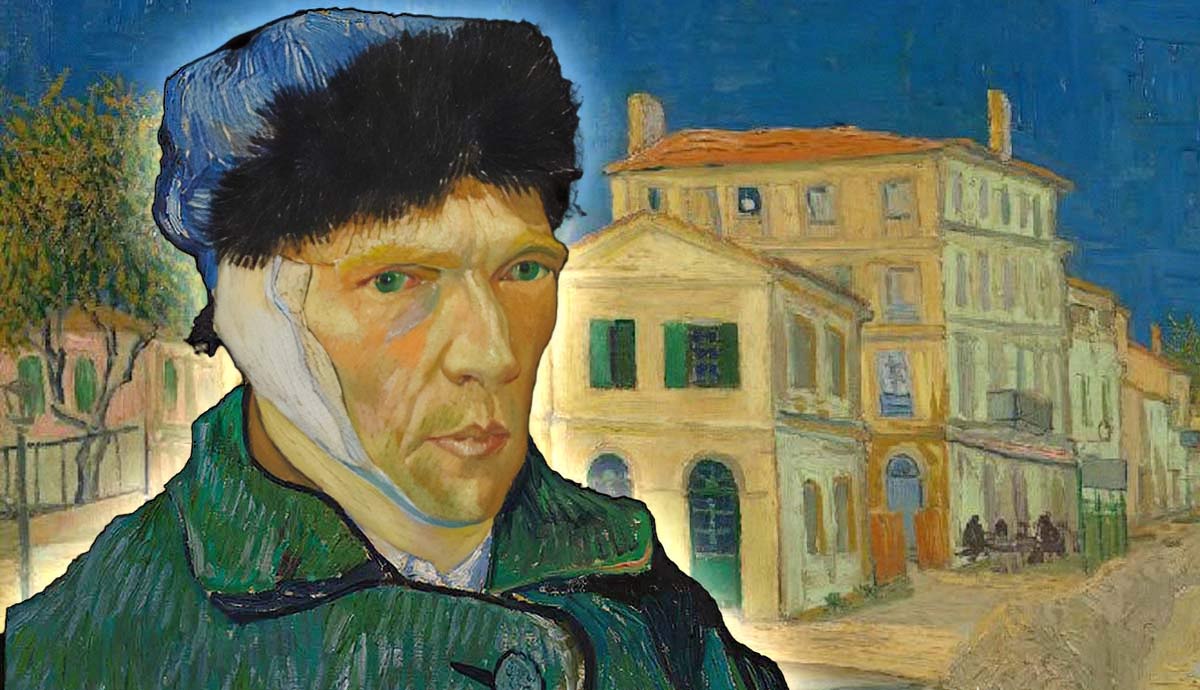
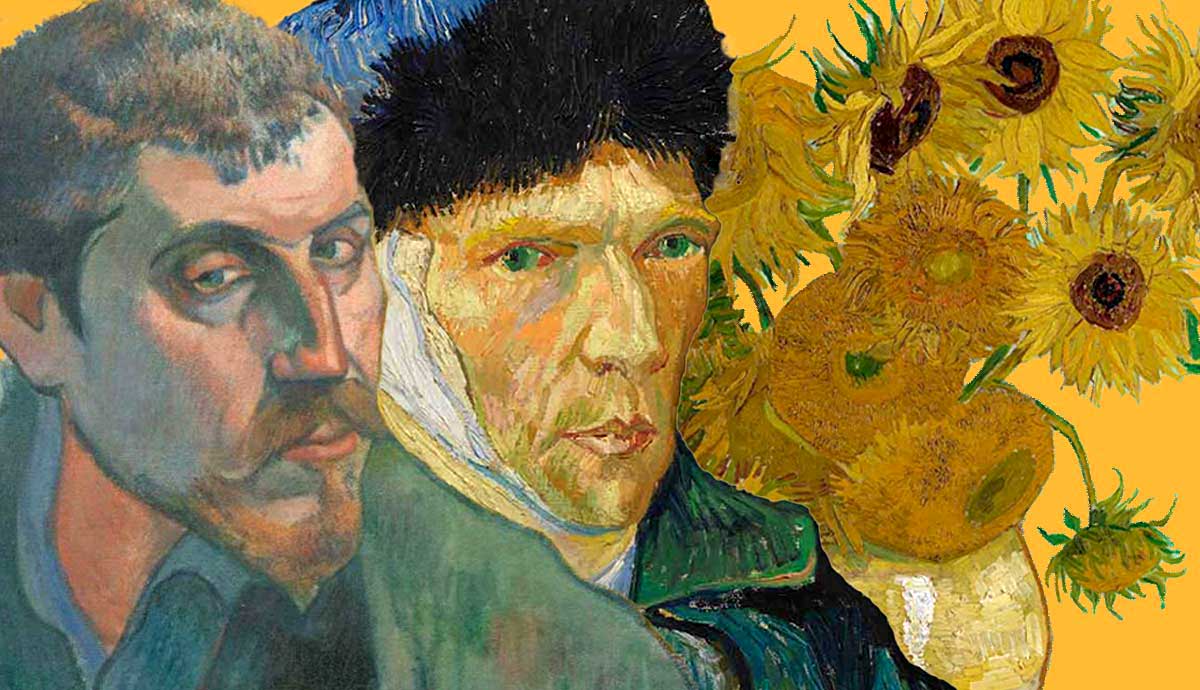
A few months after The Night Café was painted, Van Gogh suffered from his first major psychological breakdown in Arles. After having an argument with his friend and peer, Paul Gauguin, Van Gogh cut off part of his left ear with a razor in his Yellow House. He was hospitalized the next day and treated by Dr. Félix Rey. This incident marked an important moment in the artist’s life as it was the beginning of his declining mental health. After returning from the hospital, he attempted to return to his normal routine and continued painting, but his breakdowns persisted and he had to be hospitalized on multiple occasions within the following months. By May 1889, Van Gogh’s condition had worsened, leading him to take the decision of admitting himself to a psychiatric asylum in Saint-Rémy-de-Provence, where he had access to constant observation and professional support. He spent one year in this asylum before moving to Auvers-sur-Oise near Paris, where he ultimately died by suicide in July 1890.
While The Night Café was painted months before Van Gogh’s first breakdown, it can be interpreted as a premonition of his declining mental state. The people depicted in the work are lost in life and drowning in alcohol and prostitution. Van Gogh’s constant exposure to this life may have shaped his view of life and the world, and as an avid drinker and frequent visitor to brothels, he also partook in this lifestyle. In fact, scholars have considered the artist’s excessive drinking habits and lack of care for his health to be the main reasons for his worsening psychological state. To add to that, Van Gogh often struggled to cope with his failure to sell his work and found it difficult to remain hopeful.
He once wrote to his brother Theo from the asylum, “To succeed, to have lasting prosperity, one must have a temperament different from mine, I’ll never do what I could have and ought to have wanted and pursued.” However, while he struggled immensely for a significant period of his life, Van Gogh was never left without support. Theo remained a source of motivation and hope in the artist’s life until the very end. It was because of Theo’s encouragement and financial help that Van Gogh was able to pursue a career as an artist, and later, the efforts of Theo’s widow, Johanna, ultimately established Van Gogh’s name as one of the greatest artists in history.