
The connection between painting and music has been around for centuries, from ancient Greece to today. One of the essential questions to ask is why these two art forms are connected and what effect does this connection have. There can be a structural or synesthetic approach to this intermedial exchange. The former takes as a model the math behind music composition and harmony. The latter considers the emotional effect that music has on the listener. Focusing on the first case, the Swiss-German Bauhaus artist Paul Klee is the perfect example to look at.
Paul Klee’s Biographical Journey With Music
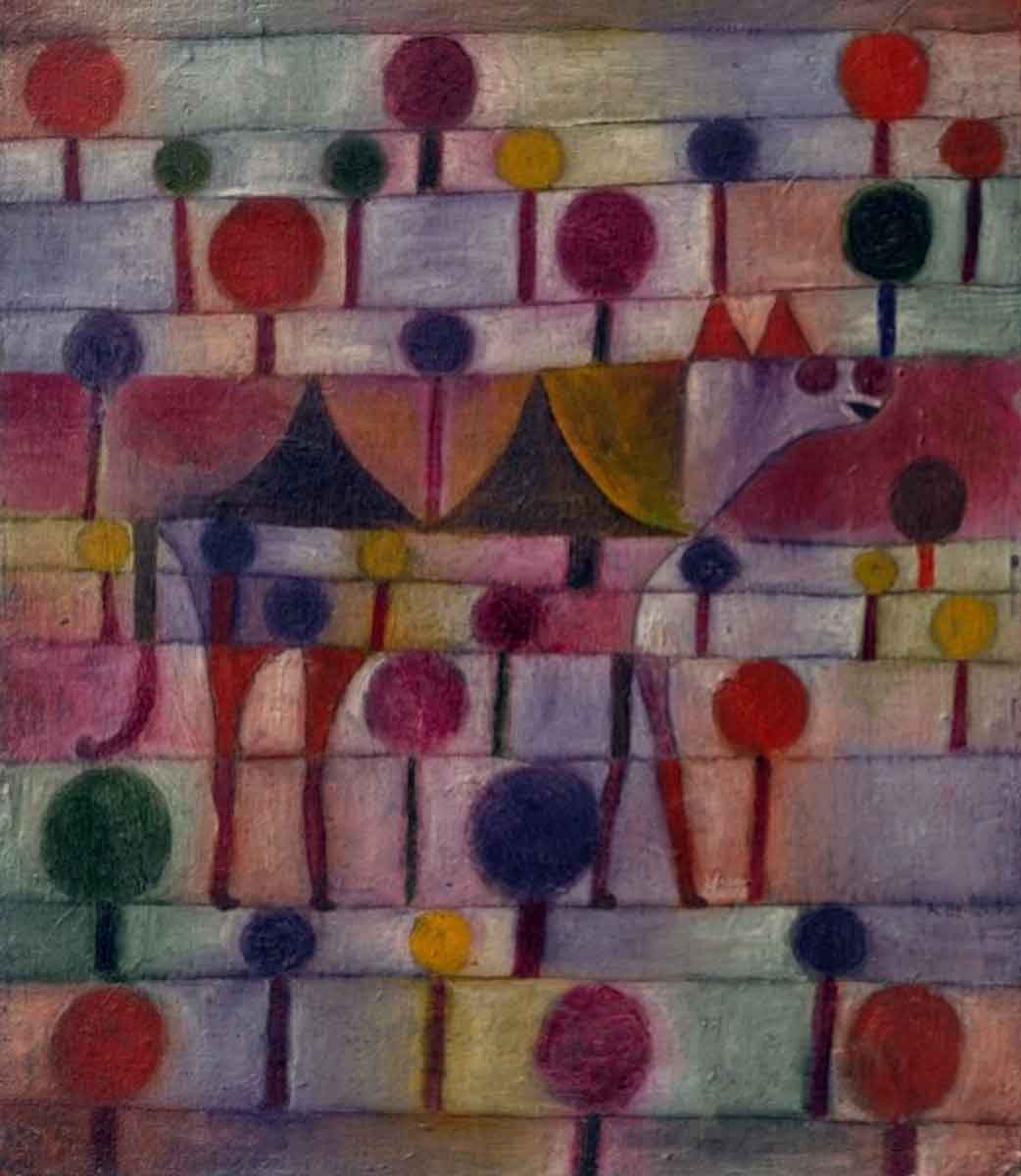
The special character of Paul Klee’s art resides in his heterogeneity, which makes simultaneous and diverse readings of his production possible. Klee’s distinctive “structural polysemy” is on the boundary between abstraction and figurative. Despite this variety, we can notice how Klee’s artworks are intrinsically coherent wholes, consistent both in their components and in the overall structure. How is this duality harmonized? The answer lies in Klee’s relationship with music.
Klee’s family gave him a bourgeois musical education. He became an accomplished violinist in the Bernese orchestra at the age of 11 and played chamber music throughout his life. In this context, music was a social event, as Klee regularly attended concerts and operas. From a biographical point of view, music was gradually internalized and absorbed into his practice as a visual artist, a career he finally chose when he moved to Munich to attend the private academies of Heinrich Knirr and Franz von Stuck. During this period, he joined the Expressionist group Der Blaue Reiter, together with Wassily Kandinsky, August Macke, and Franz Marc.
After a trip to Tunisia in 1914 and Klee’s participation in World War I, musical references gradually structured his pedagogical writings and were systematically applied to the visual arts. His reflections on the topic can be followed in the first theoretical publications (1919-1920), during his teaching years at the Bauhaus in Weimar (1921-1924), Dessau (1925-1930), and at the Düsseldorf Academy (1930-1933).
Klee: Music Performer
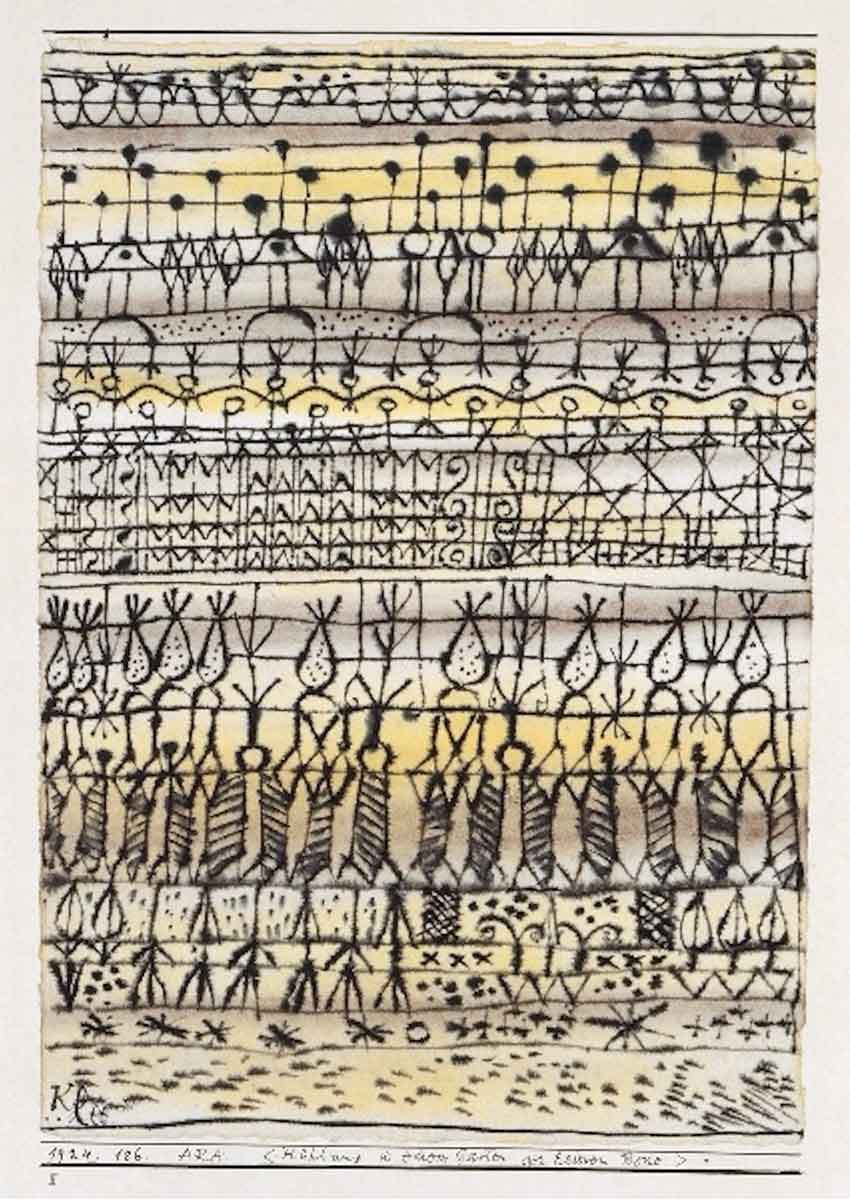
As a performer, Klee experienced technical and embodied knowledge of music in his daily life, which became a major influence on his musical tastes and sensibility. His serious, passionate, spiritual approach to the instrument and his technical affinity with Mozart’s music, as described by his cello mate Karl Grebe, shaped his view of the world and art. The fusion of Klee’s violin and art practice is reflected in his habit of playing the violin (Bach’s sonatas and partitas) in preparation for his painting practice at the Bauhaus. His daily practice allowed him to deeply understand the compositional thought and underlying structure of the pieces of music he played. In a similar way, his pictorial method consisted of superimposing layers that progressively created the works of art out of their “inner necessity” and enabled him to experiment technically with established structures or auto-referential motifs.
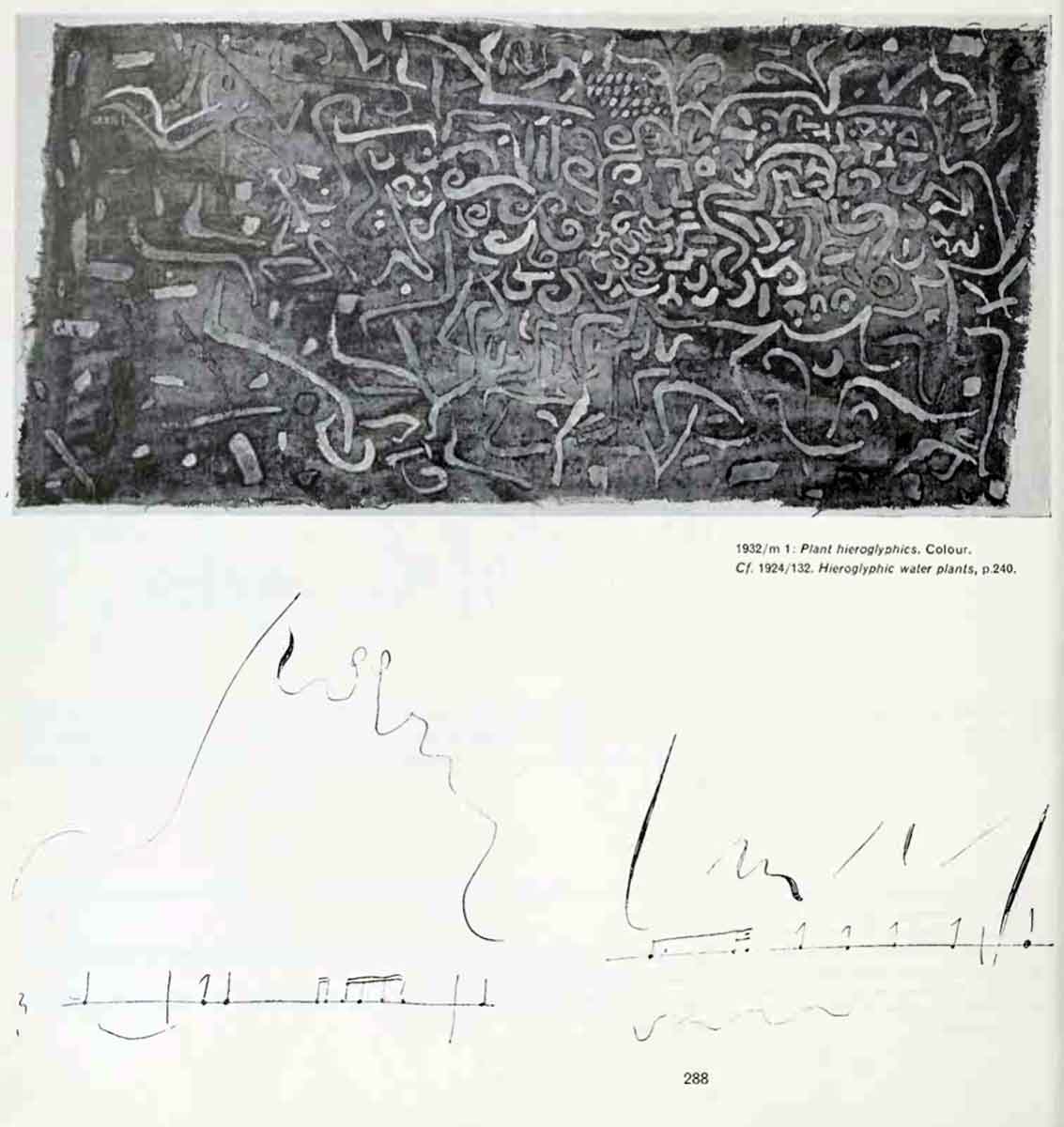
The graphic system of scores became a model in Klee’s art for both its notational signs (e.g. fermata) and for its readability—the way of reading the harmonic relationship between individual signs and the pictorial whole, which is reproduced in the note-like arrangement or stave system of some of Klee’s “score-pictures.”
Klee’s Musical Taste
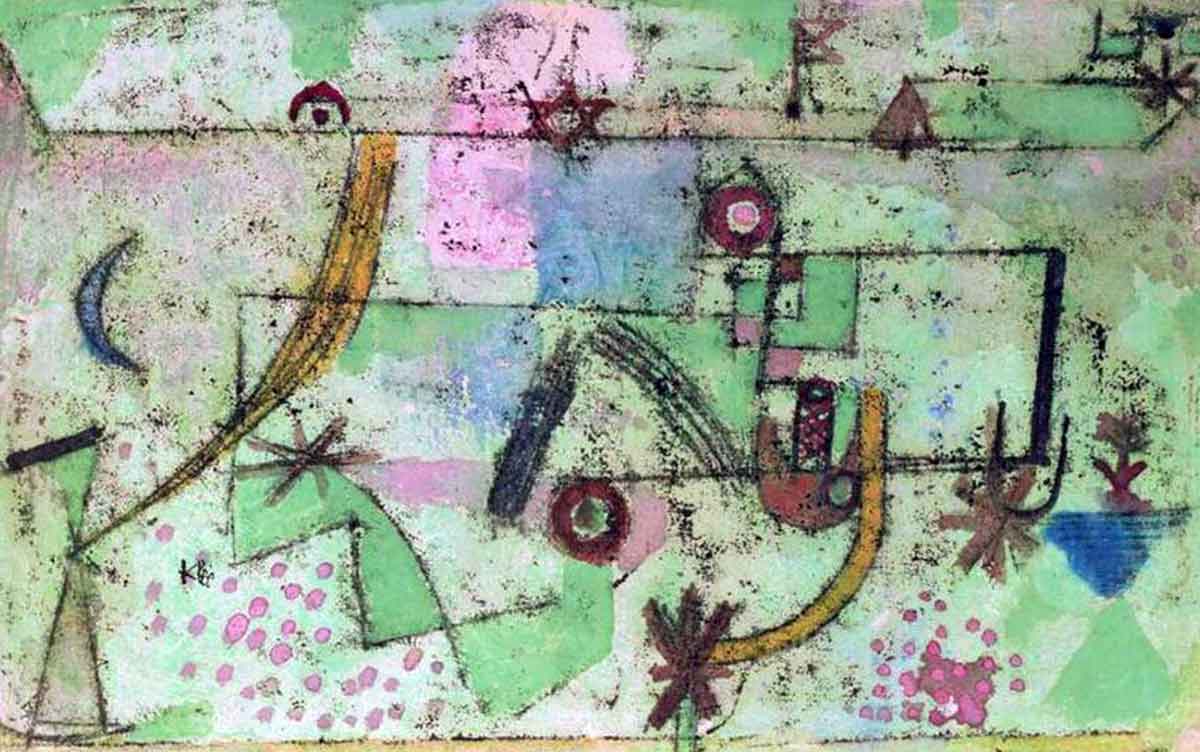
Klee’s musical taste and his attendance of musical performances are reflected in his activity as a music critic for the Berner Fremdenblatt (1903-1906), his Diaries, and personal letters. They provide information about his interpretation of music. In addition to Klee’s preference for Bach, Mozart, Haydn, Beethoven, Schubert, and Schumann, he also appreciated Claude Debussy, Richard Wagner, Anton Dvořák, Richard Strauss, and Johannes Brahms, as well as pieces written by his contemporaries. Moreover, Klee’s peculiar affinity for Mozart’s opera, the marionette theatre, and the world of theatre in general—an allegory for the duality of the real world—led him to be passionate about the Bauhaus theater and its cinematic innovations.
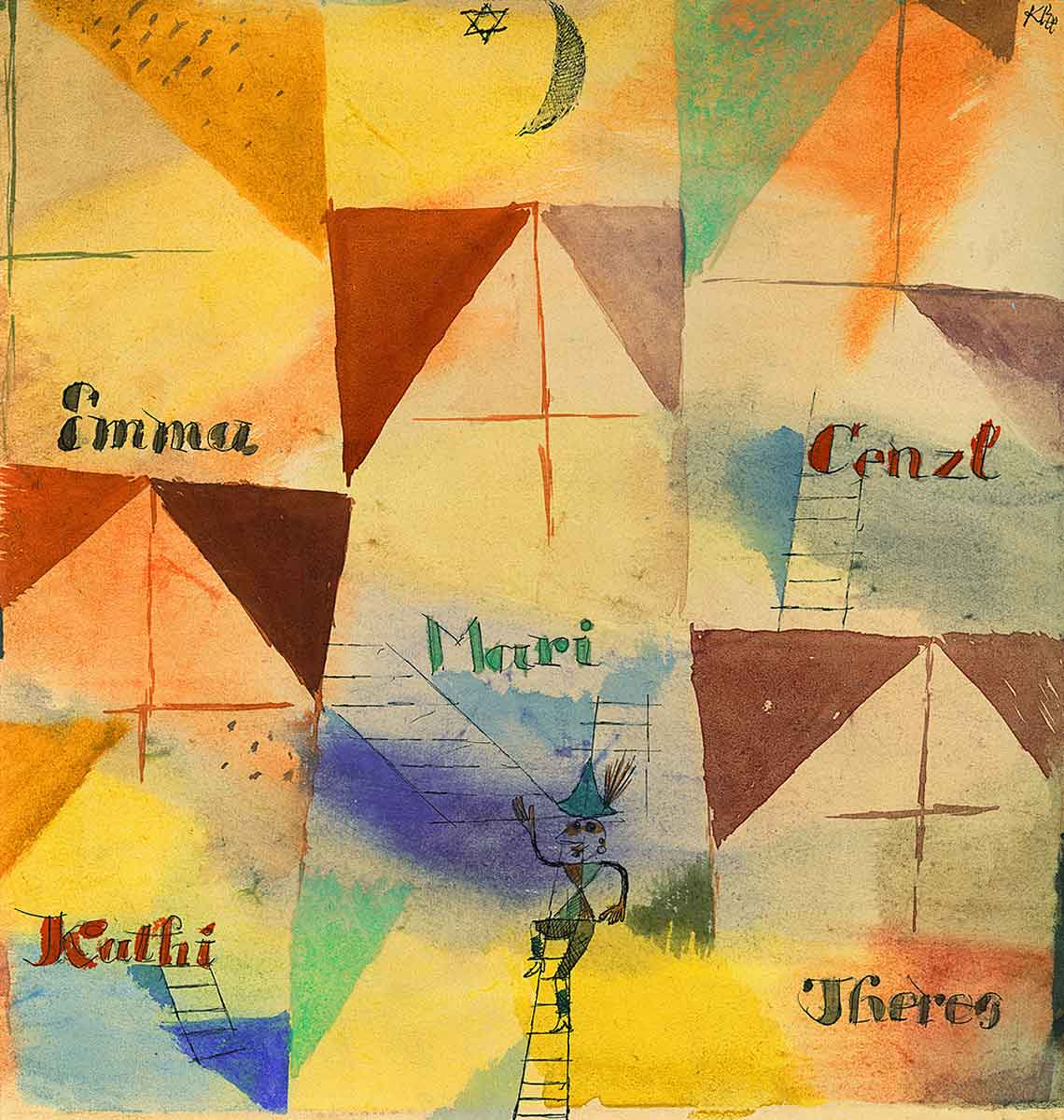
Klee found in Mozart’s music (especially opera) an analogy to his own work, a stability that derives from the balance of tensions in the dramatic action, the characters, and the equilibrium between libretto and music, which is transposed into the two-layered visual structure of Klee’s “opera pictures.” The “total artwork” constituted by the interaction of music-text-plot explains why Klee attached such importance to faithfulness to the librettist’s and composer’s intentions in performative interpretations.
For example, the original finale of Don Giovanni is essential to its definition as a dramma giocoso—a “playful tragedy”—in contrast to Romantic performances that concluded the opera with Don Giovanni’s death. It was a passion he shared with the neo-classical composers Ferruccio Busoni (whom he met in Zurich in 1916), Igor Stravinsky, and Paul Hindemith (whom he met at the Bauhaus in Weimar in 1923). Don Giovanni, the Commedia dell’Arte, and Hoffmann’s writings are common references for both Busoni’s theater and Klee’s art, as is the centrality of the spectator’s time and role in complementing the artwork. For both, the anonymity of masked figures, the sense of alienation, irony, and caricature became instruments for critically relativizing and objectifying the essence of art and reality.
Music in Klee’s Creative Process
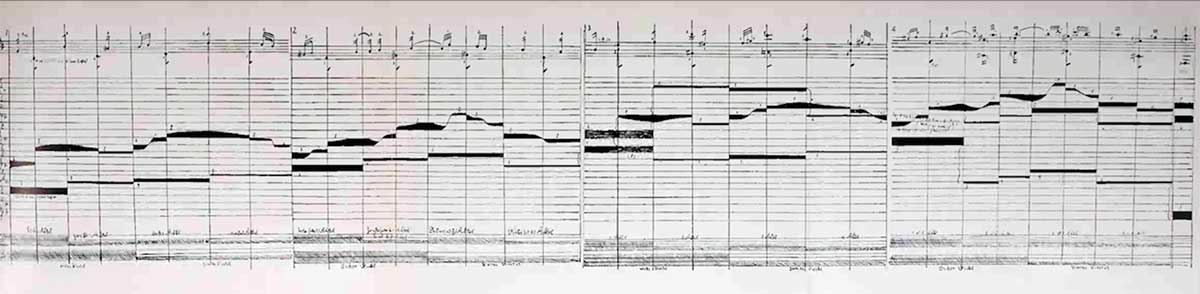
Klee’s life experience converges in his artistic approach, sources, and theories, which he explored and systemized during the Bauhaus teaching years. Starting from the imitation of the violin shape and the movement of the conductor’s baton, musical analogies and principles seem to guide the gradual composition of artworks. The pictorial language is progressively related to musical notions of line, melody, color, harmony, rhythm, variation, syncopation, voices, measures, dynamics, counterpoint, and polyphony, as in the transposition of Bach’s Sonata in G Major BWV 1019.
Klee’s art can be read as based on dualities in both the horizontal and vertical sense. The visible effect results from a process rooted in the natural principles of growth in Goethe’s notion of the primordial plant. Cosmological principles are physically rooted in universal mathematical laws underlying organic/inorganic realms of existence, as stated in Hans Kayser’s Neopythagorean theories.
Based on Klee’s personal sympathies and technical knowledge, the principles of musical composition structured the formal synthesis of painting. The condition for the possibility of this transposition is the awareness that both the creative arts and nature are temporal.
Space is a temporal concept, and time can be spatialized. The two dimensions are integrated into the construction of a whole that transcends the limits of the sequential unfolding of language and music in time. This is the polyphonic simultaneity of painting that matured after Klee’s Parisian encounter with Robert Delaunay in 1912.
The application of musical principles aims to make visible the temporal act of forming or constructing the artwork, the movement behind the genesis of the form, from point to line to plane to body. Music emerges as a relational model that determines the rhythmic juxtaposition and superimposition of pictorial elements assembled into a new organism.
Klee’s Musical Painting Types
Reading Klee’s pedagogical writings and his Pedagogical Sketchbook, the horizontal duality of contrasting forces—line, tone, color—arranges the artworks. Pictorial harmony starts with blending “individual” and “dividual rhythms.” Rhythm, in essence, is the key to transposition. It can be seen as a “measure”—a bar pattern that shapes the relationship between the elements of a composition and its overall structure—or as a “factural rhythm,” which captures its expressive quality, like the motion of a conductor’s baton or the physical sensation of a beat.
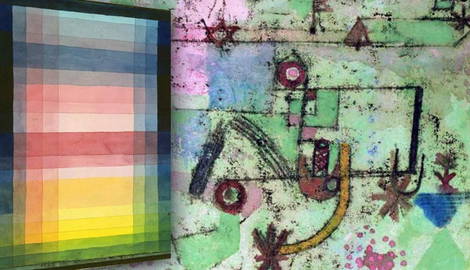
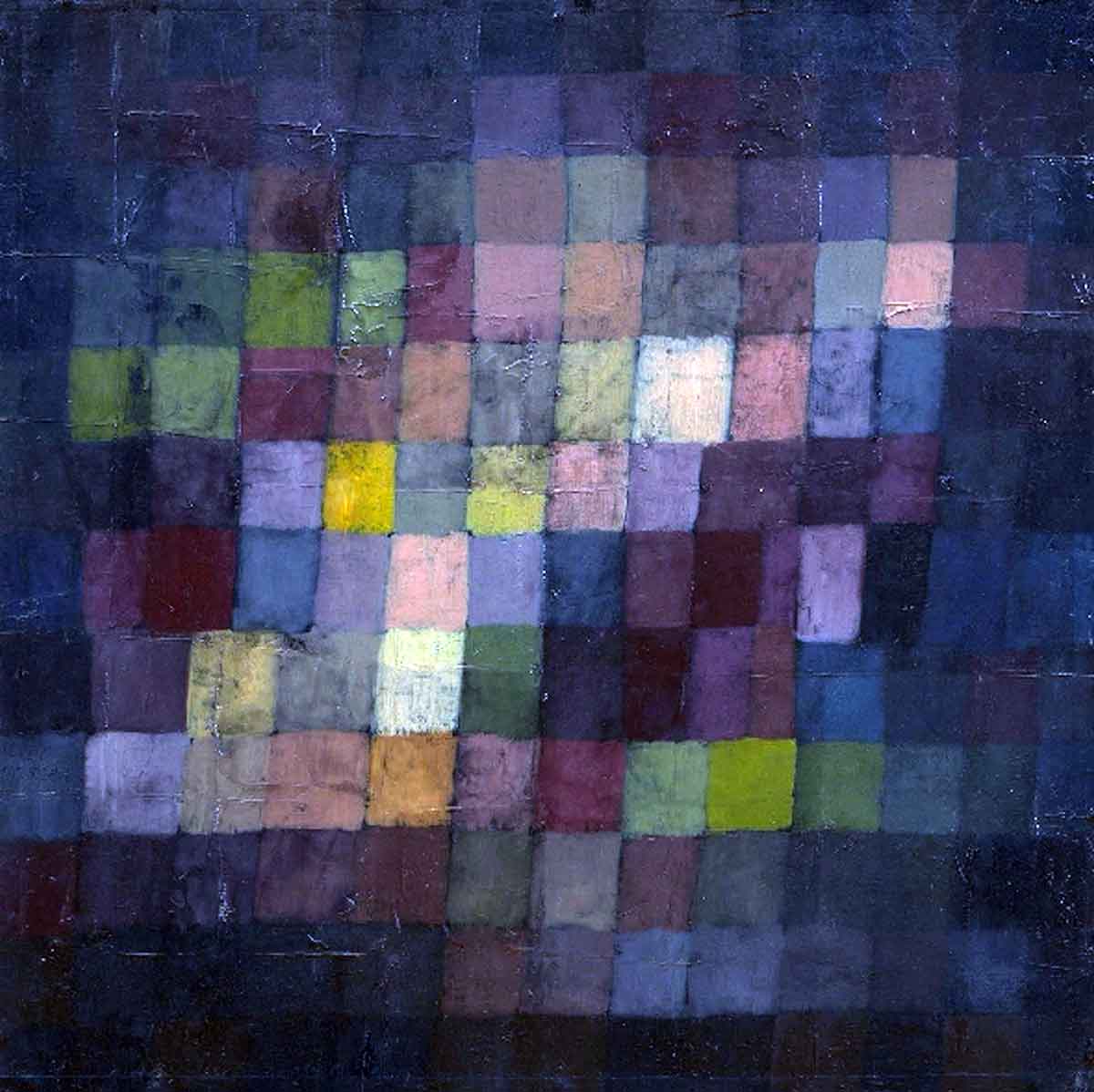
Klee’s color-theme format, as defined in 1916—after the artist came into contact with Cubism, Orphism, Non-objectivism, and Hans Arp’s Dadaism—evolved in the “fugal compositions” and successively in the magic squares. In the latter, a two-dimensional (homophonic) color grid/chessboard houses rectangular but sketchy color-contrasting tones, which are given movement by the variation of stained-glass-like light (e.g. Ancient Sound, 1925; the “classical polyphony” in New Harmony, 1936).
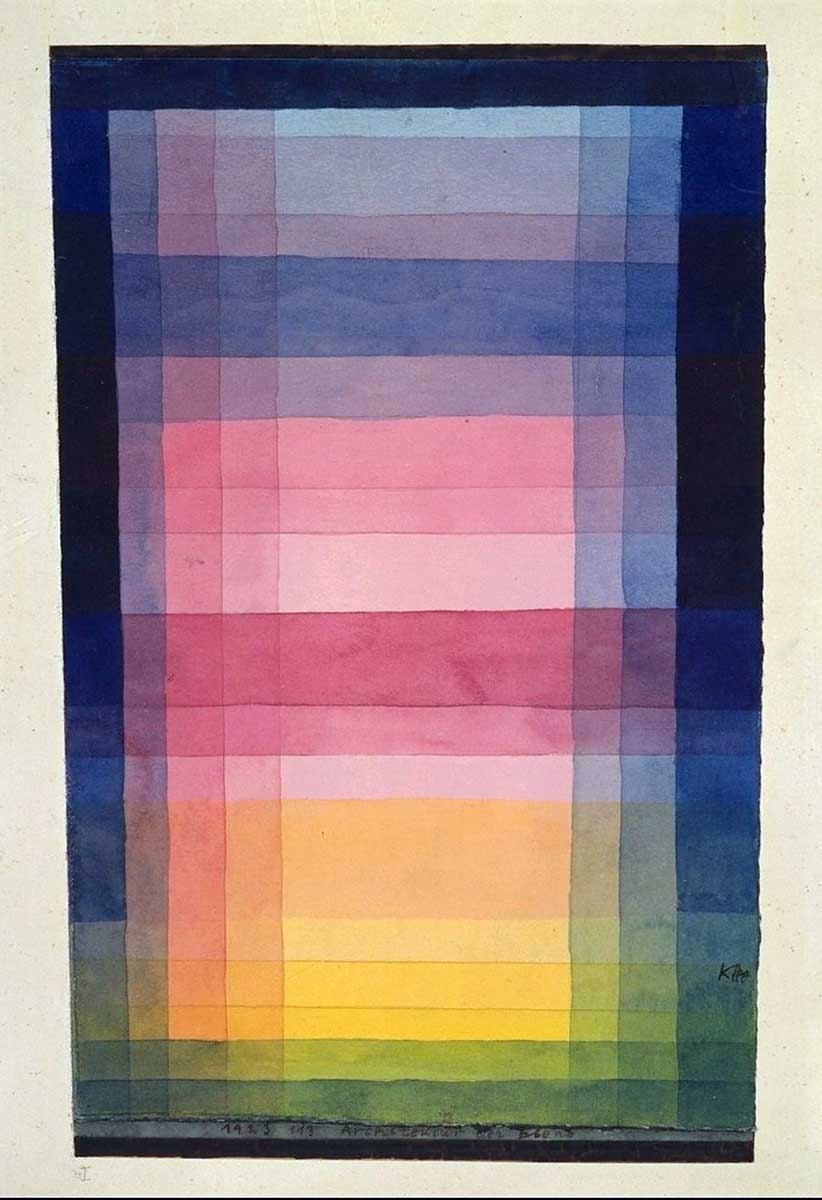
Three-dimensional color polyphony, on the other hand, is based on the superimposition of homophonic rectilinear surfaces according to the principles of variation and counterpoint, creating a sense of depth (Architecture of Planes, 1923; Polyphonic Setting for White, 1930). The simultaneity of the voices is then achieved by overlaying transparent watercolor glazes. Alternatively, an “individual” open line can be added to the “dividual” structure, representing the “melody” that sings over the underlying “harmony.”
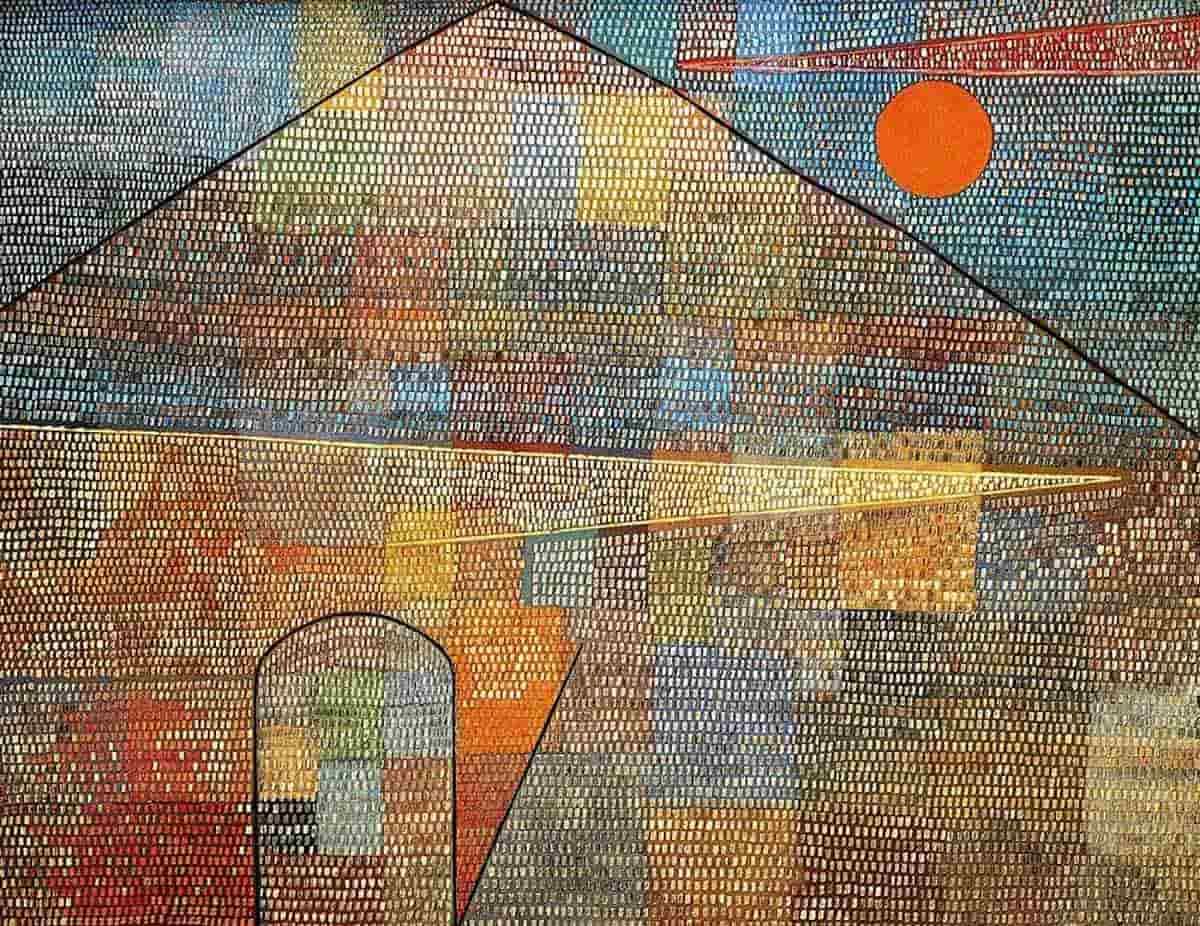
We can observe how the technical means concretize the performative act of forming in the viewer’s time. The highest fluid independence of simultaneous themes/planes is achieved with Klee’s “divisionist” or “counter-pointillist” technique, reaching its climax in Ad Parnassum (1932). This artwork was interpreted by Kagan and in Ole Henrik Moe’s 1985 exhibitions as the perfect pictorial synthesis modeled on the mathematical principles of counterpoint as systematized in Johann Joseph Fux’s Gradus ad Parnassum (1725). In the two exhibition catalogs of the proposed case studies, however, Osamu Okuda reinterpreted it as an allusion to Muzio Clementi’s homonymous piano etudes.
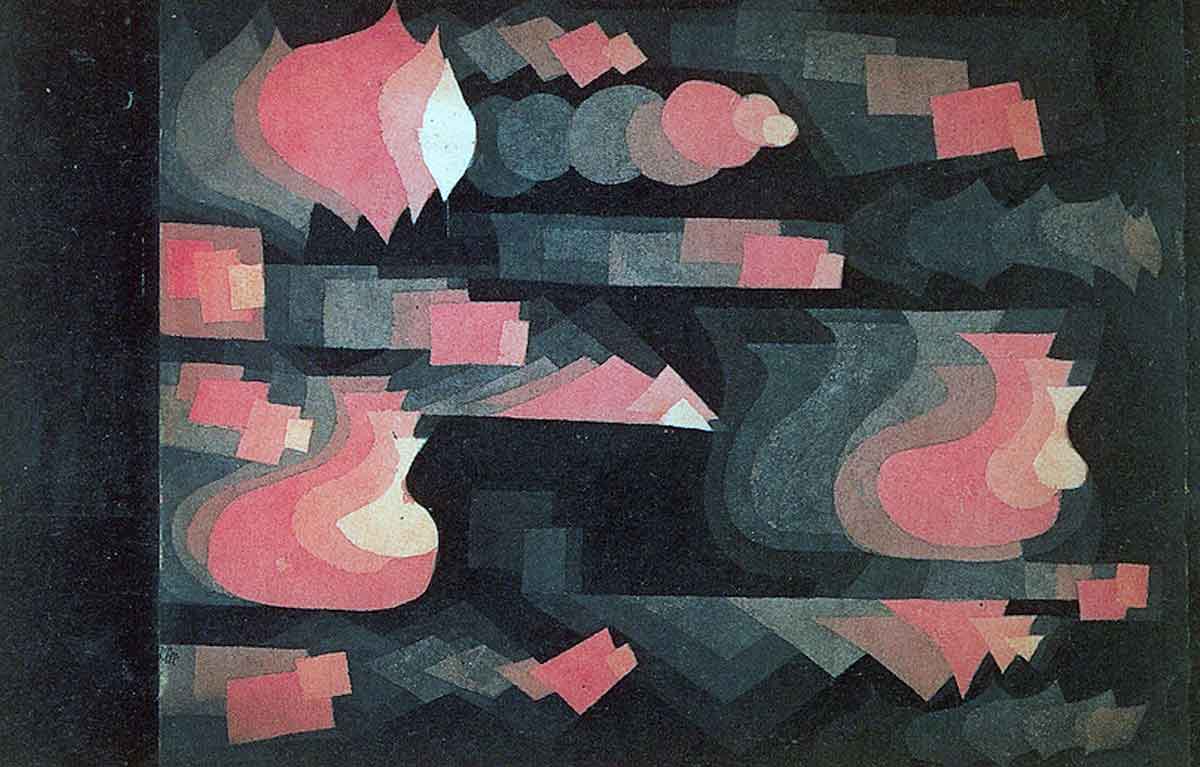
Returning to the deciphering of the reasons for Klee’s musical affinities in the Swiss and German context of the early 20th century, his references to classical music may be reflected in some stylistic features of his favorite composers. At the beginning of the 20th century, Baroque music was rediscovered in its composers and musical instruments. The “interpretive construction” of Bach’s vocabulary, as well as the principles of counterpoint and fugue, were applied to the visual arts in order to compose a purely abstract, expressive organism. Indeed, we can argue that Klee’s “fugal paintings” embed the method, process, and aural effect of fugal compositions.
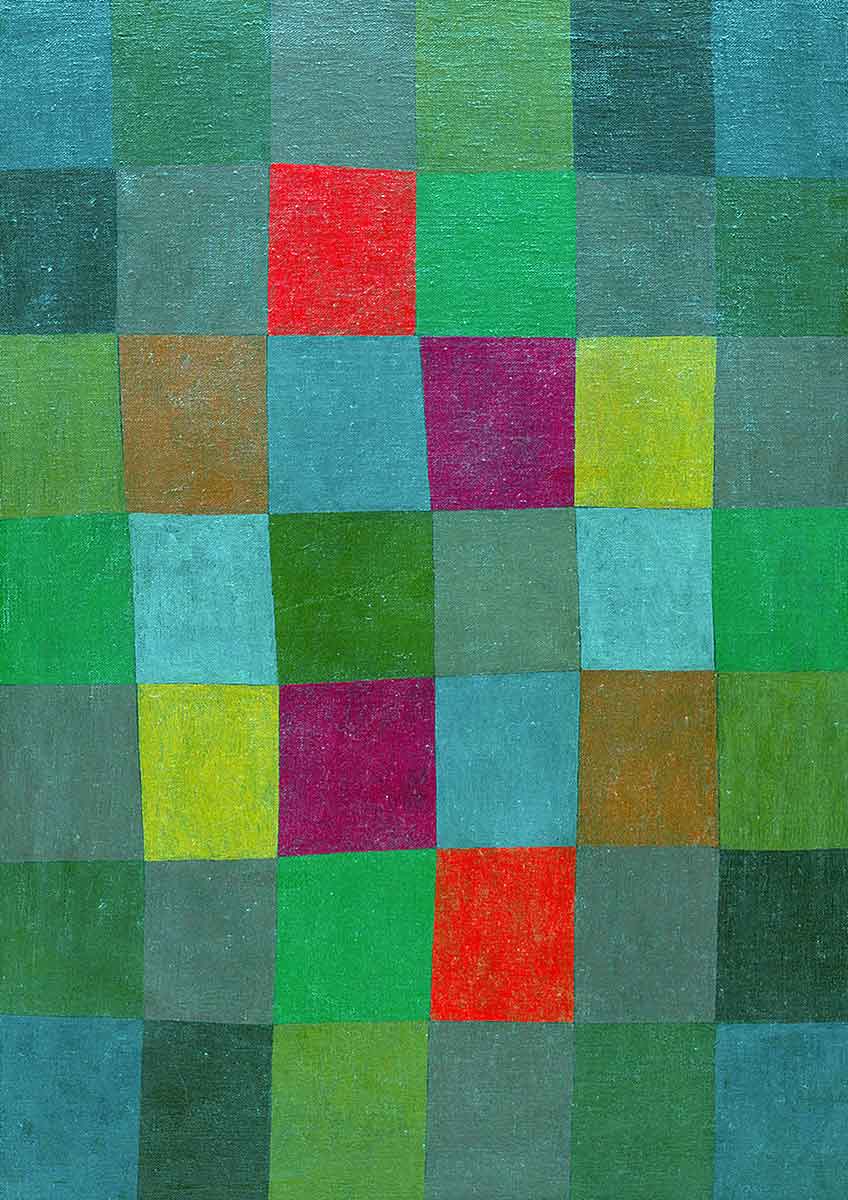
The principle of variation, on the other hand, is the base of the internal unity and consistency of the Classical form. In it, for musicologist Charles Rosen, a motif determines themes, details, and the underground structure of the piece, which can be grasped through the score. Quoting Rosen: “The notes of a tonal composition have significance beyond the immediate context in which they are found, a significance that can be understood only within the total scheme of the whole work.”
However, Klee’s classical style was filtered through modernism and the reinterpretations of his contemporary composers. Following Nancy Perloff’s parallelism with Anton Webern’s music, in the “magic squares,” the classical hierarchy given by the tonal center is absent since each variable unit is different, independent, equally important, and extremely reduced. The “essentialized” and rationalized theme becomes a “dodecaphonic series” according to a practice that Klee knew from his work at the Bauhaus in Dessau (through Arnold Schönberg), where technological sound experiments were carried out.
Klee’s Musical Art and Its Afterlives
Klee’s art and theoretical writings have been among the most inspirational sources for contemporary musicians and jazz composers, especially after World War II. This is because, quoting Monika Fink, Klee’s pictorial “transfigurations” do “not refer to a direct translation between the two media, […], but to the method of developing musical and visual composition according to the same construction principle.” For Simon Crameri, the constitutive silence of the images remains open to multiple readings, moods, approaches, and thus intermedial transpositions/evocations.
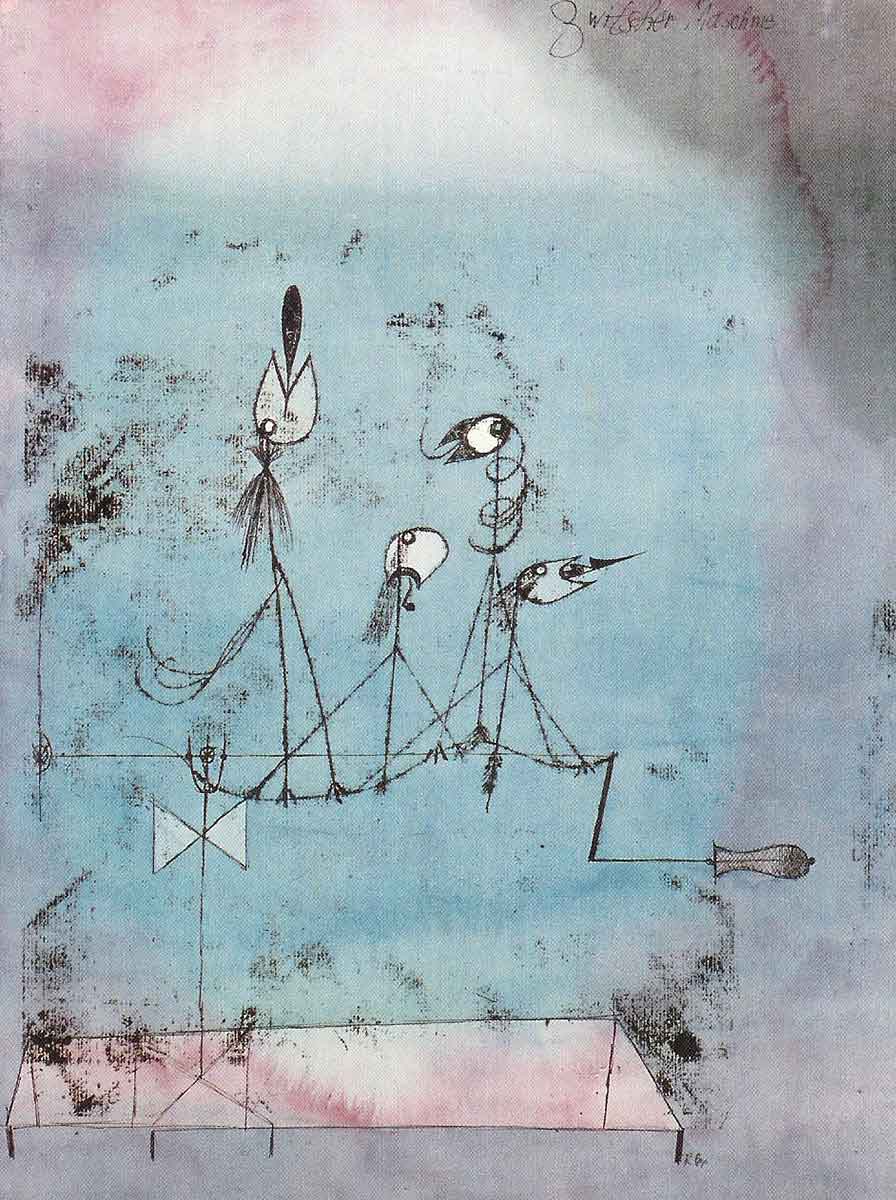
Klee encourages us to compose music not only for the emotions conveyed by his art, a recurring source has been his Twittering Machine of 1922, but also for his methodological-pedagogical reflections and his linguistic inventions. Eighty of Klee’s selected works have inspired 400 compositions. They emphasize specific aspects of the paintings according to the composer’s sensibility and, if associated with Paul Klee’s musical works, they direct the viewer’s attention to internal details of the paintings, opening up new connections and a mutual dialogue that expands the visual experience in new multimedia works.