Come along on a musical journey through ancient Greece’s history to discover the ancient Greek instruments that played a role in everyday life. Our journey will follow the development of Greece from the Bronze Age to the Classical Period. From the earliest examples, such as simple flutes like the aulos, to complex machines like the hydraulis, ancient Greece laid down the foundation for the modern instruments we still use today.
Bronze Age (ca. 2000–1100 BC)
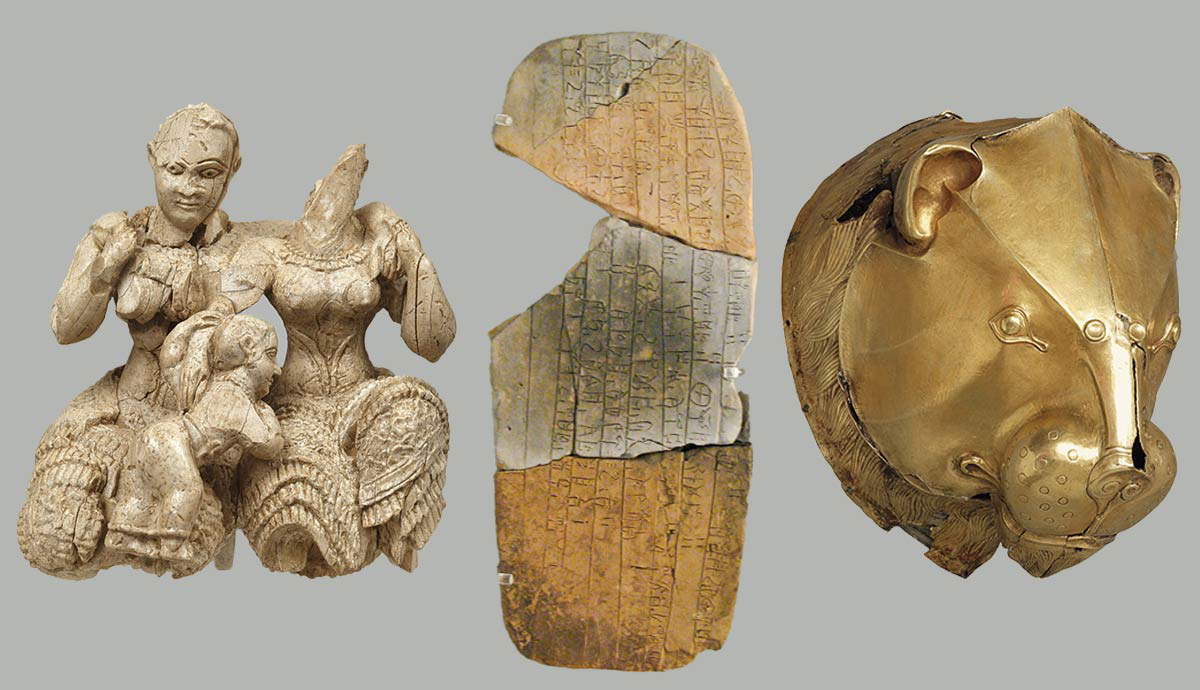
The Grecian Bronze Age saw the emergence of complex societies, expanding trade and commerce, as well as the development of a writing system known as Linear B. Mycenaean society built impressive palaces like Mycenae and Knossos and established social hierarchies. The arts and architecture flourished, as seen at the Lion Gate at Mycenae. Writing also allowed music to be written down, such as the Seikilos Epitaph from the Archaic Period.
Unfortunately, this period came to an end through various factors, likely caused by droughts, famine, and the invasion of the Dorians. With this historical setting in mind, let’s dive into the instruments.
Syrinx (Σῦριγξ) – Pan Pipes
In its most basic construction, a pan flute (also known as panpipes or syrinx) is a set of closed or plugged tubes with multiple, increasing lengths of pipes held together for ease of playing. Sometimes the girth of the tube may also increase to allow deeper tones. Typical materials include bamboo, cane, or local reeds. Sometimes, clay, metal, plastic (in modern instruments), and wood are also used.
Pan, with his human upper body and goat legs and horns, was the god of the wild and wilderness. His main pastimes were playing music and partying with the nymphs in acts that represent fertility. But Pan is also a representation of the duality of nature; its untamed beauty and wild, sometimes destructive power. Furthermore, Pan was the protector of pastoral people and hunters.
Because Pan had an untamed sexual appetite, he would pursue the nymphs in the rugged countryside of Arcadia. Three nymphs, Pitys, Syrinx, and Ekho, all suffered somewhat unfair fates. Because Pitys fled Pan’s advances, she was transformed into Pan’s sacred tree, the mountain or Corsican pine. Syrinx, who did not feel a mutual attraction to the half-human, half-goat god, fled too. However, when she reached a river, she could not escape further. Zeus took pity upon her and transformed her into a clump of reeds. Pan cut the reeds down to different lengths and fashioned the first pan flute, or syrinx. Last was Ekho, who was cursed to fade away. She was reduced to a voice repeating the god’s mountain cries as an echo.
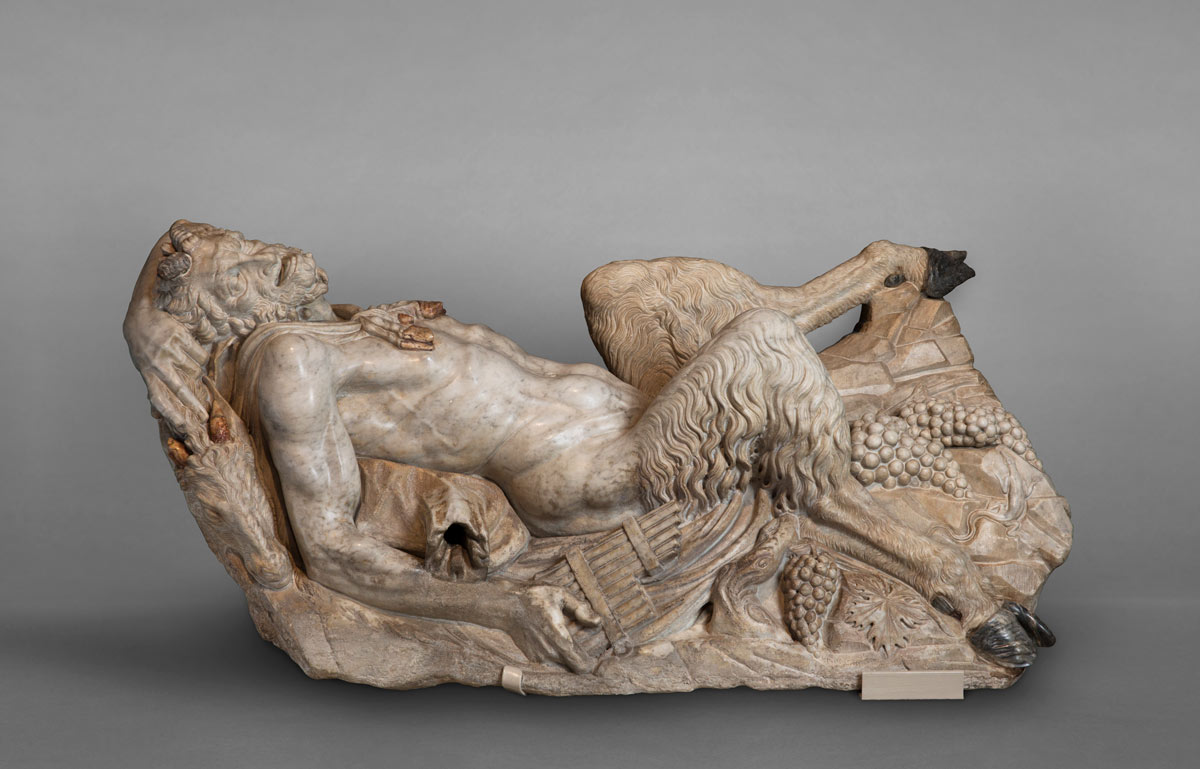
The syrinx was later adopted by other ancient cultures, such as the Etruscans, who called it the fitsula. The instrument was popular at banquets, festivals, and even funeral processions. Depictions of it have been found on urns and in tombs. Numerous depictions have also been found in Roman mosaics and artworks, emphasizing its importance to their culture.
The pan flute is still an integral part of many cultures across the world today, from the Andes to Thailand to tiny island nations dotting the ocean.
Aulos (Αὐλός) — Flutes
The aulos was made from a range of materials, from boxwood to cane, ivory, or bird bones. Sometimes they were also made from bronze or copper. It features a circular pipe fitted with one to three bulbous mouthpieces that change the pitch. The pipe could have up to five interlocking pieces. Seven holes (tremata) were drilled into the pipe, which the player opens and closes to produce melodies.
An aulos produced a penetrating sound akin to the oboe and was often used to accompany a male chorus and to help athletes, like rowers, to regulate their cadence. Today’s oboe, and to a lesser extent the clarinet, is a closely related relative of the ancient aulos (plural: auloi): sound was produced by blowing into the mouthpiece and vibrating a single or double reed (glottides) inside the mouthpiece. In most depictions, we see the diaulos (double aulos). With this, a richer sound could be achieved, or two melodies could be played at once.
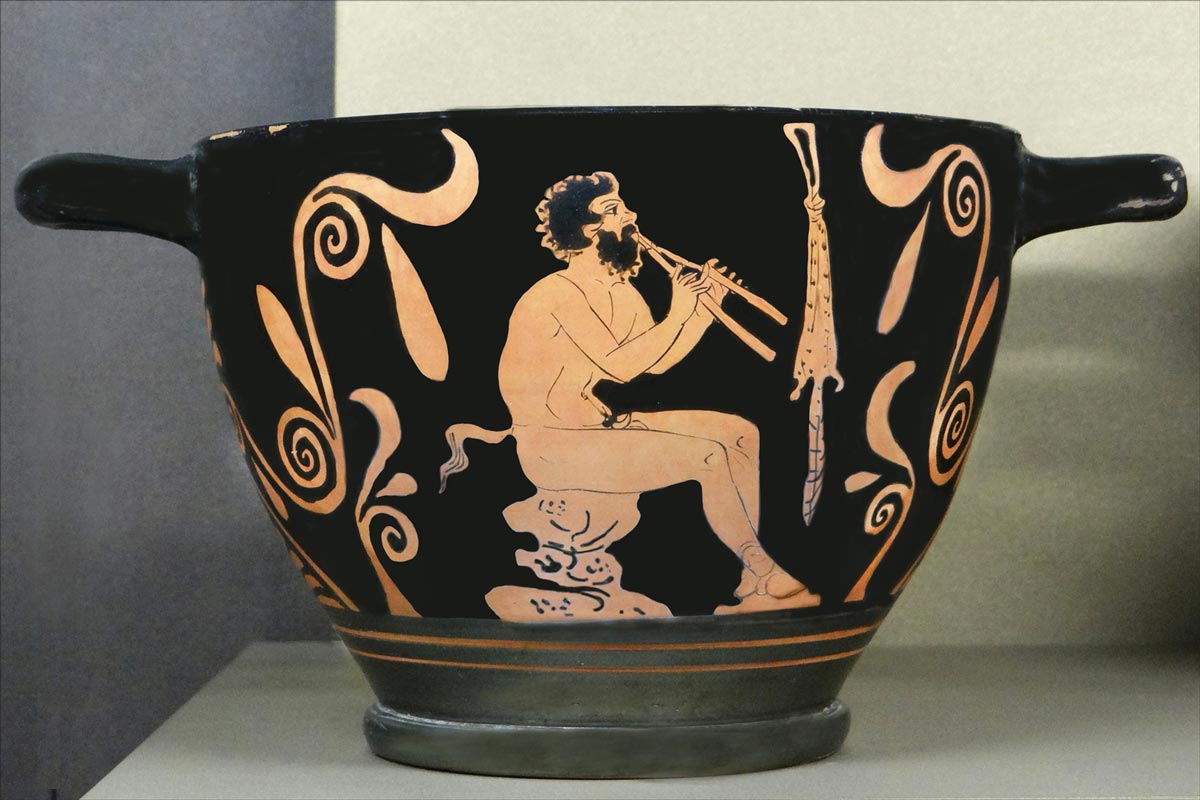
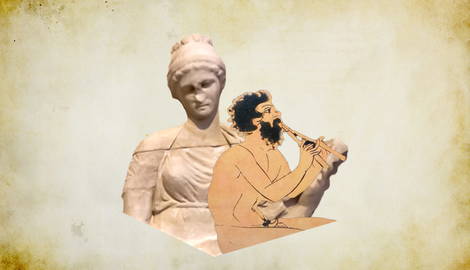
Marsyas, a satyr, is said to have invented the aulos. Other myths state that Athena discarded the instrument because it made her cheeks puff and ruined her beauty. Being impressed by his invention/new instrument, he challenged Apollo to a musical duel where the winner could do anything they wanted to the loser. Being a satyr, Marsyas’s ideas were sexual in nature. Apollo accepted the challenge with a caveat: in the second round, they had to play their instruments upside down, something the flute is ill-suited for.
The competition did not go according to plan, and Apollo, with his lyre, emerged victorious. Apollo had Marsyas tied to a tree, and for his hubris, he was flayed alive. His blood, mixed with the tears of the Muses, formed the Marsyas river in Asia Minor (modern-day Turkey).
The myth served as an educational tool warning against excess (associated with Dionysus) and moderation, as exemplified by Apollo. The aulos is symbolic of the former, where the lyre represents the latter.
Iron Age to Archaic Period (ca. 1050-480 BC)
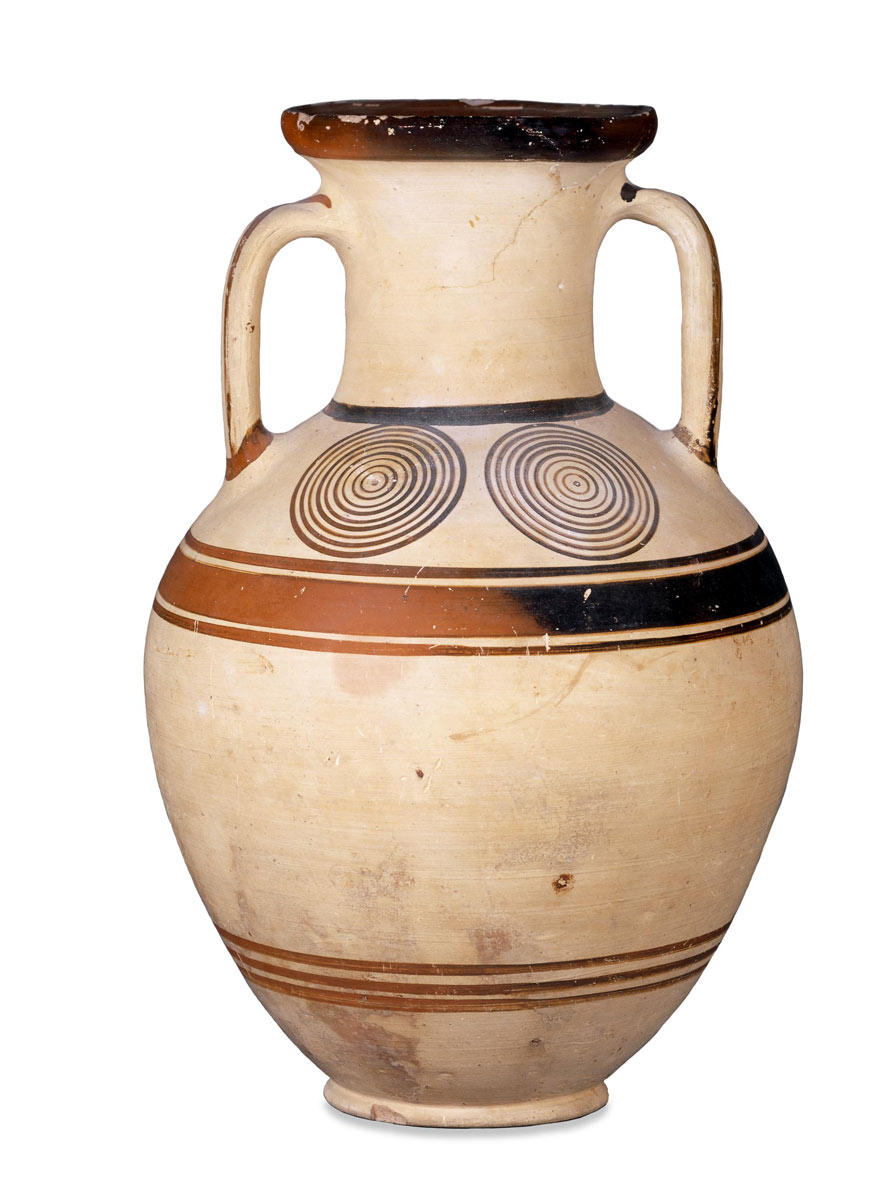
With the collapse of the Mycenaean empire, Greece entered its Dark Ages (ca. 1100-700 BC), a period of turmoil and strife that lasted almost 300 years. Famine led to a population decline and a loss of literacy as people abandoned major cities where learning was important. Due to their pastoral existence, there are no written records from this period. The arts also declined, as there was a loss of writing.
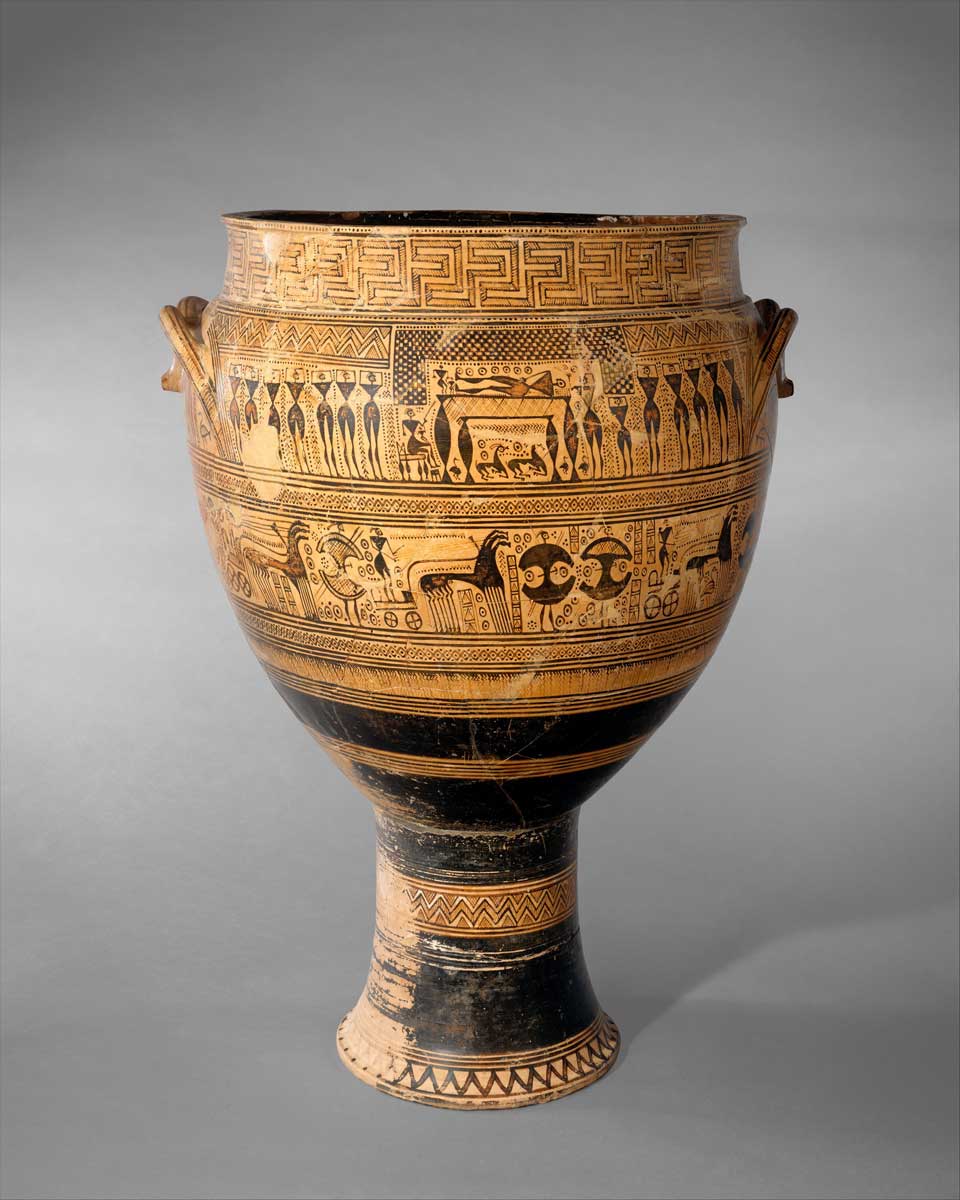
But all hope was not lost. With the Geometric Period (ca. 900-700 BC), Greece experienced a rebirth: the population increased, trade was revived, and the Greek alphabet was developed. Iron may have played a role because it was cheaper and more durable than bronze when prepared properly.
With the Archaic Period (ca. 800-480 BC), Greece paved the way for its Classical/Hellenistic Period (ca. 480 to 31 BC). With writing in place, Greece flourished again with intellectuals such as Socrates. Early advances like democracy (demokratia, “rule by the people”) and early city-states (polis) facilitated urban growth and complex political systems.
Tympanon (Τύμπανον) — The Drum
Because the tympanon was constructed of wood and animal skin, archaeologically speaking, it is near-impossible to find a preserved example. Sizes varied too: from small tambourines to huge shield-like discs held by goddesses like Cybele, Demeter, and Rhea.
Because of its association with the feminine goddesses who presided over fertility, marriage, and motherhood, it was mostly played by female performers. These instruments were also used in matrimonial and resurrection rites (funerals) associated with Dionysus. Frenzied playing often led performers to achieve an ecstatic state, something Dionysus would be proud of as the god of hedonistic pleasure.
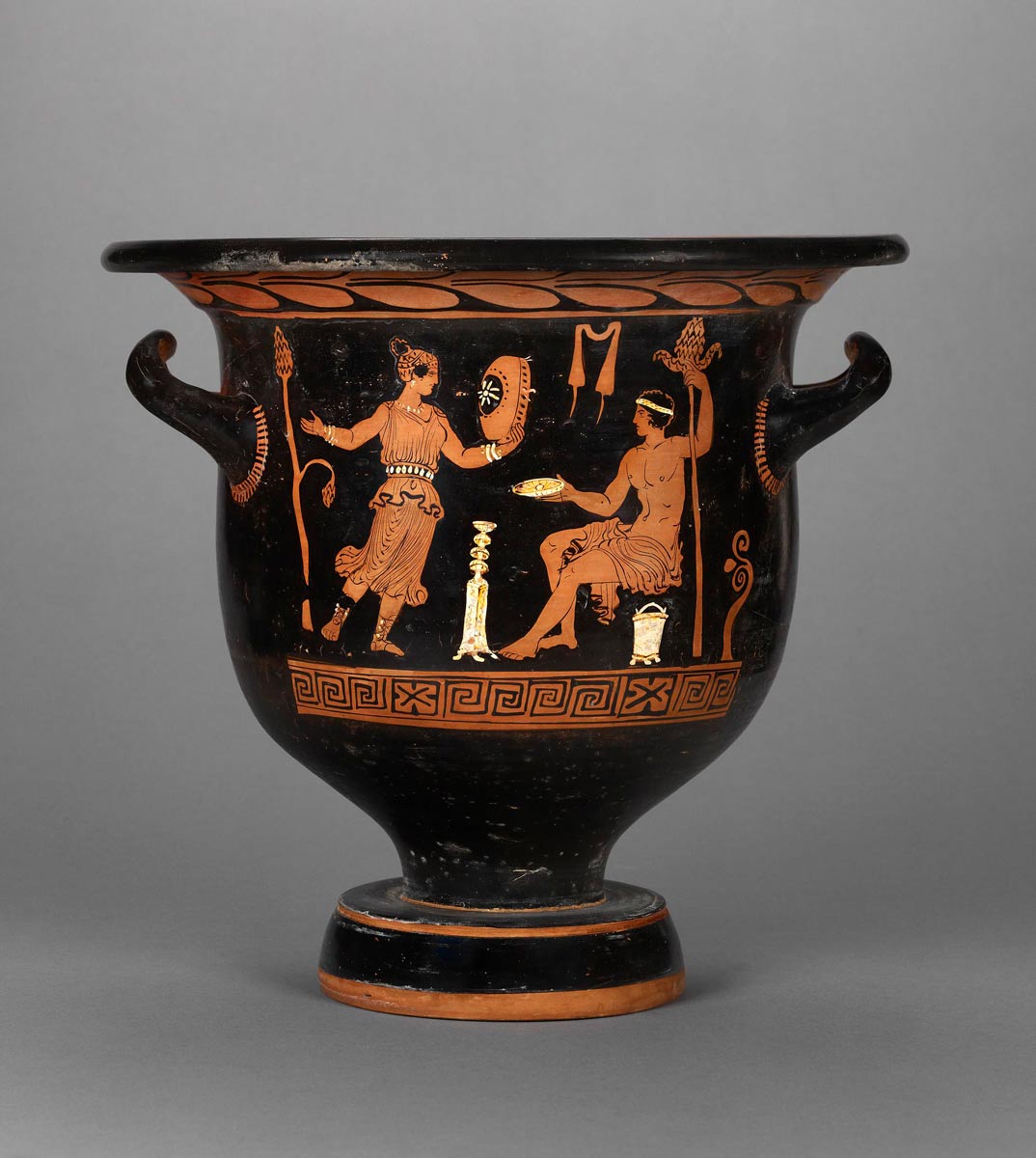
Euripides (ca. 484-407 BC), the great tragedy writer, is often quoted as a source for Dionysus and his cult. The extract below from the opening of his Bacchae offers an overview of the tympanon and its widespread use in the worship of the god:
“But, you women who have left Tmolus, the bulwark of Lydia, my sacred band, whom I have brought from among the barbarians as assistants and companions to me, take your drums (tympana), native instruments of the city of the Phrygians, the invention of mother Rhea and myself, and going about this palace of Pentheus beat them, so that Kadmos’ city may see. I myself will go to the folds of Kithairon, where the Bacchae are, to share in their dances.” (lines 1-64)
Lyre (Λύρα)
The earliest form of the lyre, called the chelys, was made of a tortoise shell covered with a membrane, usually animal skin, like an ox or kid. Two curved arms (horns or wood) provided the classical form, and a crossbar provided stability and a place to attach and tune the strings. A fixed tailpiece (chordotonon) held the strings in place over the hollow soundbox. The earliest form had four strings. These were usually made of hemp or flax, but later materials included animal gut or sinews. Later versions had seven or up to twelve strings.
Players could play the instrument sitting or standing and use a plectrum or their fingers to pluck the strings. Strumming with the fingers was another technique in their arsenal.
The lyre was played at almost every event in Greek life: from accompaniment to the choruses to festivals, at private banquets (symposia) to religious ceremonies and funerals. Music competitions were also held, and examples include those hosted at the Karneia, Panathanaia, and Pythian festivals.
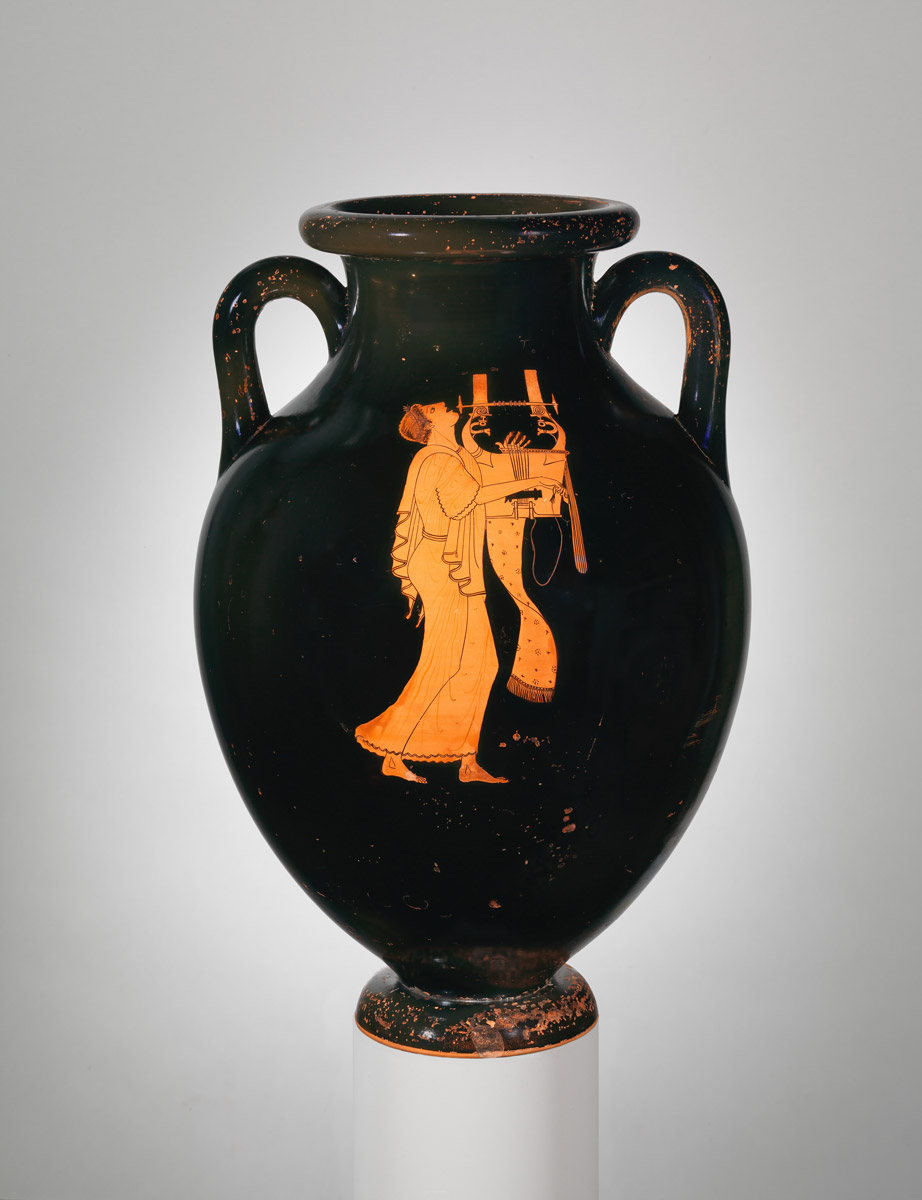
Playing music, especially the lyre, was an integral part of Greek education. It was seen as an instrument of rationality. Even mythical people in antiquity had training on the lyre: Achilles had lessons from the wise centaur, Cheiron, while Apollo taught Orpheus to play the lyre. Plato considered the lyre, alongside the kithara, the only worthwhile instruments for musical education.
The lyre occupied such an important place in society that several city-states (poleis) used it as an emblem on their coins, while numerous Greek vases depict it too.
Kithara (Κιθάρα)
If you thought the kithara looked like a lyre, you would be correct. It is seen as a more robust and professional version of its cousin. It is also perfect to teach beginners due to its solid construction.
Seven equal-length strings, made from animal gut or sinew, are attached to the wooden body. Usually, the base was flat. The wood varied from one region to the next, but cedar and boxwood were popular choices. The front, called the soundboard, was made of animal skin or a thin piece of wood to enhance resonance. Its solid construction made it louder and suitable for large audiences.
Unlike the lyre, from which the kithara developed, the instrument was considered the professional’s choice and was used in formal performances. A professional player would be called a kitharode. The right hand would hold a plektron (today a guitar pick) and stroke the strings. The left hand damped certain strings to form the desired melody.
Classical Period (ca. 480–323 BC)
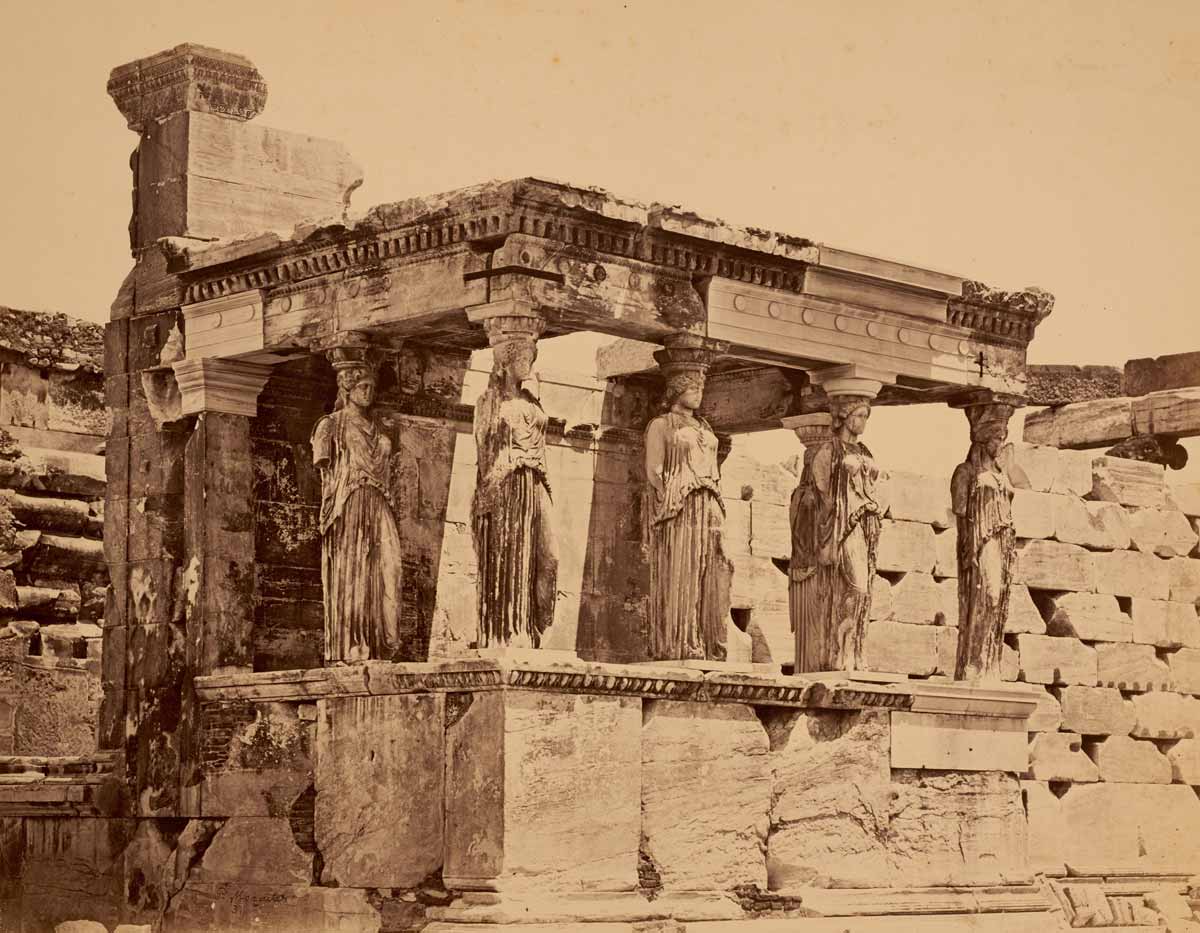
When you say, Classical Greece, this is the period of Greek history most people think of. The Classical Period is one of the most influential periods in Greece’s history, beginning with decisive victories against the Persian Empire. Athens became the cultural, intellectual, and political center of an empire; all areas of Greek life flourished.
Architectural masterpieces like the Acropolis rose towards heaven; the three classical orders, Ionic, Doric, and Corinthian, have their genesis in the period, too. Intellectual and influential thinkers like Aristotle, Plato, and Socrates established schools of thinking that still resonate in Western thought today. Literary traditions we use today found their foundation in the historical writings, poetry, and theater of the Classical Period.
Despite constant wars, including the devastating Peloponnesian War, Athens’ importance declined, but the art and architecture of the Classical era endured and continues to shape Western civilization on various levels, even today.
Pandoura (Πανδούρα)
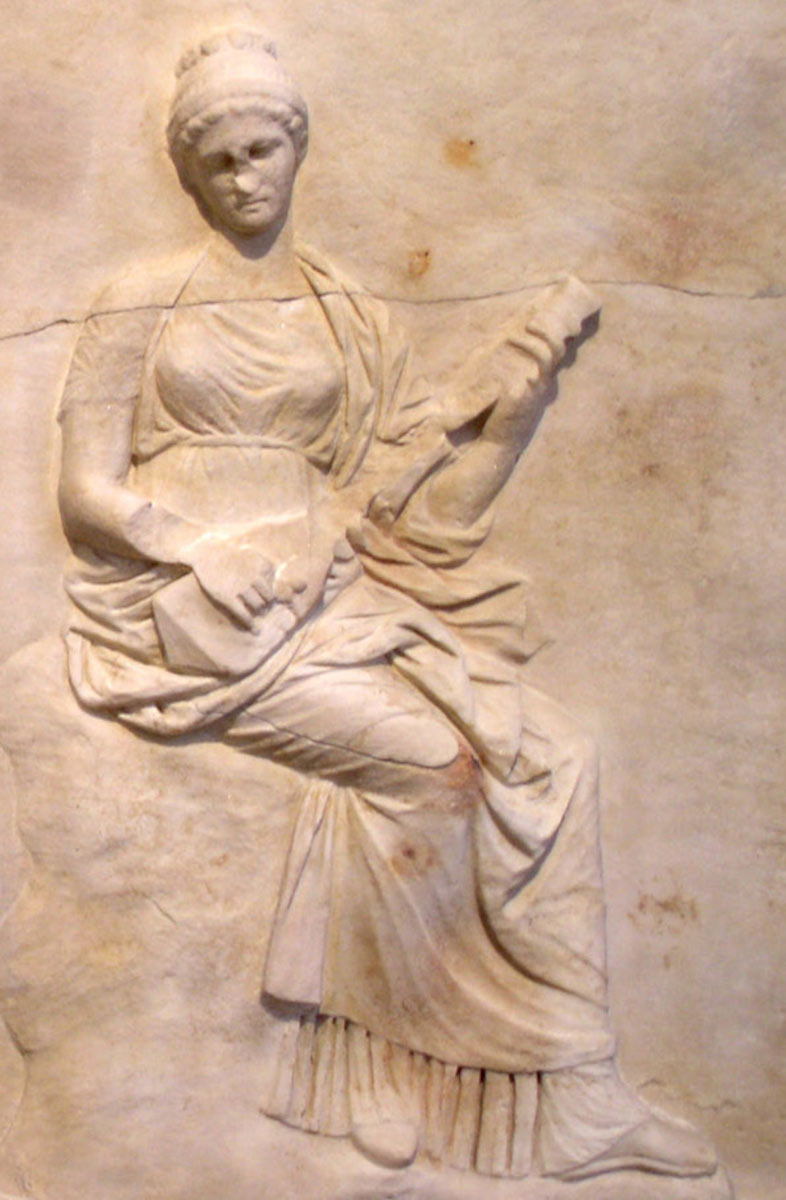
With all the wars ancient Greece was waging against its neighbors on the fringes of its borders, cross-fertilization was bound to happen. With its long neck and relatively small resonating body, the pandura’s origins can be traced back to ancient Mesopotamia, to about 3000 BC. The name, pandura, was derived from the Sumerian word pandur, meaning “long-necked lute.”
What sets it apart from the kithara and its sibling, the lyre, is the medium to long neck, with frets. When a player presses a string down between two raised frets, they alter the length of the string and thus, its pitch. Commonly, the pandura had three strings and was known as a trichordon (three-stringed instrument).
Like the modern guitar and banjo, the instrument is held with the neck to the left, and the strings are pressed by the left-hand fingers. The right hand will pluck or strum the strings with a plectrum.
In Schlomo Pestcoe’s opinion (a respected music researcher), the lack of historians writing about the pandura likely affected the instrument’s popularity. It did not have mythical connotations like the lute and was not regarded as “important” for music education. Thus, the instrument was “too common” or even “vulgar” for a respectable citizen to take seriously. Nevertheless, it was a popular instrument used for informal entertainment and even street performances.
Hellenistic Period (323–31 BC)
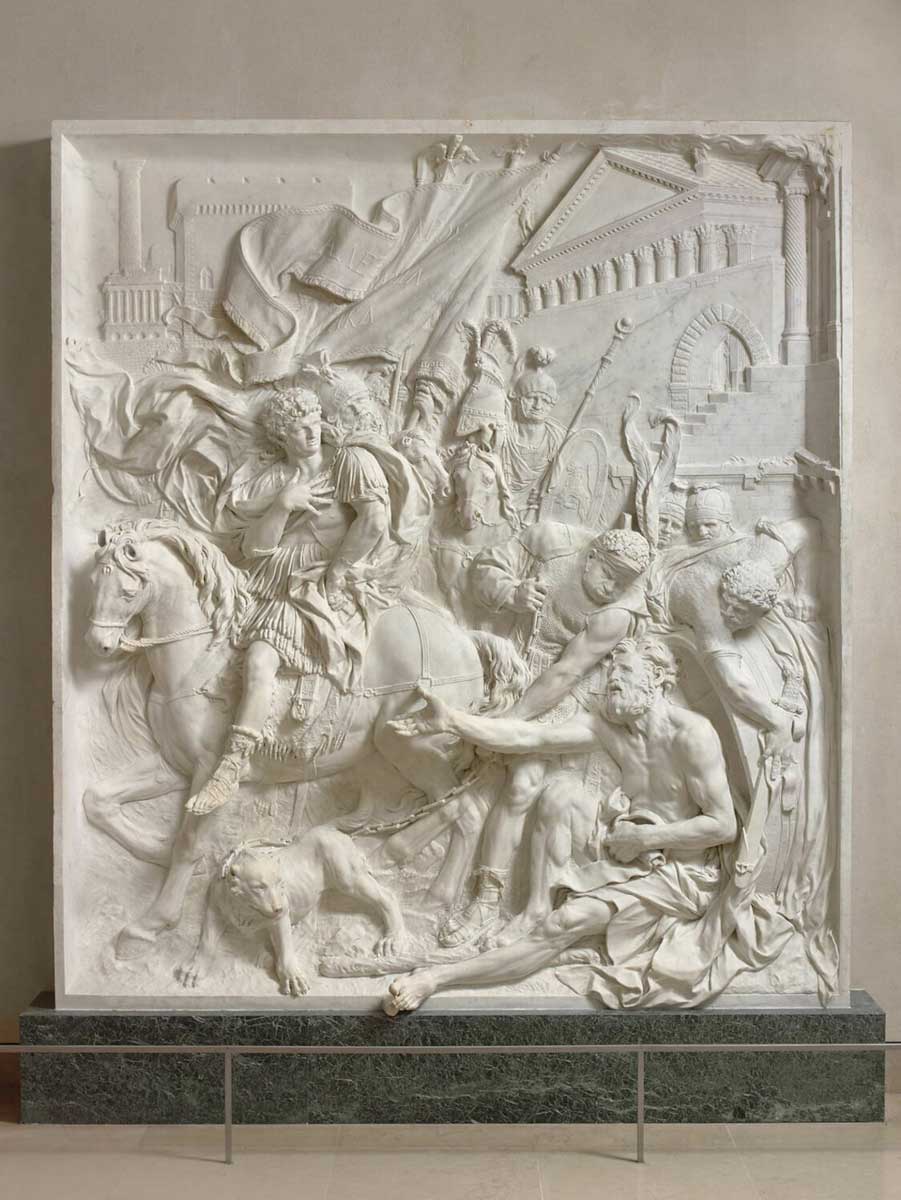
The Hellenistic Period (323-31 BC) began with Alexander the Great’s conquests, which spread Greek culture from Egypt to India, creating a vast cosmopolitan civilization. This era saw the fusion of Greek traditions with Eastern influences, producing remarkable advancements in science, mathematics, astronomy, and engineering. Alexandria became an intellectual capital, home to its famous library and museum. Artists experimented with dramatic emotion, movement, and realism in sculpture, moving beyond Classical restraint. Philosophical schools like Stoicism and Epicureanism emerged, addressing individual ethics in an expanded world. This period of cultural synthesis and scientific innovation profoundly influenced Roman civilization and subsequent Western development.
Hydraulis (Ὑδραυλις)
The pipe organ, as we know it today, is a direct descendant of Ctesibius of Alexandria’s 3rd-century BC invention. Prior attempts by inventors to apply a mechanical wind supply to a large set of pan pipes became the world’s first keyboard instrument.
In its most basic form, the hydraulis had a set of pipes connected to a conical wind chamber. But the problem of constant air pressure enters the playing field; without constant pressure, the pipes could not sound equal.
Ctesibius overcame this problem by placing the pipes on top of a conical wind reservoir. The open part of the cone was set inside a tall outer container filled halfway with water. When the air pressure inside the cone was too low, the water level would return to normal, i.e., “balance” itself. With the balancing act, the air pressure would increase, allowing the musician to produce music. But this led to a problem: air had to be constantly replenished.
Depending on the size and application of the instrument, one or two assistants would pump air into the funnel-shaped chamber. As the player pressed the keys, the compressed air would escape through the pipes, producing a sound while the water level balanced itself.