
Existential dread can come from anywhere. It often strikes when we realize how fragile our concepts of identity and success are. When Western existentialists faced the void, they often experienced angst, fright, or anxiety. The founder of Japan’s influential Kyoto School of philosophy, Nishida Kitarō, offered an alternative. By bringing classical Western logic into dialogue with Zen Buddhism, Nishida formulated three profound lessons that can transform anxiety into psychological freedom. Apparently, we need not tremble when we face the void once we realize that we can inhabit the nothingness.
Lesson 1: Pure Experience Lets You Stop Watching Yourself From the Outside

The first lesson is that one must return to the foundational concept of pure experience (junsui keiken) to overcome existential dread and anxiety. Nishida describes this as the very beginning of the inquiry into reality. Pure experience is a state that occurs before the split between subject (the knower) and object (the known).
The split is artificial. At its simplest, pure experience is a state of immediate, undivided awareness. There is no individuated “I” nor a separate “it”; there is only the flow of experience. If you overthink like me, you might find this useful. Overthinking can intensify existential dread.
In Nishida’s terms, reflection or introspection (hansei) is itself already an instance of overthinking. When we begin to label and categorize our reality, we create distance between ourselves and the world. This bifurcation, ironically, tends to isolate us rather than help us understand the world by relating to it. This isolation, in turn, leads to existential suffering.
Nishida argues that the subject-object dualism is a secondary construct of the intellect. In other words, going against the current of Western philosophy, Nishida claims that dualism does not describe fundamental reality in a satisfying way. By over-analyzing things, we fall into a world of fragmentation.
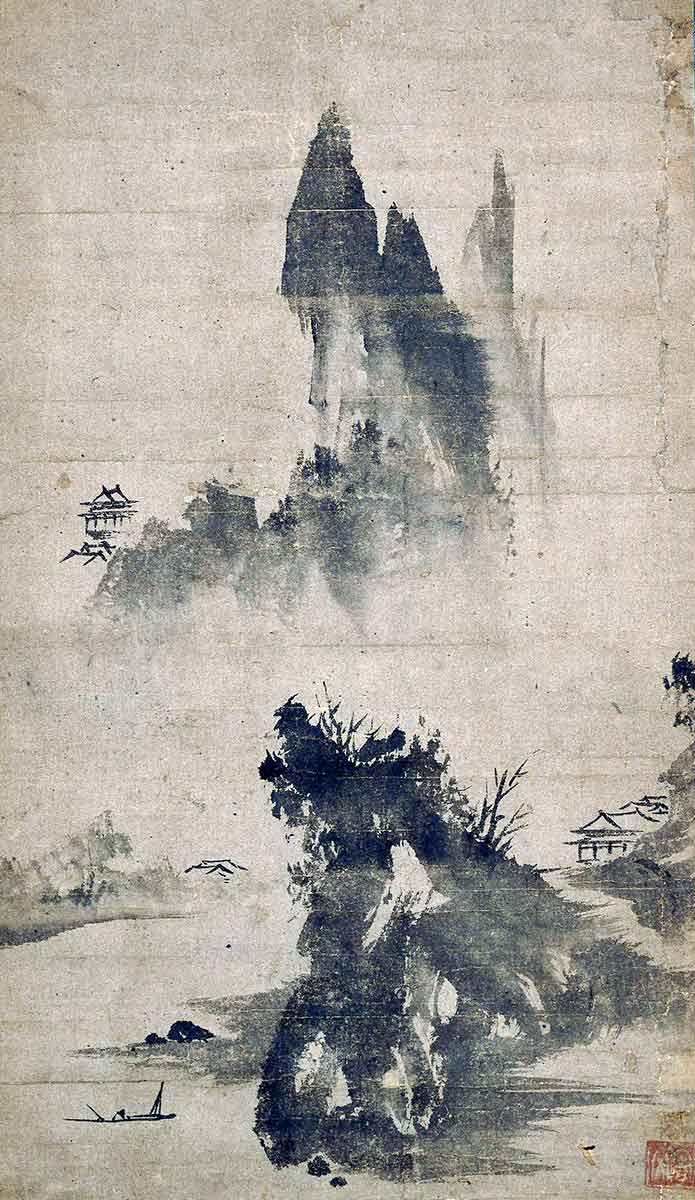
To prevent ourselves from spiraling into anxiety of compulsive self-confession, Nishida provides actionable instructions. You need to ground consciousness in immediate perception (chokkan). The term refers to an intuitive mode of being where one “sees without a seer.” The point is to break free from the alienating perspective where you constantly judge your experience from the outside. Instead, try to dwell within the immediate activity without reflecting on it.
This state is similar to what a driver experiences when they feel one with the car; this kind of seeing is pre-theoretical. It is an embodied awareness inseparable from the act of driving itself. Nishida calls it acting-intuition (kōiteki chokkan). This mode of experience collapses the distance between the self and the perceived task. By returning to the immediate state; the pure experience, you find that reality is a unity of opposites.
Pure experience lets you inhabit the “eternal now,” where the past and future are simultaneously co-present, dissolving the pressure of linear time and removing the dread of an uncertain future.
Lesson 2: Your Self Is Absolute Nothingness, so Failure Cannot Touch It

The second lesson in conquering existential dread requires deconstructing the illusion of a permanent ego.
Modern consumer culture and traditional Western philosophy often try to defend the notion of a rigid, unchanging identity. This creates immense psychological pressure to maintain a flawless self-image. Nishida counters this epistemology by introducing the concept of Absolute Nothingness (zettai mu). He distinguishes this from “oppositional nothing,” which is the mere absence of a thing, or a “nothing” that still stands opposed to “being.” But Absolute Nothingness is the spacious, non-judgmental background of human consciousness. It is a place that allows all things to appear.
Contrary to classical Western metaphysics, Nishida envisions the true self as a mirroring mirror. It is nothing in itself, with no fixed form or content. The nature of the self is self-emptying, so to speak. The world appears within it as mirror images.
When you realize that the self is this vast openness rather than a specific set of labels (success, failure, identity), you might just achieve this newfound freedom. If the self is Absolute Nothingness, it cannot be destroyed by external failures or existential alterations; it is the very place (basho), the condition where these events occur.
Rejecting the rigid, bounded self eliminates the crushing burden of trying to stay self-consistent and predictable. That is essentially what helps overcome anxiety. So we can peel off banal corporate identities and social roles, as well as the pressure to perform and outperform. Instead of defending an ego that will always be fragile compared to the waves of turbulent change the universe throws at us, the realization that we are already nothing can serve as a much more useful coping strategy. Nishida describes this as a “determination without a determiner.” The world determines itself within you, and your self-awareness is just the self-mirroring of the universe.
Realizing that you are a shadow of the infinite, self-nullifying background allows you to exist in the face of death and transformation.
Lesson 3: You Are Never Isolated, You Are Always Implaced in a World

The final lesson is found in Nishida’s philosophical framework known as the logic of place (basho). Having established that one common source of existential dread is the feeling of isolation, we can look to the logic of basho for a drop of salvation. Basho teaches that we are always “implaced” (oitearu) within a greater, nurturing existential context.
One of Nishida’s central problems was to formulate an ethical philosophy that could overcome narcissistic solipsism. Nishida needed to show that one does not exist in isolation. We are always already placed or implaced in a world that encompasses an important historical dimension.
The universalist principles of formal logic and theoretical reason cannot capture the historical aspect of our experience. This is how place differs from space. Space is homogeneous; it is the same everywhere. One cutout of space can be substituted with any other. Place, on the other hand, is singular and exceptional; it is historical, cultural; it contains stories that speak to its uniqueness. A place is not substitutable.
The logic of basho thereby reframes and counters modern feelings of alienation and sense of self by showing that you are not a stranger to the universe because you are one of its many unique determinations. Nishida describes the world as a dialectical universal where the environment and the individual are “one body.”
This relationship is defined, once again, by acting-intuition (kōiteki chokkan), a dynamic that can be restated as “the making is made” (tsukuraretamono kara tsukurumono e). This implies that you are not a passive victim of fate, given that you are in a position to shape the world as the world shapes you. Alienation disappears when you realize that your very existence is a resonance between you as an individual and you as the universe at large.
By viewing your life through the logic of basho, you also understand that the socio-historical context of the universe, beyond the cosmic, always supports you. Your body is, in a sense, a historical body, and it bears the world.
According to Nishida Kitarō, existential dread is resolved through the realization that your singular existence is a necessary particularization of the universal. You are a mirror-image of the “eternal now.” Your presence in the world is both a death to the isolated ego and a birth into the creative life of the historical reality. This continuity of discontinuity should allow you to live fully.