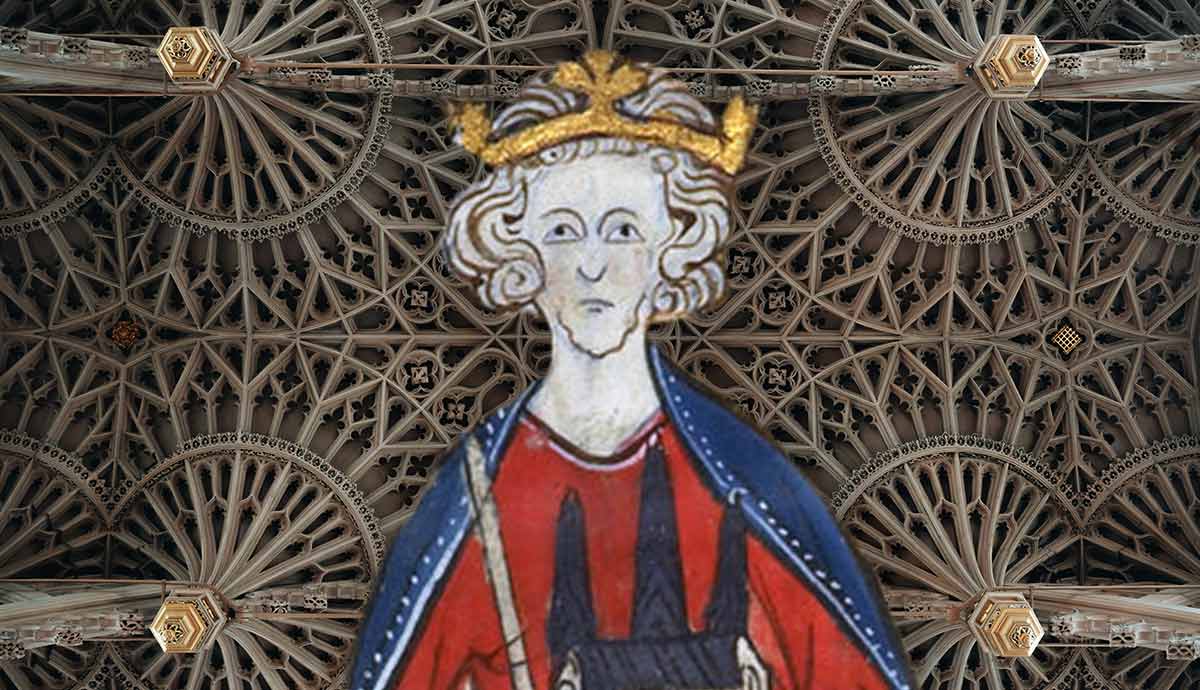

Upon the death of his beloved wife Eleanor of Castile in 1290, King Edward I of England gave himself over to grief. In an expression of his sorrow, the king commissioned the construction of twelve elaborately decorated crosses to mark the route his wife’s body took to its final resting place in Westminster Abbey. Was this a symbolic reminder of one of the greatest romances of the Middle Ages, or were they designed as a piece of dynastic propaganda in a calculated statement of royal authority?
A Great Romance – Eleanor of Castile and Edward I
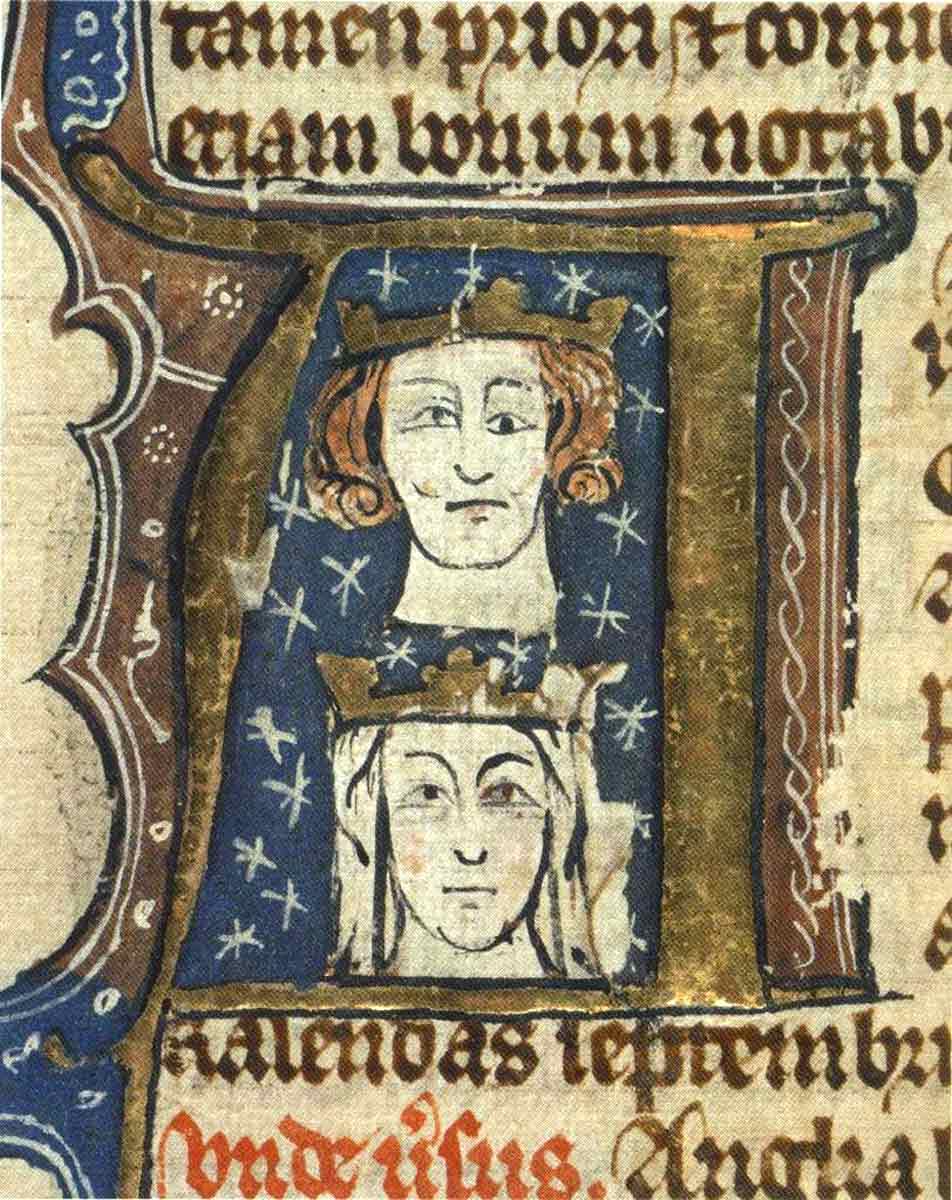
It is often assumed that the loving royal family was invented in the 19th century when Queen Victoria married Albert. However, in the 13th century, we have two examples of a loving nuclear family: that of Henry III and his wife Eleanor of Provence, and their son, King Edward I and Eleanor of Castile. Edward married the Spanish princess in 1254 before he became king to secure the Duchy of Gascony for the English throne. Eleanor was twelve years old and her groom fifteen. The couple had approximately 14 children together, although not all survived into adulthood. Their only surviving son was Edward of Caernarvon, the future King Edward II.
While medieval royal marriages were always conducted for political reasons, Edward and Eleanor’s union flowered into genuine romance. There is no evidence to suggest Edward took a mistress or had any illegitimate children. His wife was cultured and educated and said to be a great beauty. She was a formidable queen with a head for business who increased her lands significantly as consort. Edward encouraged his wife in her business dealings, and his devotion to his wife as they aged can be attested to by the sheer amount of time they spent together.
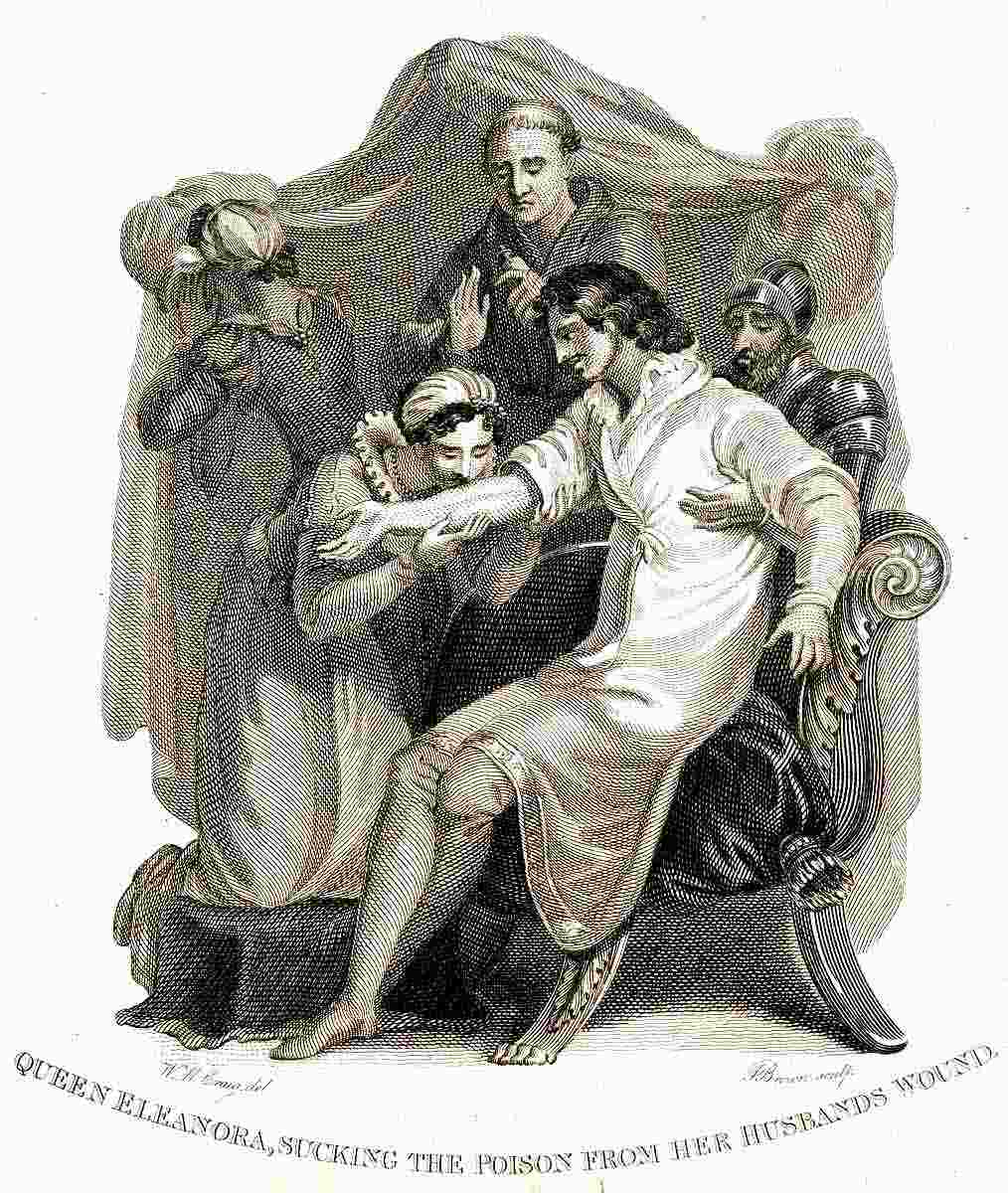
Edward was seldom separated from Eleanor, who accompanied him on crusade to the Holy Land. Later legend credited her with saving his life by sucking poison from his wound, reflecting notions of the closeness of their relationship. As a dutiful wife, Eleanor supported her husband during his campaigns in Wales, and later joined him as he traveled north toward Nottinghamshire in late 1290, where she fell gravely ill. Despite the intense pressures of kingship and his plans to go to Scotland, Edward remained at her side in her final days.
The Death of Eleanor And the Royal Funeral Procession
Eleanor died on November 28 at the village of Harby near Lincoln. She was only 49 years old. The cause of her death is unknown, but she probably did not fully recover from the malaria she had contracted during a recent trip to Gascony. Continual pregnancies would have also taken a toll on her body. For three days, the king’s grief was so intense that he was unable to leave the place where she died. The extent of Edward’s love was expressed months later as he wrote to the Abbot of Cluny requesting prayers for his wife: “our most serene consort who while living we loved dearly, and in death we do not cease to love.” (Armstrong, 2023).
Eleanor’s body was moved from Harby and traveled seven miles to Lincoln and prepared for burial. Her internal organs, except for her heart, were buried at Lincoln Cathedral. This was a practical measure used when corpses were to be transported long distances for burial. Her heart was gifted to the Dominican Church in Blackfriars, London and buried alongside that of the heart of her son, Alphonso. Her body was then embalmed and placed in a coffin, making its way slowly down to London. Opting for three burial sites, each with its own tomb, was rather unusual for a queen consort.
The cortege rested at twelve different locations overnight as it made its way down to London on the solemn 200-mile journey. The grief-stricken king walked behind the coffin in a very public expression of grief. His sorrow was felt and shared by all his subjects. As the king made his way south, he identified locations for memorials for his wife.
The Twelve Eleanor Crosses
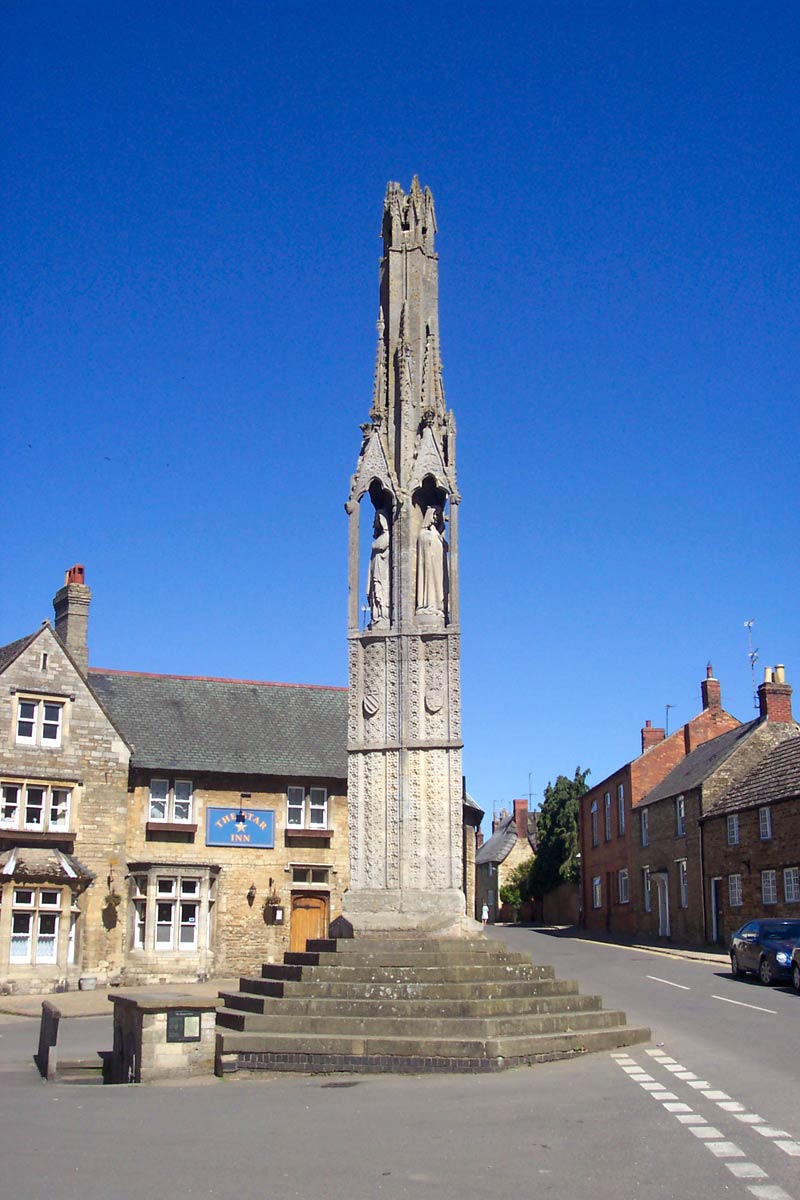
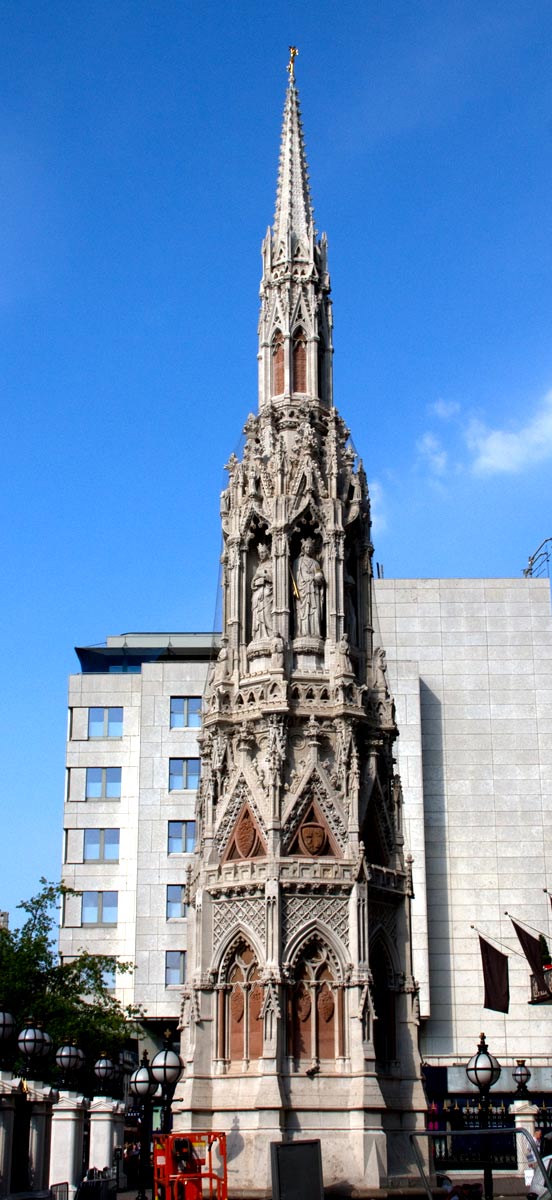
The twelve locations where the queen’s funeral procession had stopped overnight were commemorated by crosses. Edward commissioned these monuments, which were built between 1291 and 1295, to serve as a permanent memorial to his beloved wife. Each monument was multi-tiered and elaborately decorated in an ornate Gothic style and incorporated life-size sculptures of Eleanor. The crosses were also decorated with the coats of arms of England, Castile and Leon (Eleanor’s native kingdom) and Ponthieu, which Eleanor inherited from her mother.
Locations
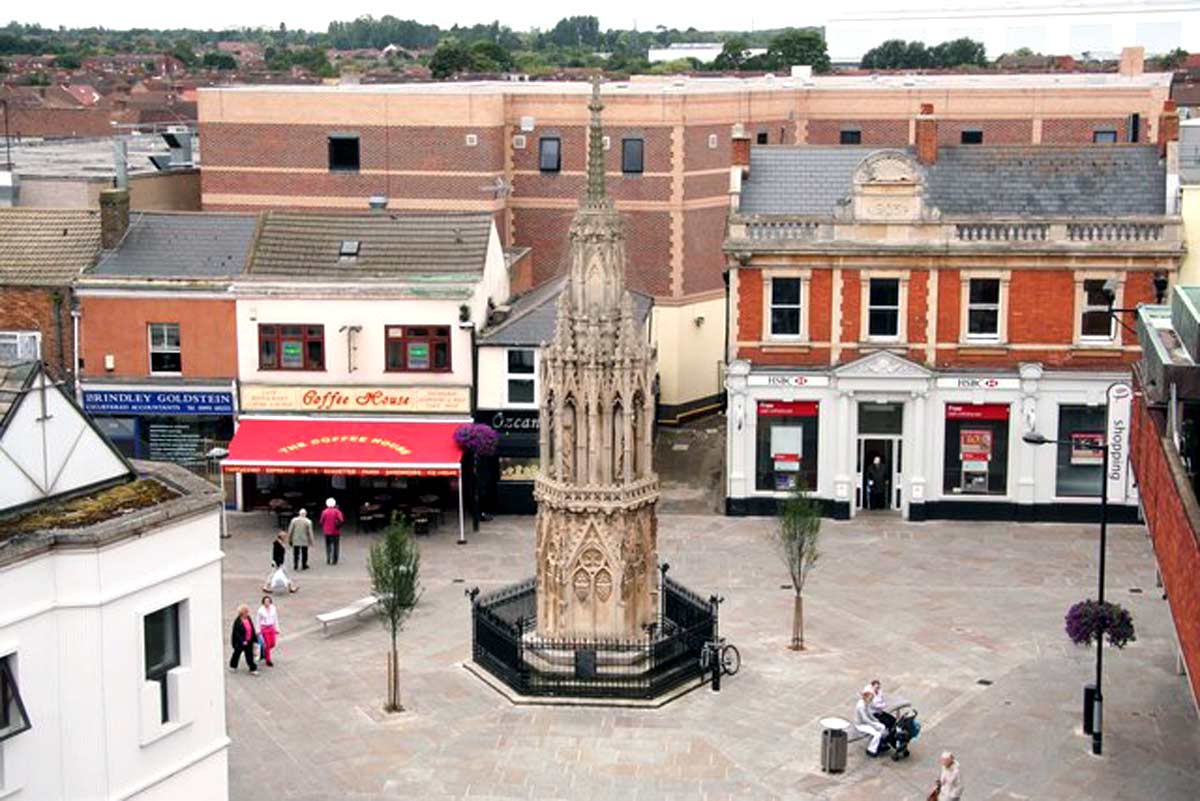
The first location was Lincoln, where the procession began. A fragment of the original Lincoln cross survives and was relocated to Lincoln Castle. 25 miles further, another cross, known as the Queen’s Cross, was placed at Grantham in the widest part of the High Street. Stamford, Lincolnshire, was the next stop and the cross there was erected just outside the town. Two of the three surviving crosses, the triangular Geddington Cross and the octagonal Hardingstone Cross, were erected in Northamptonshire villages.
The cortege moved down into Buckinghamshire, where a cross was placed at Stony Stratford. Nothing remains of either the Woburn cross or the Dunstable cross, both in Bedfordshire. A clock tower marks the location of the site of the St Albans cross, lost by the 18th century. A cross at Waltham was placed at the crossroads to the village of Cheshunt and still survives today in the eponymous town of Waltham Cross. After the procession reached the City of London, a cross was placed at Cheapside near St Paul’s Cathedral. The final and most expensive Eleanor Cross was located in the village of Charing on the way to Westminster Abbey and gave its name to Charing Cross.
All the Eleanor Crosses were placed at busy strategic locations, often at crossroads where they could dominate the surrounding landscape. An impressive bronze tomb was then constructed at Eleanor’s final resting place in Westminster Abbey.
Power, Piety, and Dynastic Propaganda
The construction of an elaborate set of monuments to mark a funeral procession was unique in England. So where did Edward get the idea from? Edward had joined the Eighth Crusade, led by King Louis IX of France in 1270, but the expedition continued without its leader. Louis only made it to Tunis when he died in August 1270; his organs were buried in Palermo, but his bones were brought home in a funeral procession that crossed Sicily, Italy, the Alps and France. Nine elaborately decorated stone monuments marked the locations of Louis’s funeral procession as it made its way through France. These monuments were part of a successful attempt to have the pious French king canonized.
While Edward was undoubtedly inspired by such an act of commemoration, he ensured that his wife’s crosses were taller and more ornate. By erecting such structures in strategic locations throughout southeast England, Edward was not only commemorating his wife but seeking to assert his royal authority. The 13th century was a turbulent time for the English monarchy; Edward’s father Henry III and his grandfather King John had both faced the wrath of the barons who challenged their authority. While Edward generally enjoyed a constructive relationship with his barons, he remained keen to assert his kingly authority. His memorials to Eleanor proved to be a lasting and permanent reminder of Edward’s reign. They projected the image of a stable monarchy following decades of turmoil.
The Eleanor crosses therefore functioned as lasting symbols of royal authority while reinforcing contemporary ideals of queenship and maintaining the queen’s symbolic presence after her death. The Eleanor Crosses further associated both Edward and Eleanor with piety, presenting the queen in a saint-like manner that elevated her image beyond that of a conventional consort. The Crosses served as an excellent piece of Plantagenet propaganda.
The Legacy of the Eleanor Crosses In English History
Edward spared no expense in memorializing his wife. Beginning at Lincoln, individual statues cost from £100, with increasing elaboration and expense as the crosses approached London. At Charing Cross, the most ornate of the series, master craftsmen were paid as much as £600. Today, only three crosses survive substantially intact, at Geddington, Hardingstone, and Waltham, along with fragments at Lincoln. These remnants represent what was once a far more extensive commemorative program, conceived as an enduring testament to both grief and royal authority.
Many of the crosses were lost to time, decay, and deliberate destruction, particularly during the English Civil War, where their royal symbolism backfired. Nevertheless, the crosses were first and foremost a public expression of Edward’s personal grief and affection. They also invited the nation as a whole to grieve for the loss of their beloved queen. At the same time, they served a secondary political function: projecting Eleanor and Edward’s presence across the kingdom as a symbolic and watchful extension of royal authority.
This duality complicates Edward’s reputation as a formidable military king. Though remembered as the formidable “Hammer of the Scots,” his actions following Eleanor’s death reveal a deeply personal dimension. It reveals a human level often absent from narratives of kings. His decision to remain unmarried for nine years, despite the dynastic risks of having only one surviving son, underscores the depth of his loss. In the Eleanor Crosses, Edward created not only a memorial to his wife, but also a new model of royal commemoration, one that fused personal devotion with political symbolism.
Source:
- Armstrong, A. A. (2023). Eleanor of Castile: A consort of contradictions. In A. Norrie, C. Harris, D. A. Messer, E. Woodacre, & J. L. Laynesmith (Eds.), Norman to early Plantagenet consorts: Power, influence, and dynasty. Palgrave Macmillan, p. 142.