World War I took a huge toll on the small Balkan nation of Serbia. Estimates show that the country lost nearly a third of its pre-war population, while almost two out of three Serbian men perished in the war. Despite fighting bravely early on in the conflict, the Serbian military soon had to retreat together with a portion of its population. They endured the Albanian Golgotha, only to recuperate for the final push at the Salonica front to liberate their homeland. The following images document this struggle.
1. Dragutin Hawkeye Matić
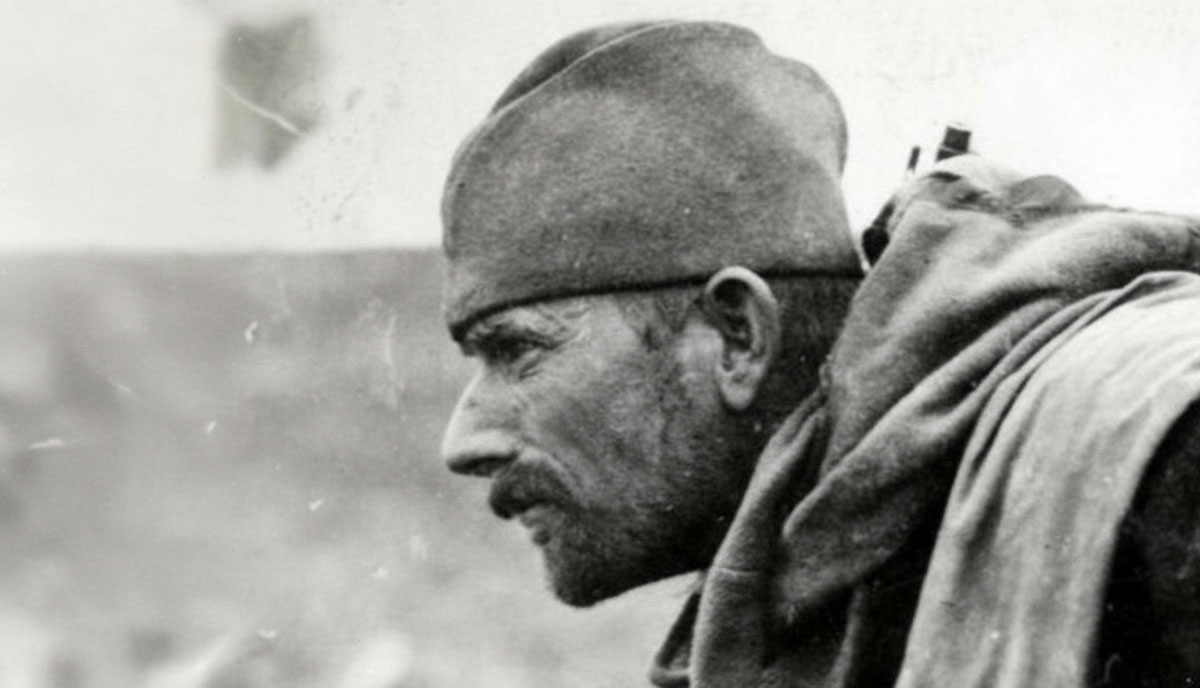
Arguably, the most famous image of World War I in Serbia is called Hawkeye (Oko sokolovo). It depicts a Serbian scout at the beginning of the war, in 1914, on patrol somewhere along the Drina River, which formed the border between the Kingdom of Serbia and Austria-Hungary.
The man in the photo was Dragutin Matić, an infantryman from the south of Serbia and an experienced warrior who had fought in both Balkan Wars. Interestingly, Matić found out about his fame nearly half a century later. In 1965, his acquaintance recognized him on the cover of a vinyl record and sent it to his home village, confirming that he was the soldier in the famous photo. Until then, all Matić knew was that a reporter passing by had caught a snapshot of him, but he assumed that the man had perished in the war.
Unbeknownst to Matić, the photographer in question was Samson Černov. The Russian Jew was just 25 when he arrived in Serbia to cover the First Balkan War as a correspondent for a newspaper in his motherland. Not long after, the Serbian high command employed him to document the Great War. He captured in film and photos the atrocities Austro-Hungarian soldiers committed against the civilian population in the Mačva and Posavina regions in Western Serbia.
It was during this period that he photographed Matić on patrol. He organized photography exhibitions in London and New York to raise global awareness about the suffering of the Serbian people.
2. The Great Retreat
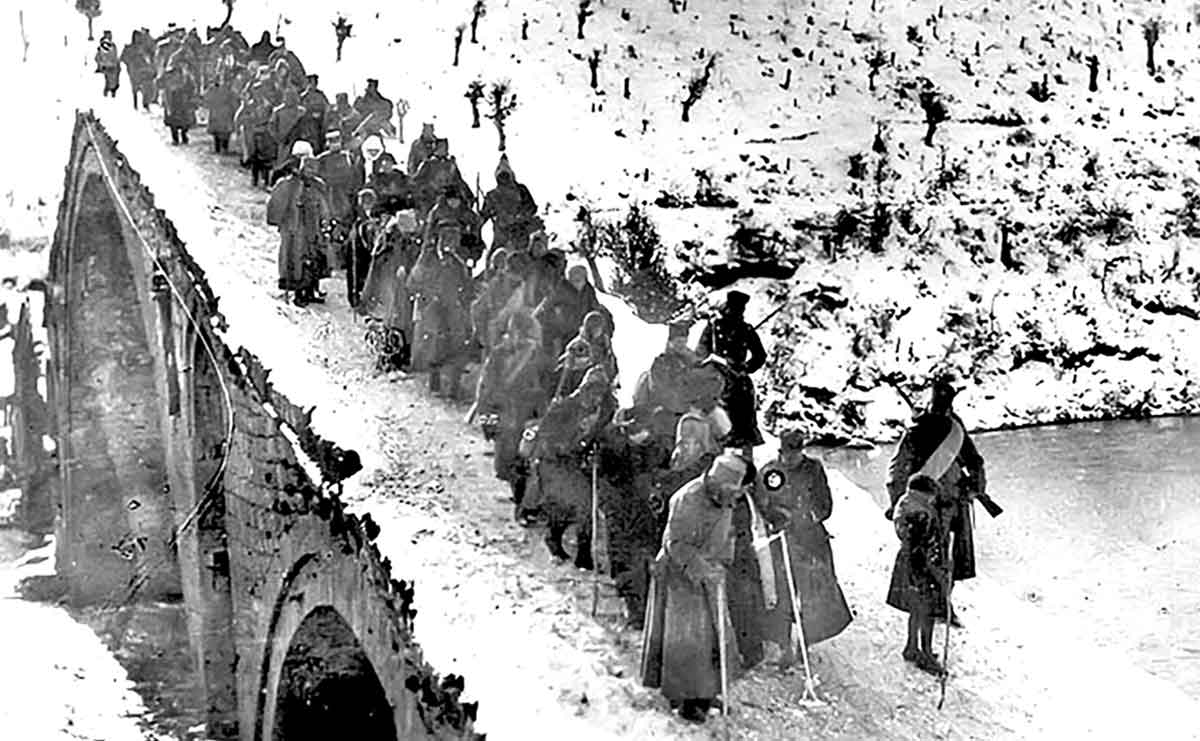
The image shows the Serbian high command crossing the frozen Vizier’s Bridge, which once stood over the White Drin River near the town of Kukës in Albania. At the head of the column is King Peter I of Serbia, supporting himself with a cane.
Rista Marjanović, the first Serbian photojournalist, took the image in 1915, during the Great Retreat, or the Albanian Golgotha, as Serbs refer to this arduous period of their history.
After the German military had come to the aid of the Austro-Hungarians and Bulgaria’s declaration of war, the Serbs were forced to retreat south or face annihilation. The path took them across the high mountains of Albania, which was the deadliest stretch. Soldiers and civilians, who had previously joined them, died from the bitter cold, malnourishment, and attacks from the local tribes. Their goal was to reach the coastline, from where Allied ships would transport them to safety.
At the time, the bridge in the photo was on the main road from Prizren to Scodra and Lezhë on the Adriatic coast. Kara Mahmud Pasha, the Ottoman governor of Albania, had built it in the latter half of the 18th century, hence the name. Although the Serbian troops had partially destroyed it during the retreat to slow down the enemy, it was soon reconstructed, only to be finally demolished in 1978 to make way for a hydroelectric dam.
3. The Old King Stays by His People
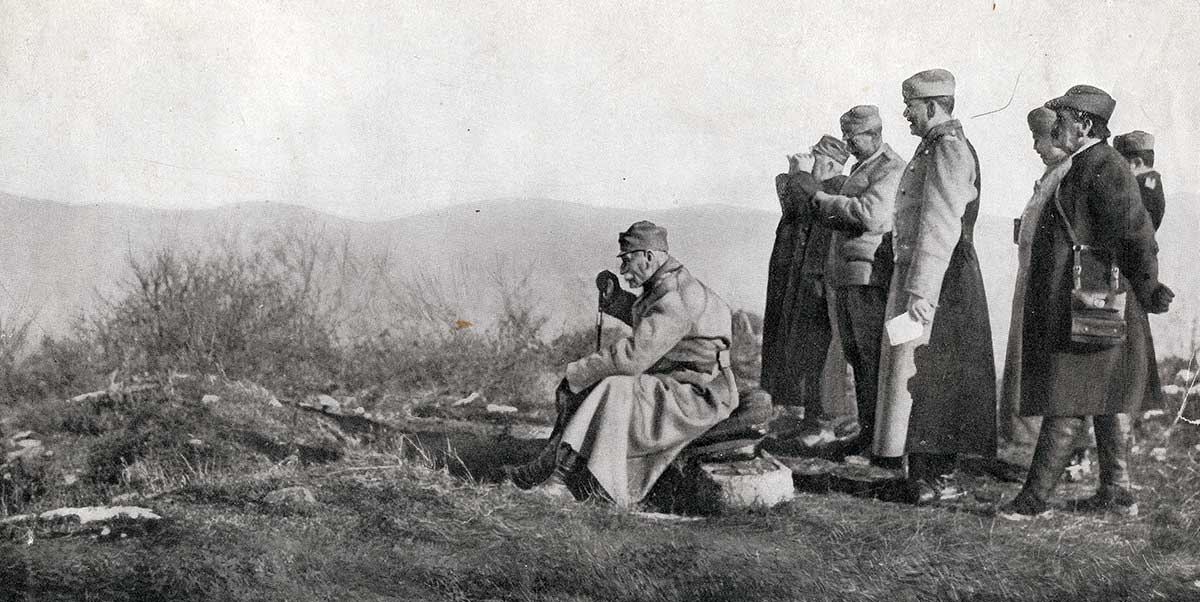
The aforementioned Samson Černov took this photo near the village of Darosava in Central Serbia on November 17, 1914. King Peter I of Serbia is in a seated position, surveying the area, while behind him stands his oldest son, George, Crown Prince of Serbia, and a distinguished military commander, Stepa Stepanović, among others.
The photograph, which was also published in the French illustrated weekly L’Illustration, is unique because it’s one of the first times during the Great War that a sovereign was captured on film at the frontlines. Several months earlier, he had proclaimed his son Alexander as the regent, but remained popular among the Serbs, who nicknamed him The Old King or King Peter the Liberator.
The image documents the onset of the Battle of Kolubara, which, alongside the Battle of Cer, was one of the two most important skirmishes early in the war. Outnumbered and poorly equipped, the Serbian army had managed to win both battles, forcing the more powerful enemy to retreat back across the Drina River on two occasions.
4. The Most Decorated Woman Soldier in History
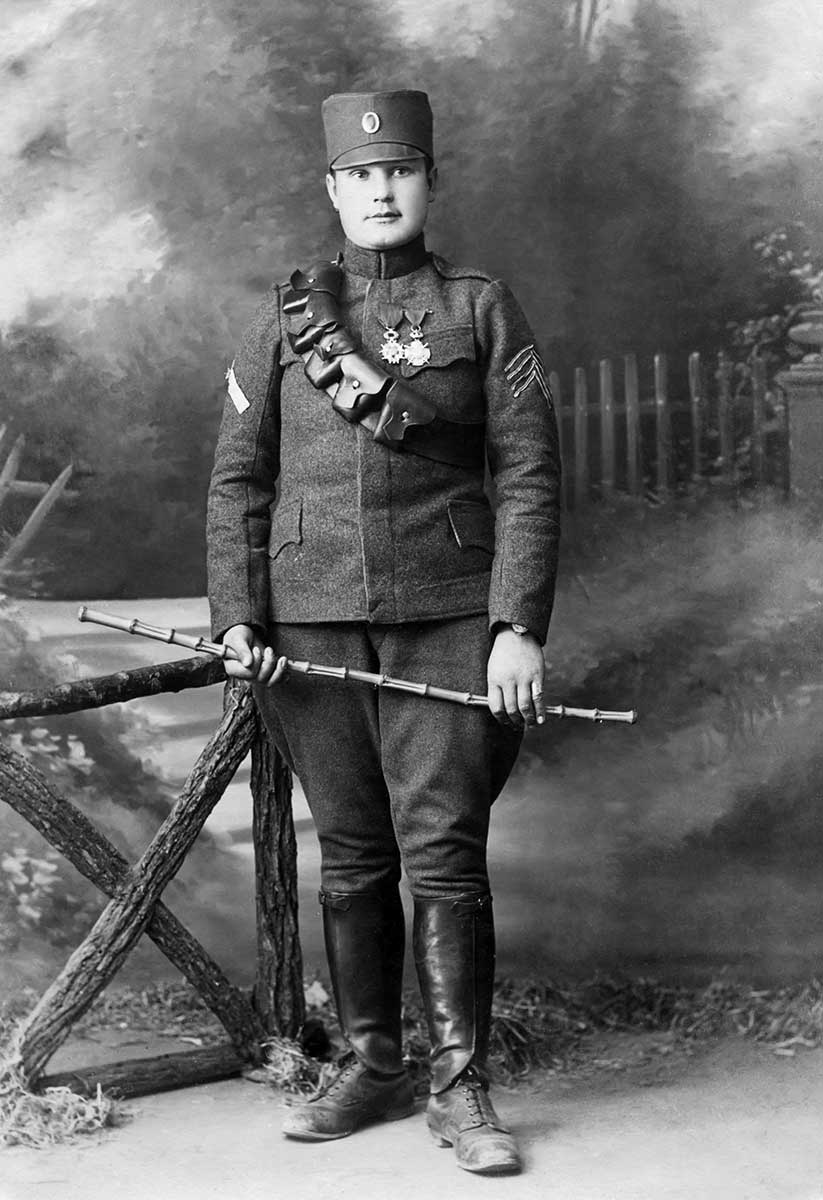
Milunka Savić (1892-1973) was the most decorated female soldier in the history of warfare. Her épopée started in the First Balkan War (1912) at the age of 20, when she volunteered under the false male name of Milun Savić. She had also cut her hair and bound her breasts to pass as a man. She fought bravely alongside her comrades, who discovered she was a woman a year later, after she was wounded in battle and needed medical attention.
By the time she was demobilized in 1919, she had been wounded nine times in total. Milunka was a member of the “Knjaz Mihajlo Infantry Regiment,” which was comprised of volunteers from Southern Serbia. This was the only unit of the Serbian military to receive the honorary title of “The Iron Regiment” for the valor and courage it displayed in battle.
At the time, female soldiers were a rare occurrence, as most Western countries drafted women into civilian work, such as medical nurses or factory workers. Milunka, standing side by side with her male brothers in arms, drew attention wherever she went.
Apart from Serbian military honors, she was awarded the French Légion d’Honneur twice, the Russian Cross of St. George, and the British medal of the Most Distinguished Order of St. Michael, to name a few. The French nicknamed her the “Serbian Joan of Arc.” After the war, she helped put through school dozens of children from her native Jošanička Banja, proving her heroic figure in the time of peace as well.
5. The Youngest Soldier of World War I
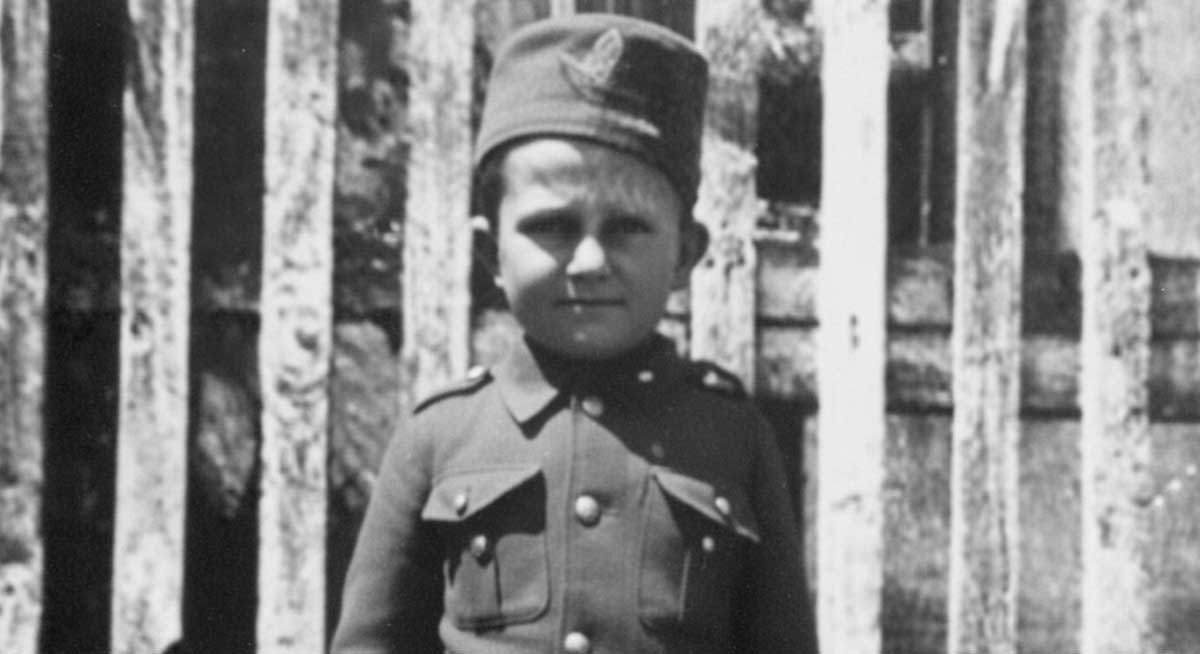
The war crimes of Austro-Hungarian soldiers against the civilian population in Western Serbia resulted in a high number of orphans. One of them was Momčilo Gavrić, who was only eight years old when he lost his family, surviving the carnage in his home village of Trbušnica by pure chance.
The boy went looking for Serbian soldiers, who, after hearing what had happened to him, decided to adopt him as the “Son of the Drina Division,” which was another name for the Serbian Third Army. The unit’s tailor made a special uniform for him, together with the traditional Serbian headwear, the šajkača, which is visible in the photo. At nine, he was already a corporal, the youngest in the world at the time.
The original photograph is displayed in the Serbian Museum of Corfu, the Greek island where the Allies evacuated the Serbian army in early 1916. This means that Gavrić managed to survive the Great Retreat, which is something that countless able-bodied adults could not achieve.
On Corfu, he got a proper, new uniform and soon rejoined his division in the Salonica Front. There he met the famous general Živojin Mišić, who could hardly believe his eyes when he saw an eleven-year-old in uniform in front of him. He immediately promoted Momčilo to lance sergeant. After the liberation of his homeland, a British mission sent him to the United Kingdom to finish his schooling, after which, he returned to Serbia.
6. The Negative Propaganda Against Serbia
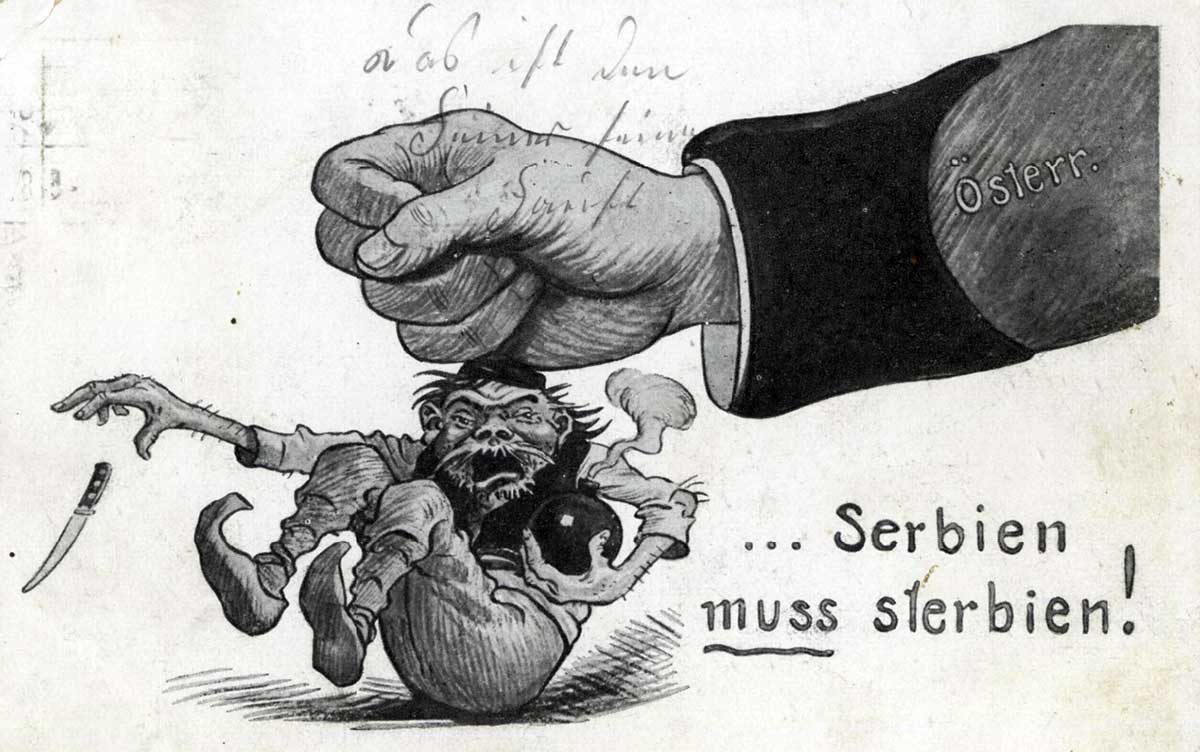
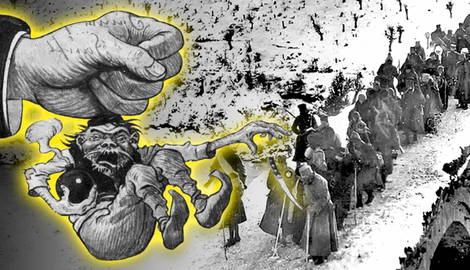
Apart from the physical battlefield, World War I was fought in the media sphere as well. The postcard above is an example of Austro-Hungarian negative propaganda against Serbia. It shows the firm fist of Austria (“Österr.”) punching a representation of a primitive Serb on the head.
The man is carrying a rudimentary knife and a bomb, indicating that the Serbs are warmongers who need to be smothered. The words in German, which translate as “Serbs must die,” reflect this. The verb “sterben” was altered into “sterbien,” so it would neatly rhyme with “Serbien.” The verb “must” is underlined to justify to the person reading the card that it was Austria-Hungary’s duty to act militarily against Serbia.
This sort of propaganda was nothing new, as anti-Serbian sentiment traces back to the First Balkan Crisis of 1908 when Austria-Hungary announced the annexation of Bosnia and Herzegovina. The goal of all films, posters, and postcards was the same: to portray the Serbs as barbaric and uncultured outlaws, prone to robbery and bestialities.
They often showed King Peter I as a swineherd and the prime minister, Nikola Pašić, as a beggar. The end goal was to criminalize the Serbian state, so it could be punished in the most brutal manner. Unfortunately, the same propaganda pattern repeated itself in World War II and more recently, in 1999, during NATO’s intervention against FR Yugoslavia.
7. The Defense of Belgrade
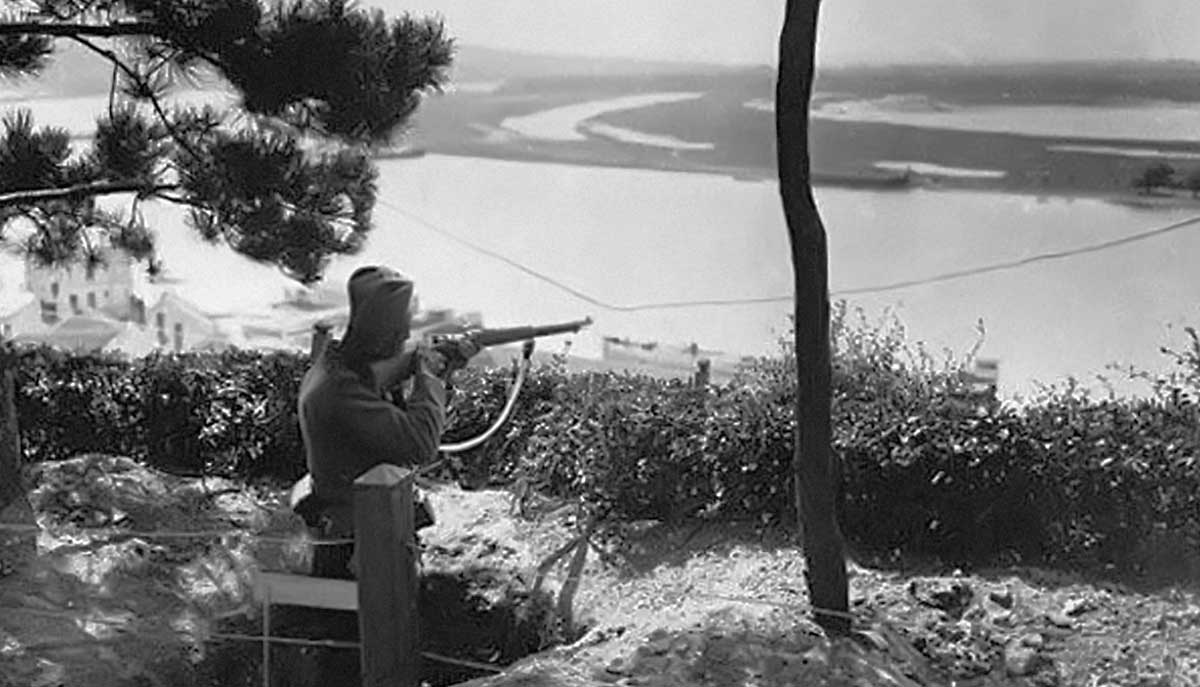
The capital of the Kingdom of Serbia, Belgrade, was in a precarious geographical location at the start of the war. It was bordered by the Sava River to the west and by the Danube to the north; Austria-Hungary lay on the other bank of both rivers.
The Serbian high command decided not to defend Belgrade because of this strategic disadvantage. As expected, Austria-Hungary bombarded Belgrade on the first day of the war. However, they had failed to capture the city by land. Belgrade’s defenders were a mishmash of policemen, customs officers, irregulars, and conscripts.
One of them is pictured above, aiming his rifle at the enemy across the river. Despite their heroism, the city finally fell at the beginning of October 1915. After the battle, the German field marshal, August von Mackensen, commemorated the fallen enemy soldiers on a monument that read in two languages: “Here lie Serbian heroes.”
8. The Shot That Started the War
The history of naval warfare is full of famous vessels, such as the Russian cruiser Aurora, which reportedly fired the first shot of the October Revolution. However, few people know the name of the ship that started the Great War.
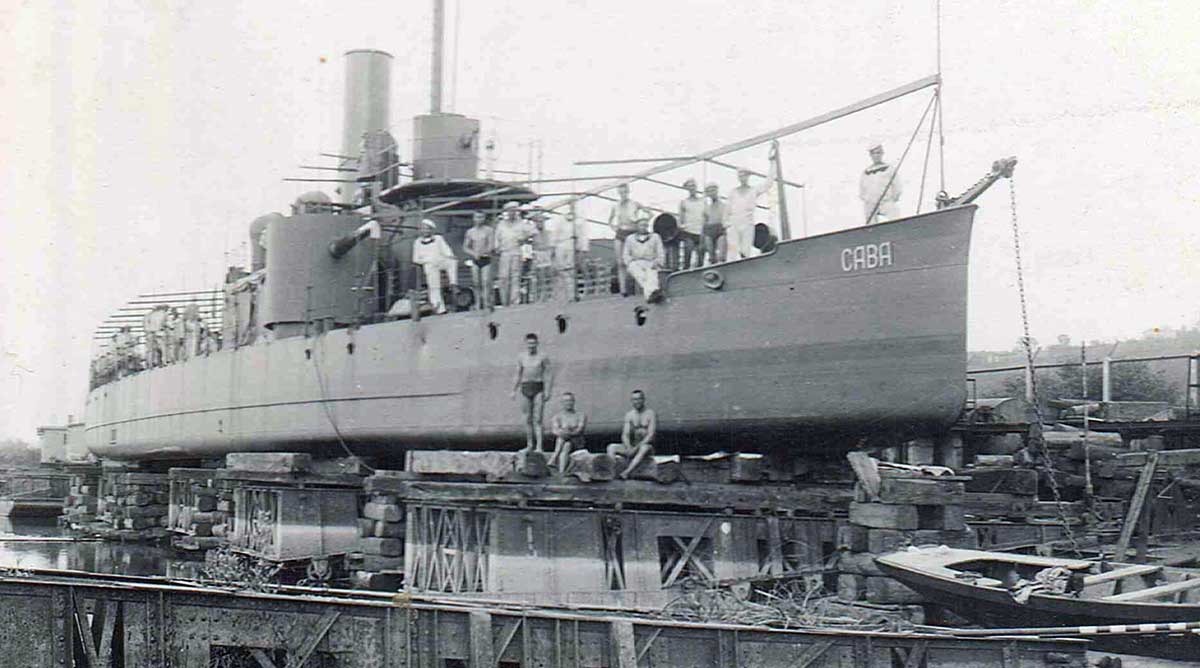
It was the Austro-Hungarian river monitor Bodrog that, in July 1914, sailed downstream from Zemun port to bombard Belgrade. “Monitors” got their name from the USS Monitor from the American Civil War. They were patrol ships on rivers, usually the largest vessels of a flotilla. At the start of the war, the Kingdom of Serbia did not possess similar ships, so Bodrog wreaked havoc on their capital city. It was driven out of the area only after the arrival of Allied coastal artillery.
The vessel came out of Budapest’s shipyard in 1904. During the remainder of World War I, it fought against Serbian and Romanian troops further south. After the Serbian soldiers seized it at the end of the confrontation, the monitor got a new name: Sava (pictured above).
It sailed under this name from 1920 until April 1941, when its crew scuttled it to prevent it from falling into German hands. However, the forces of the Independent State of Croatia, a Nazi puppet state, brought it back into service. At the end of World War II, it sank for the second time, but the Yugoslav army took it out and restored it. The modernized version of the Sava/Bodrog remained in active service until 1962.