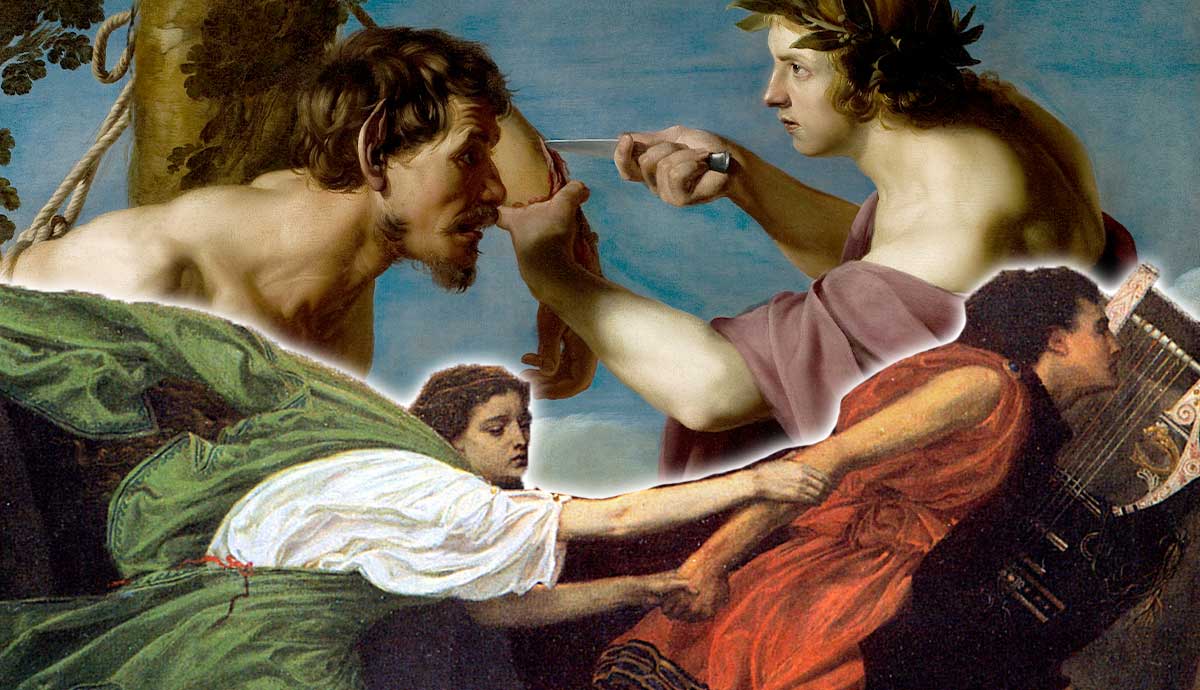

Ovid, a Roman poet who lived at the dawn of the Roman Empire under Augustus, is best known today for his Metamorphoses. Written in AD 8, the work is a compilation of over 250 stories from Greek mythology, retold for a “modern” Roman audience. As the name suggests, the fables include an element of transformation, usually a divine punishment or reward, sealing a tragic fate. Each story holds a lesson or a warning for the reader about hubris and getting too close to the divine. Discover Ovid and his theme through five tragic and haunting tales of metamorphosis.
1. Apollo Slays Python and Claims Delphi
Ovid’s Metamorphoses begins with a creation myth like so many others: a great flood story. It progresses into an epic, introducing a host of gods, goddesses, nymphs, monsters, and fickle human beings often falling prey to any or all of the aforementioned. Greek mythology was meant to instruct and caution. It also sought to explain natural phenomena, like the change of seasons or the fixed positions of constellations.
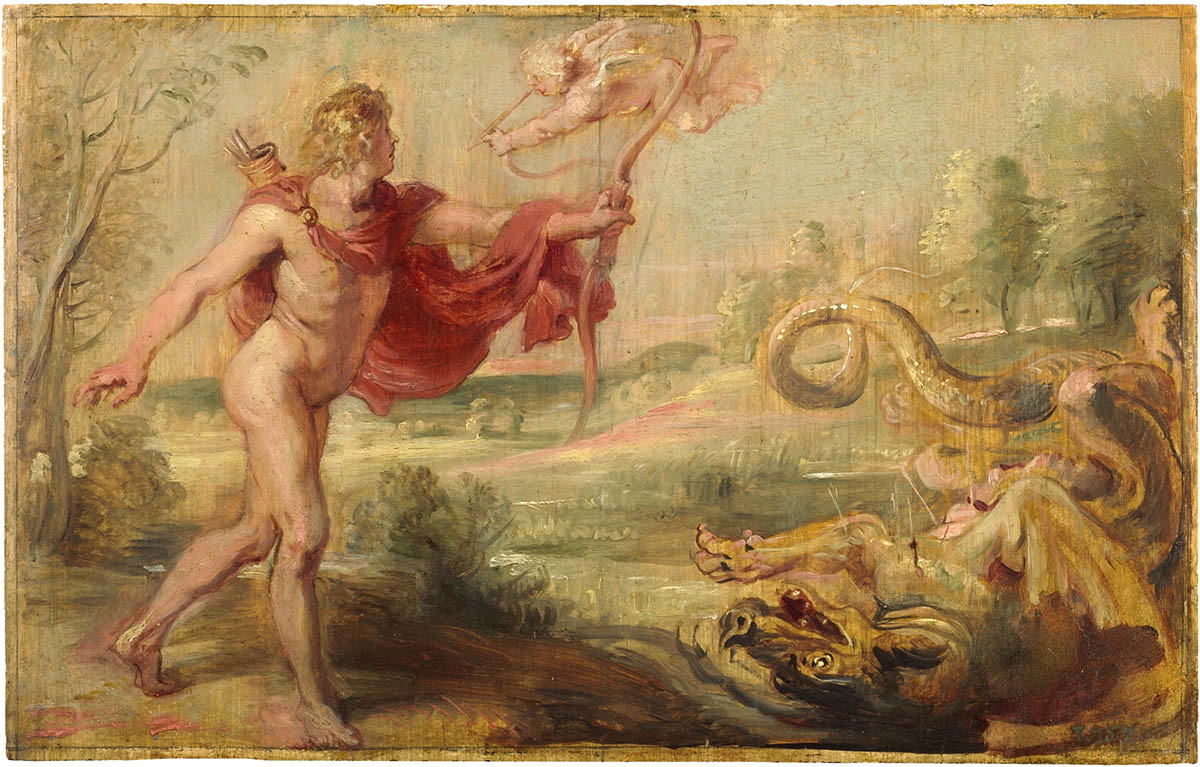
After the flood, living beings in myriad forms emerged from the heat and moisture. Among them was a great serpent called Python. The snake terrorized the people of Parnassus, the mountainous region around Delphi in ancient Greece’s interior. It was defending the Omphalos, a sacred stone marking the exact “navel of the earth,” on behalf of the earth goddess Gaia who presided at Delphi. Unable to defend themselves against it, Apollo, god of sunlight, decided to intervene. He assailed the monstrous beast with 1,000 arrows, penetrating its armored skin. Hissing and writhing, it collapsed and died in a pool of its own black venom.
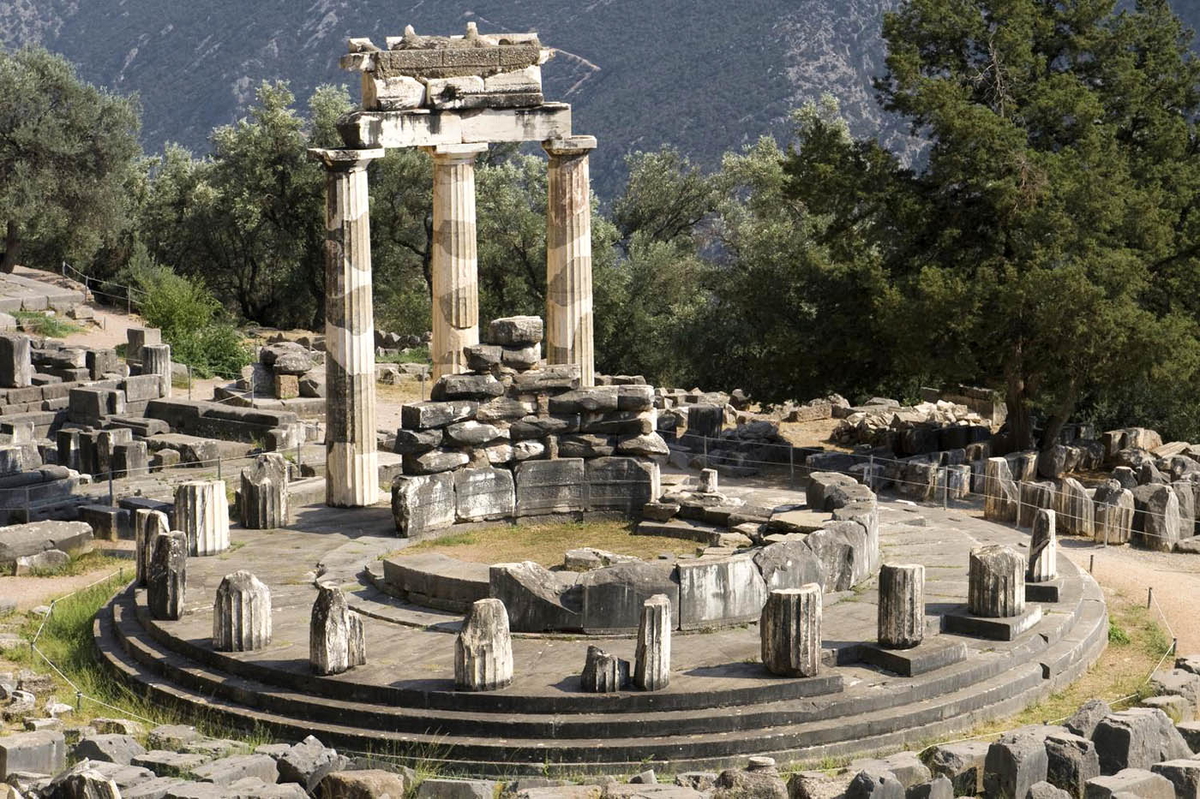
To commemorate the occasion, Apollo established the tradition of the Pythian Games. They became the second most important of the Panhellenic games, only after the Olympics, and took place biennially until the 4th century AD.
According to Greek Mythology, the dead python was placed under the Temple of Delphi, the heart of ancient Greek religion. Its rotting corpse was the source of fumes and smoke that would rise from floor grates in the oracle’s chamber. There, the Pythia priestess inhaled the fumes to enter the trance necessary for the prophecies pronounced at the Oracle of Delphi.
Slaying a child of Gaia was a severe offense that triggered spiritual pollution, known as miasma. To make amends, Zeus forced Apollo into eight years of exile as a humble shepherd for King Admetus to cleanse his blood-guilt before he could claim Delphi.
2. Daphne Turns to Wood to Escape Apollo
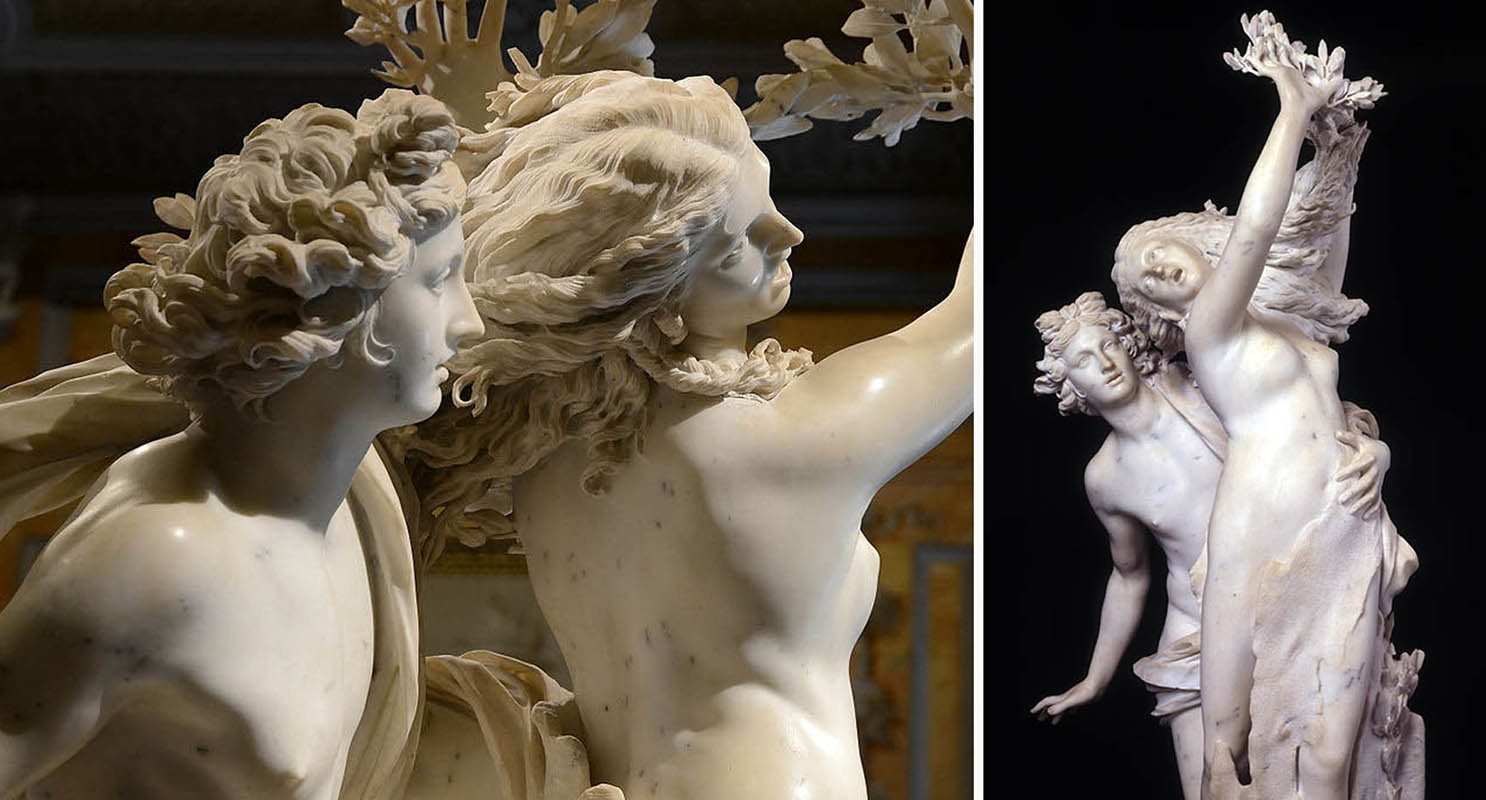
Eros, better known by his Roman name Cupid, appeared in the vicinity of Parnassus shortly after Apollo’s victory over Python. The child god, son of Ares and Aphrodite, was offended when Apollo, his ego inflated from killing Python, ridiculed Eros’ archery skills, asking what a kid was doing with weapons fit for real men. The god harnessed his infamous bow and arrow made of gold and embedded it in the sun god’s chest.
Then he spotted a beautiful water nymph called Daphne, daughter of the River Peneus. He took aim and implanted an arrow of lead into her breasts. The golden arrow overwhelmed Apollo with a sudden amorousness. He spotted Daphne and became smitten.
But Daphne’s lead arrow had the opposite effect. She was repulsed by Apollo and fled to evade him. Running as fast as she could with Apollo trailing behind her, she called out to her father and asked him to change her form into something less desirable.
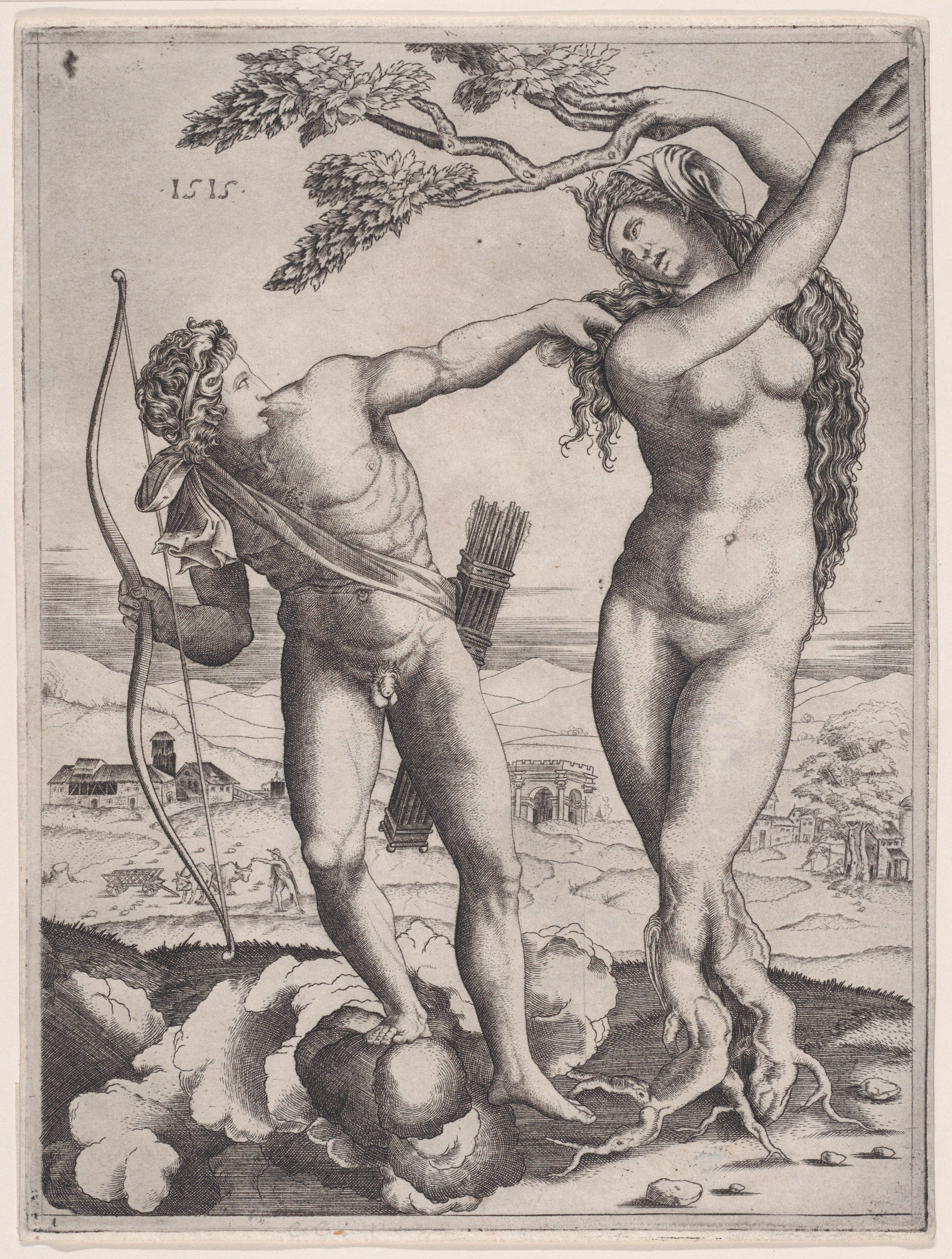
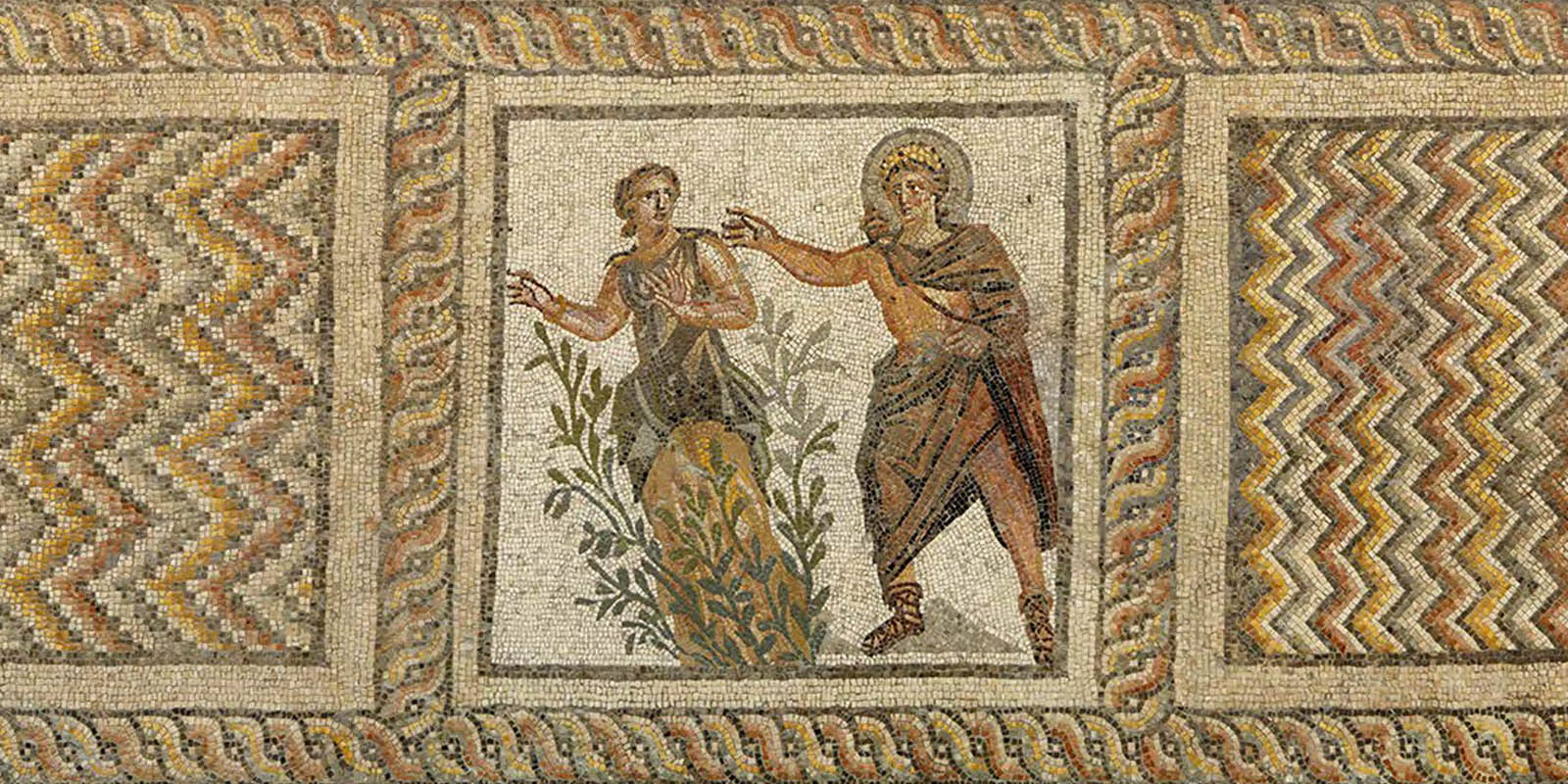
Her wish was granted, and Daphne’s skin was turned to bark. Her arms morphed into branches, and her luscious hair became a bushel of leaves. Suddenly rooted in place, the lovely Daphne was now a laurel tree.
But her dramatic transformation was for nothing because it did not stop Apollo from loving her. He caressed her bark and crowned himself with a string of laurels from her branches. He promised that all the future emperors of Rome would do the same (clearly a detail added to the original myth by Ovid).
Seleucus, one of Alexander the Great’s diadochi, claimed that the events of this fable actually occurred near Antioch and not Parnassus. Right outside of his capital city, he built a sanctuary dedicated to Apollo and called it Daphne. Its groves of fragrant blossoms and sensuous pleasures became famous as a refuge for lovers. “If Antioch has been compared to Paris, Daphne may be called its Versailles,” wrote one English classicist, William Smith.
3. Phaëthon Burns the Earth in the Sun Chariot
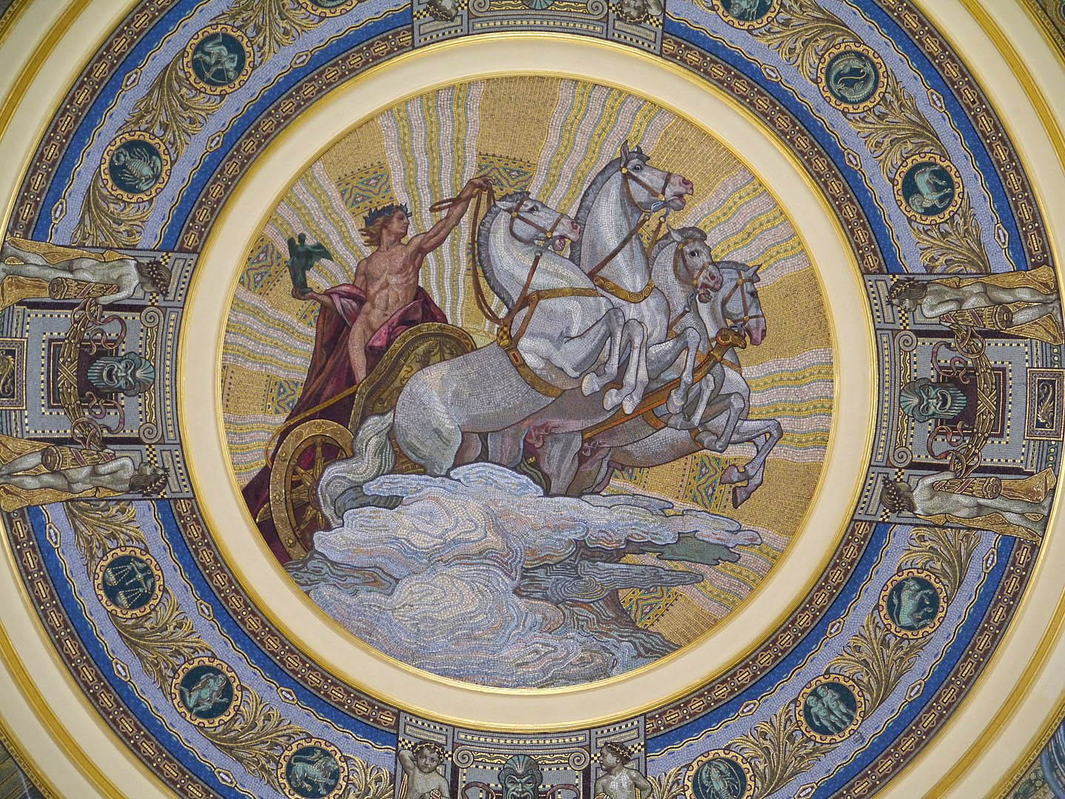
In Greek Mythology, Phaëthon is told by his mother, Clymene, an Oceanid, that his father is the sun god Helios. Still having doubts, the boy decides to visit the sun’s palace for confirmation.
Helios warmly welcomes Phaëthon and confirms that he is, in fact, the boy’s father. But this wasn’t enough for him: Phaëthon requested to test-ride his father’s chariot as a gift, the same chariot that Helios would ride into the sky every morning at dawn to fill the world with light for the day.
Helios acquiesced to his son’s demands, but immediately regretted doing so. He remembered how difficult it was to maneuver the chariot and begged Phaëthon to reconsider.
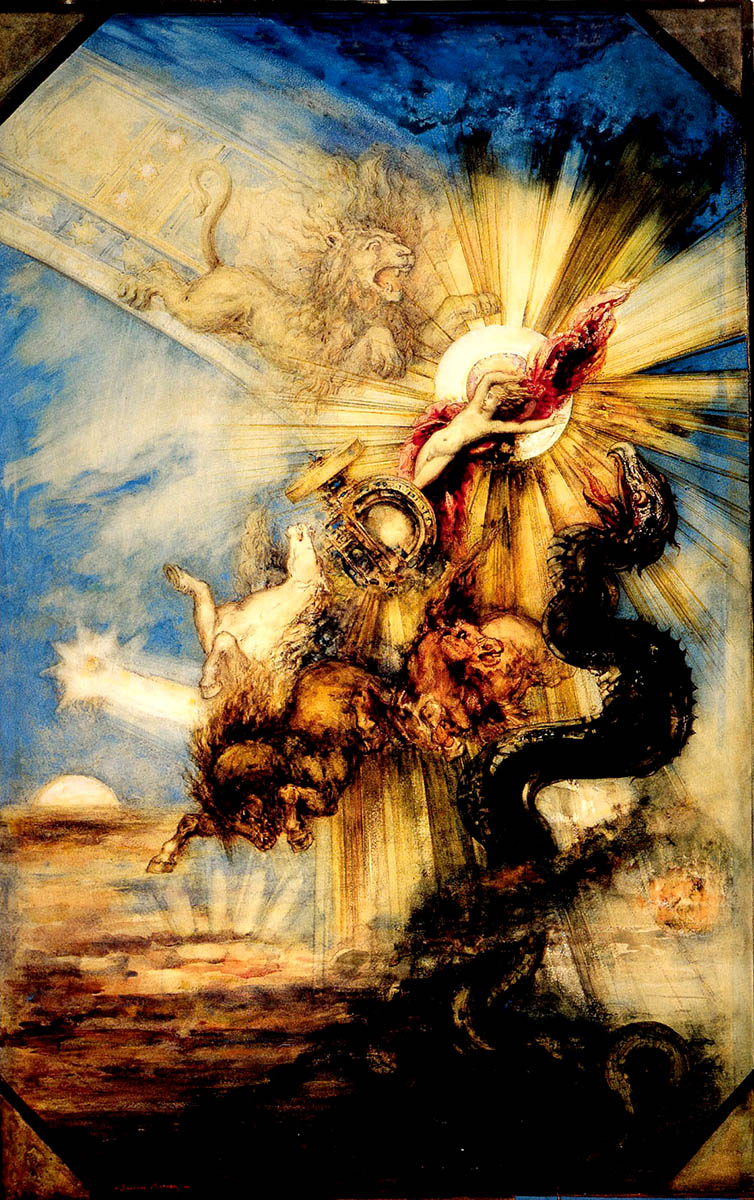
But the boy was headstrong, and Helios had sworn by the Stygian marsh to never break an oath. For if an oath made by the sacred convergence of the River Styx were broken, the oath breaker would face something worse than death.
So Phaëthon mounted his father’s chariot forged of gold and silver by Hephaestus, the god of fire and forge. And at the hour of dawn, he cracked the reins of its four horses.
Sadly, it was over before it began. The horses were ungovernable. Fiery, Dawnsteed, Scorcher, and Blaze took off in different directions, dragging Phaëthon and the sun on a rollercoaster ride across the sky.
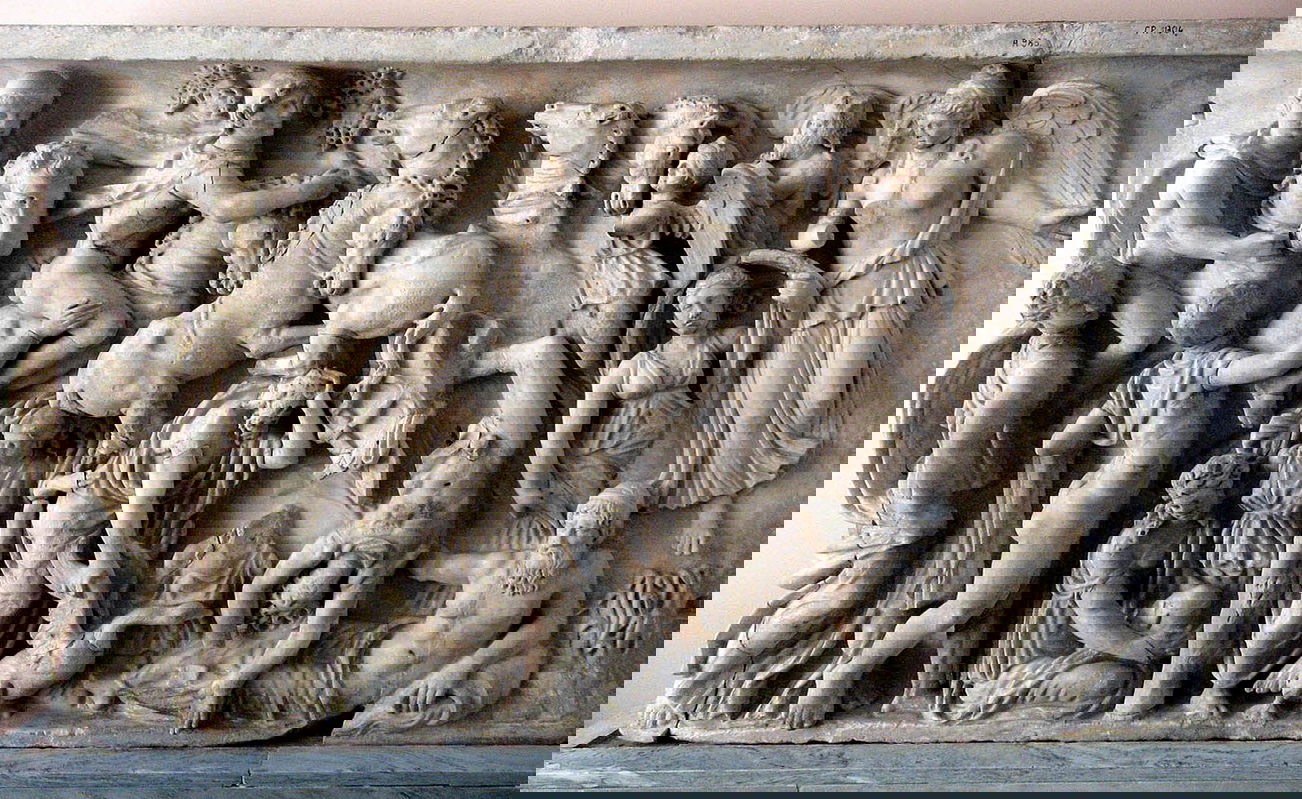
The world below was set ablaze in an epic conflagration. And it became so intense that Gaia, the earth mother, called on Zeus to intervene. The king of the gods wielded a thunderbolt and hurled it into Phaëthon, striking him down from the chariot. The boy fell from the sky and landed in the Eridanos River, thought to be somewhere in Central Europe in ancient times.
Mourning his son’s death, Helios went into an eclipse; the whole world was cast in darkness. Phaëthon’s sisters wept for months until one day, in their sorrow, they transformed into trees, and their tears turned to sap.
Helios was livid with Zeus and announced that he’d no longer drive the chariot of the sun. But at a council of the gods, he was coerced into reconsidering. And so the sun finally came out of the eclipse, and it continues to rise each morning.
4. Callisto Suffers Hera’s Vengeance as a Bear
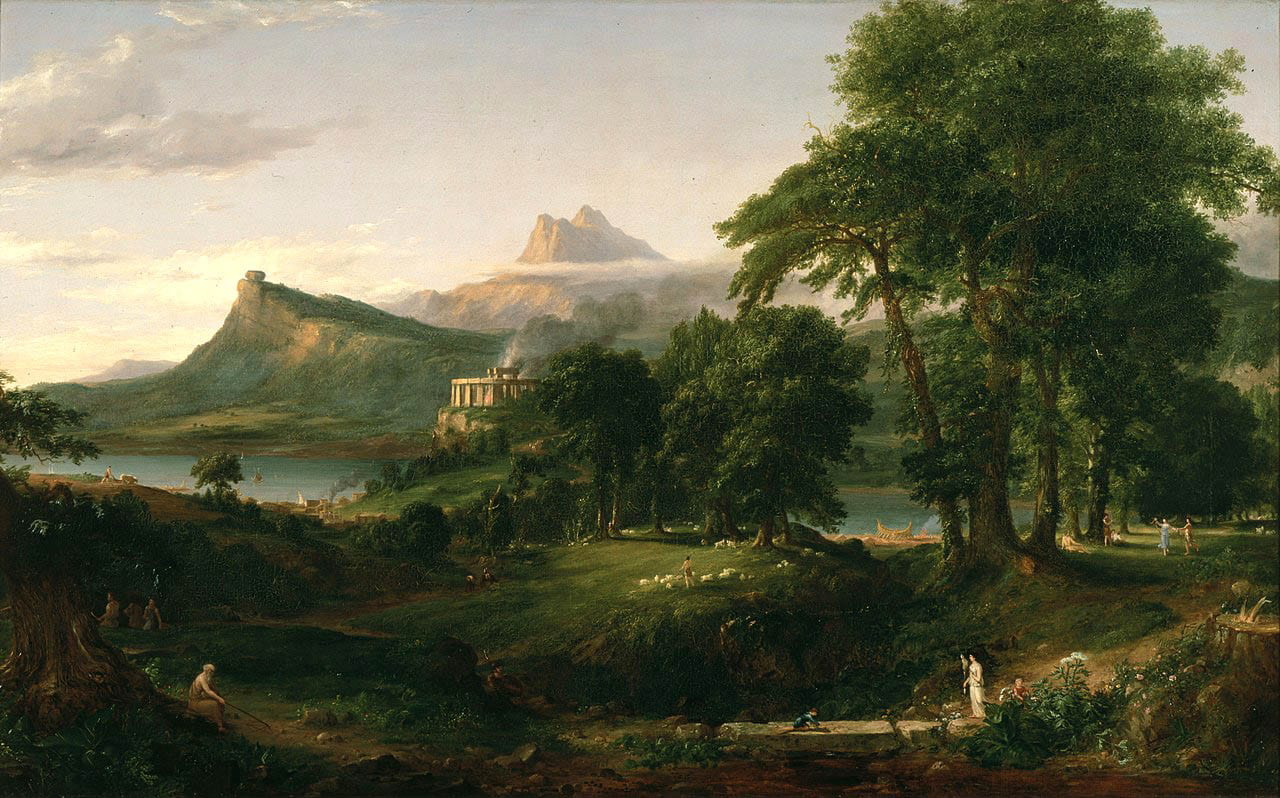
According to another fable, there was once a beautiful Arcadian virgin named Callisto. She was the favorite disciple of Artemis, the chaste goddess of the moon, and together with other virginal maidens, they formed a contingent of huntresses.
Zeus happened to spot her alone in the woods while he was in one of his philandering moods. So he descended disguised in the form of Artemis. In this way, he tricked the unsuspecting Callisto into kissing him and then proceeded to rape her.
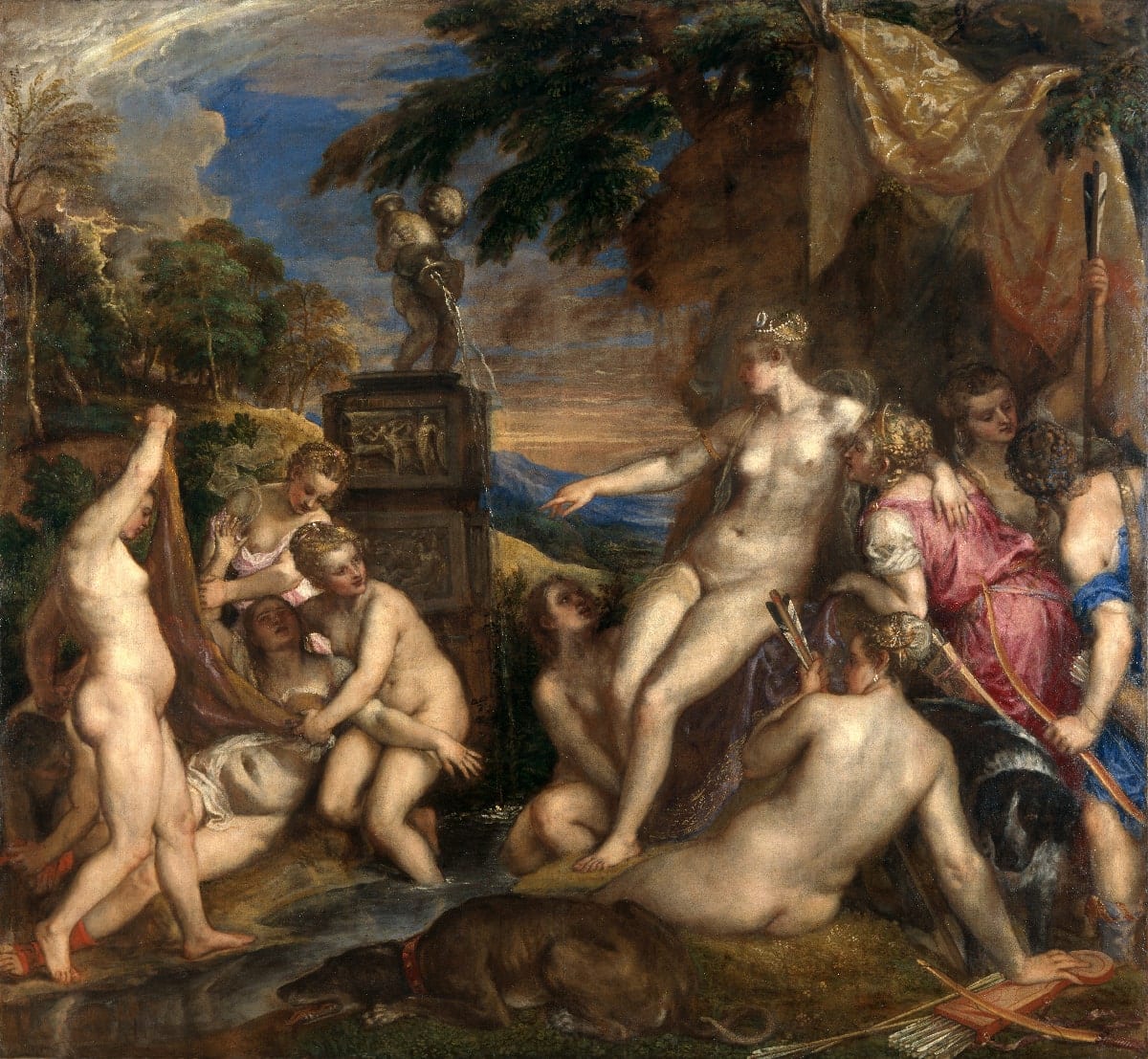
When the real Artemis and her virgin huntresses discovered that Callisto had become pregnant, they disowned her from their community. To add insult to injury, Zeus’s wife Hera decided to take revenge on her for Zeus’s actions.
After Callisto gave birth to her son, Arcas, Hera turned her into a bear and cursed her to roam the forests of Arcadia in that form while retaining her human thoughts and emotions.

Fifteen years passed, and Arcas, now an adolescent, was hunting in the woods when he came upon a bear. Callisto could recognize her son, even though she hadn’t seen him since his birth. But, of course, he couldn’t recognize his mother.
Moments from piercing her with the sharp of his javelin, Zeus decided to intervene. Feeling some remorse for his actions, he couldn’t let his son kill the mother of his child.
So in a flash, he turned Arcas into a bear, and transported both him and Callisto into the heavens. He installed them as constellations in the night sky, Ursa Major and Ursa Minor, where they would be admired by humans for all time.
5. Narcissus Dies Loving His Own Reflection
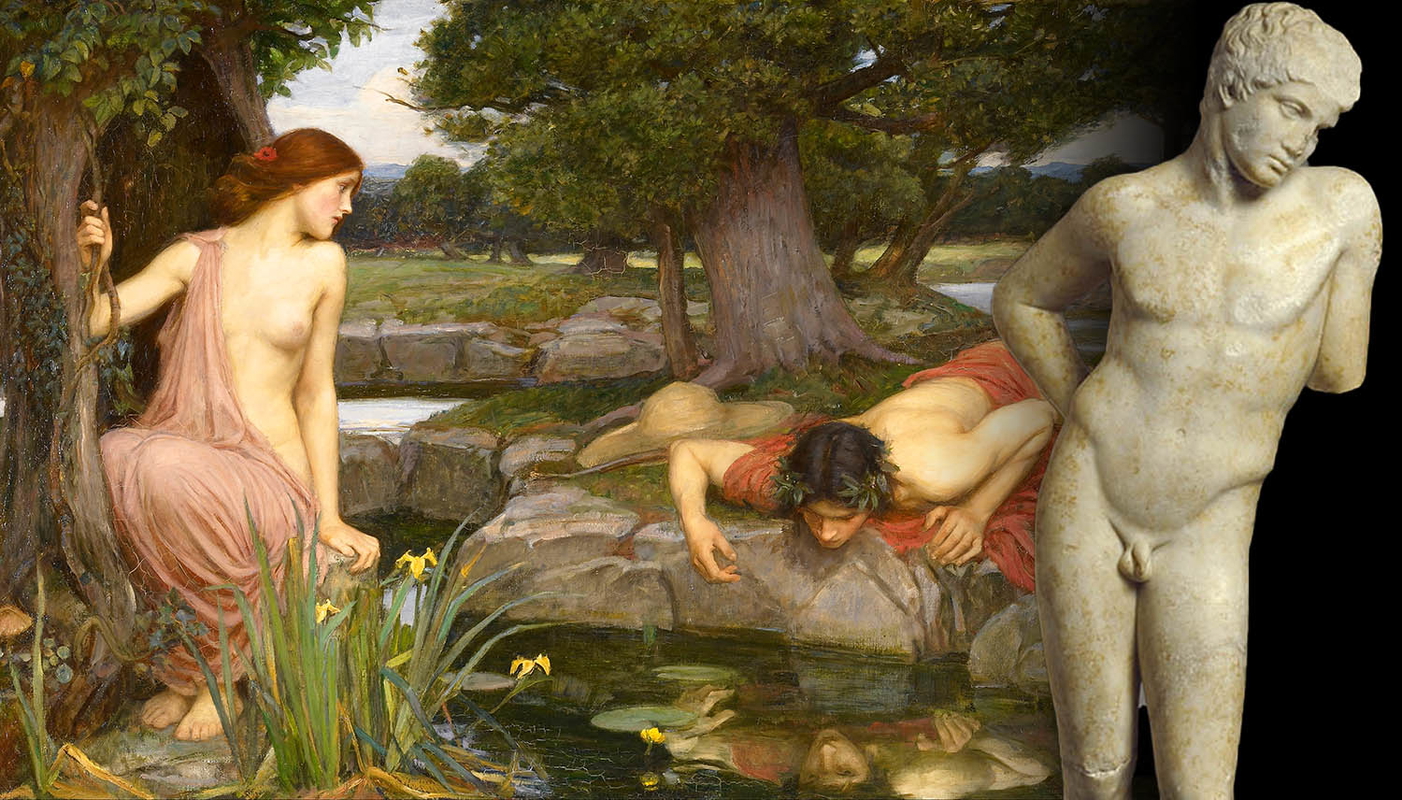
This last fable is one of the most well-known in Greek mythology. It takes us to Boeotia, an inland region of ancient Greece that lies just northwest of Attica.
Narcissus, an extremely attractive adolescent, is the son of Cephisus, a river god, and Liriope, a water nymph. When he was a baby, an oracle advised Liriope that he would live to a ripe old age “so long as he never knows himself.”
So for sixteen years, blissfully ignorant of his beauty, he evaded the desires of his admirers. Then he was discovered by Echo, a nymph who was cursed to only repeat the last few words of others and never speak for herself.
She lusted after the boy and covertly followed him on one of his hunts in the forest. He could feel her presence and called out, “Is anyone there?”
“One there?” She replied. Narcissus was startled. “We must come together!” he called out to his hidden companion.
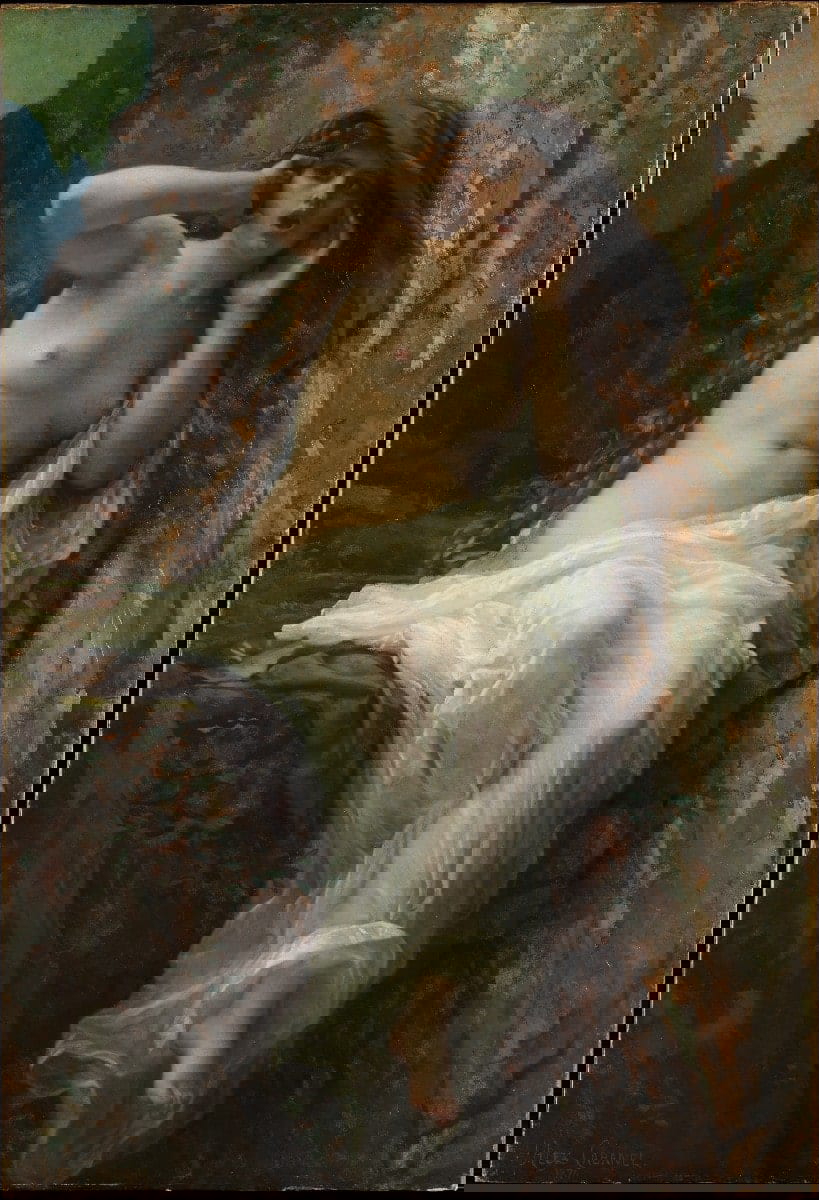
So Echo jumped at him from her hiding place and frightened him into a rage. Narcissus cursed the wretched nymph, and she fled in embarrassment. She went to hide in gloomy caves where she still resides in her shame.
Her skin melted away until she was left with just bones and voice. Then her bones disintegrated, and she became only voice and stone.
Narcissus went on like this, mocking those who tried to love him. Until one day a nymph invoked the gods to curse the boy for his mean-spiritedness. That day he came upon a silvery pool and fell in love with what reflected back at him.
“Stretched on the grass, he saw twin stars, his own two eyes, rippling curls like the locks of a god, Apollo or Bacchus, cheeks as smooth as silk, an ivory neck and a glorious face with a mixture of blushing red and creamy whiteness.”
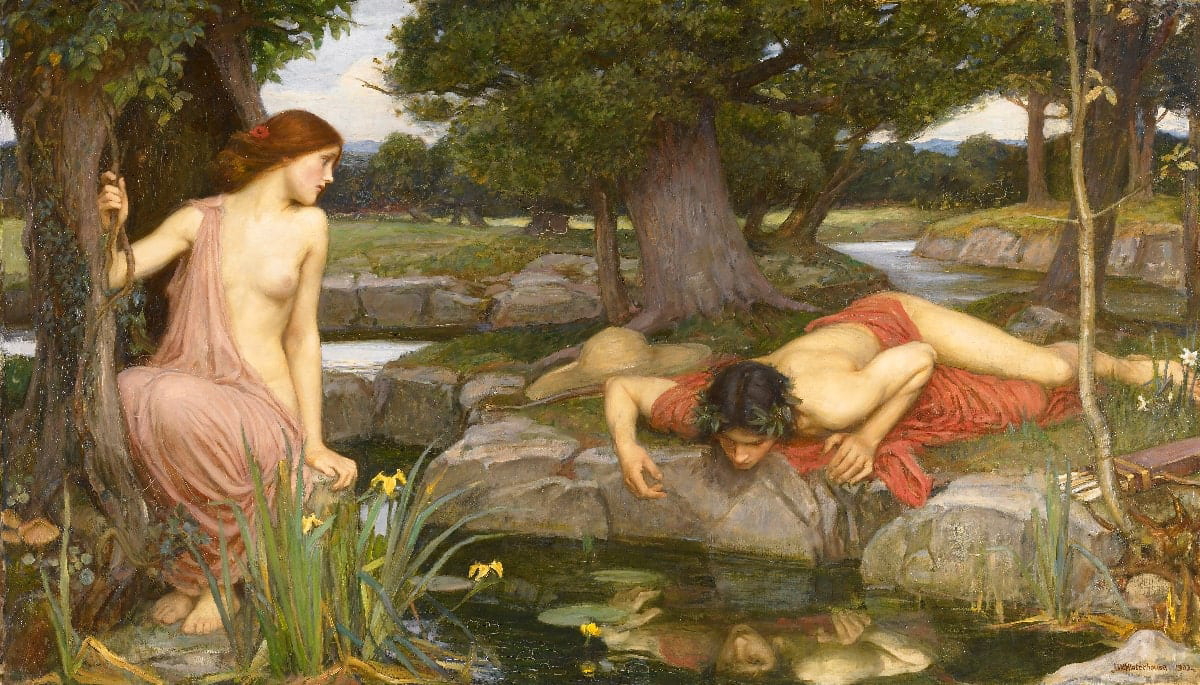
He tried to kiss his reflection, but the water would ripple and distort the figure on the other side. He called out to the trees and the gods, screaming in agony about his heartache. The tears rolling off his face obscured the boy on the other side.
Narcissus’s pain became too unbearable. He rested his head on the grass near the pool and died. His corpse was burned in Hades, and from its ashes sprang a singular flower with a golden trumpet and pale white petals.