Family honor and continuity were incredibly important to the Roman elite, who believed they could trace their lineage back to the foundation of Rome itself. They also believed that prestige and power was held in the family name. It became even more important under the Roman Empire, when smooth succession was essential to the peace and prosperity of the Roman state. High mortality rates and the unpredictability of life in a militaristic nation meant that producing a biological heir was far from certain. From early in their history, the Romans turned to adoption to fill the gap. But rather than adopt children, Romans adopted grown men of proven experience. This became the backbone of the Roman Empire during the Golden Age of the 2nd century AD.
The Roman Family as a Legal Corporation
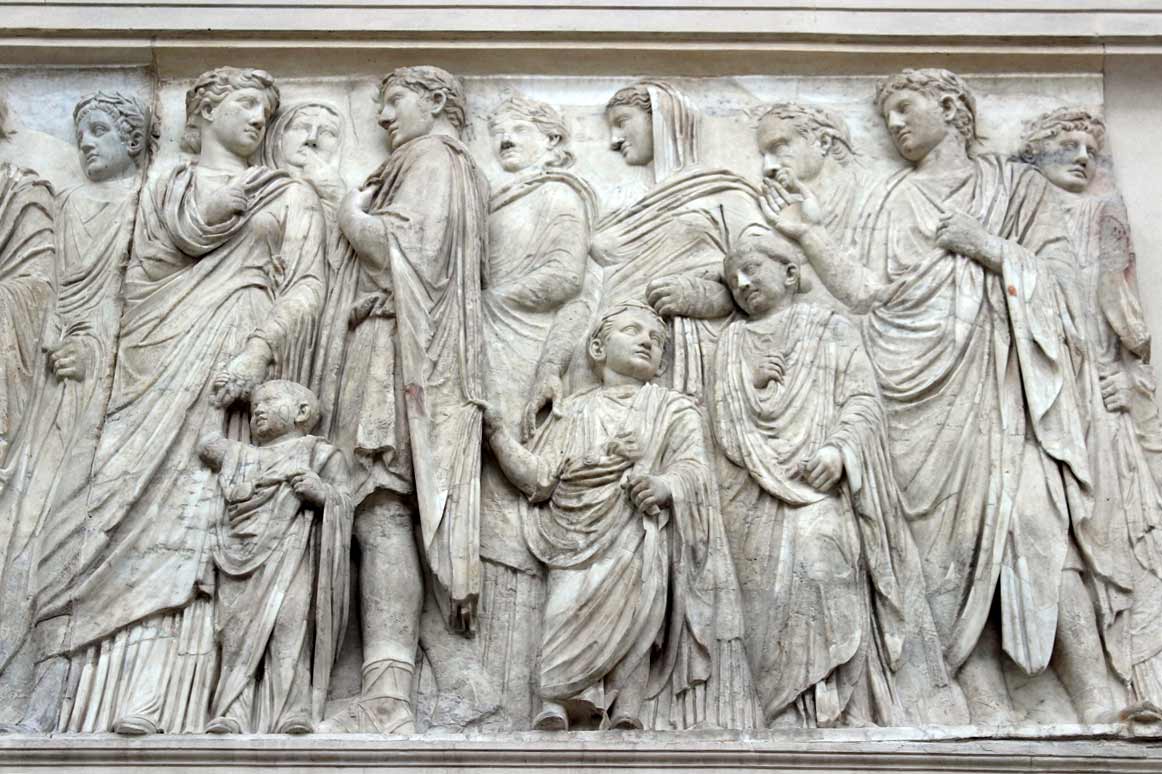
On the surface, the Roman family structure seems like a typical patriarchal hierarchy. But the power of the paterfamilias of the family was much more extensive. In the Institutes of Gaius, Roman laws about the father’s authority, marriage, and adoption are described. The eldest male in the family was the paterfamilias and had legal authority, patria potestas, over all those within his household. This included all his descendants, plus slaves and freedmen.
Unless emancipated, while an adult man’s father was alive, his father still had legal authority over him. He could not own property of his own, and could be forced to marry and divorce at will. For example, the paterfamilias Augustus forced his adopted son Tiberius to divorce his beloved wife, Vipsania, and marry Julia the Elder.
Once the paterfamilias died, his children became legally independent and, unless otherwise stated in a will, would equally share in the inheritance. By the late Republic, wills had become fashionable.
A paterfamilias could pass over their natural heirs by expressly disinheriting them in their will. While they could, in theory, name anyone as their heir, the general feeling in Roman society was that natural children should only be excluded with serious justification.
If a man lacked an heir, he could adopt one. It was not uncommon for Romans to adopt adult males as their heirs, allowing them to maintain a line of succession with a proven candidate. Often, when seeking an heir, a paterfamilias would adopt a family member, such as a nephew or son-in-law.
Adoption for Continuity
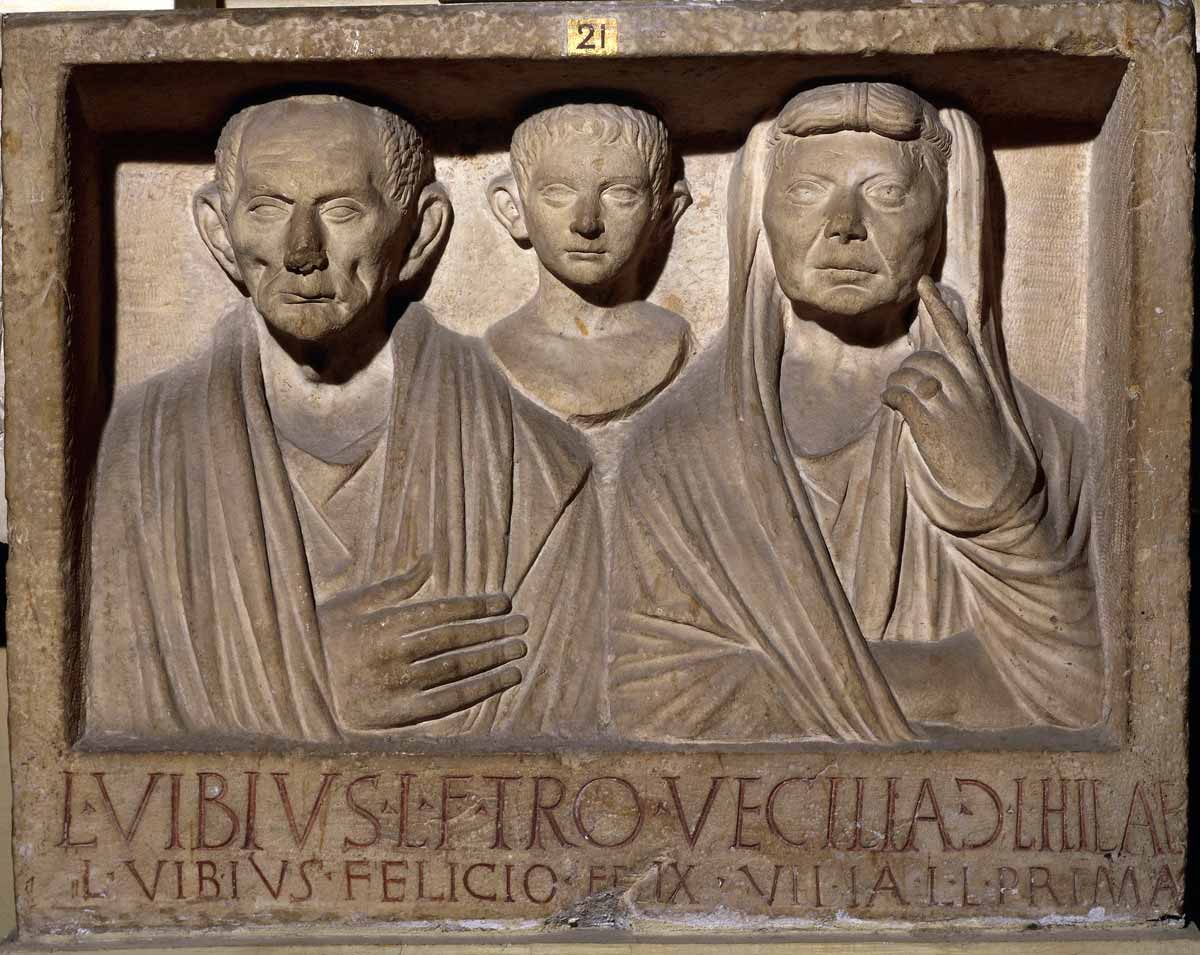
Adoption in Roman society was less about raising a child and more about ensuring the continuity of the family name. Those who were adopted were placed under the patria potestas of their new father, but were also promised a future inheritance.
There were two types of adoption: adoptio and adrogatio. The former was the adoption of someone who is currently under the patria potestas of another. The latter was the adoption of someone who is legally independent. Under the condition of adoptio, the adopted man was placed under the potestas of his new father, and this also applied to any of his own children, if he had any. In the case of adrogatio, any property owned by the adoptee would be transferred to the paterfamilias.
A man from a more prestigious family would be unlikely to accept adoption by a social inferior. It was highly controversial when, in 59 BC, the patrician Publius Clodius Pulcher was adopted by the plebeian Fonteius. This allowed him to change his class so that he could stand for Tribune of the Plebs.
In the case of children, the state had other mechanisms for ensuring the upbringing of a child, such as guardianship. An orphaned child would require guardianship, but would not be under the patria potestas of anyone else. To be adopted required the consent of the paterfamilias or of the legally independent adoptee. Since children could not provide that consent, and neither could guardians, the adoption of children was rare.
This was also the reason why Roman women were legally unable to adopt. They had no legal authority over their own children or even themselves, so they couldn’t place anyone under their own authority.
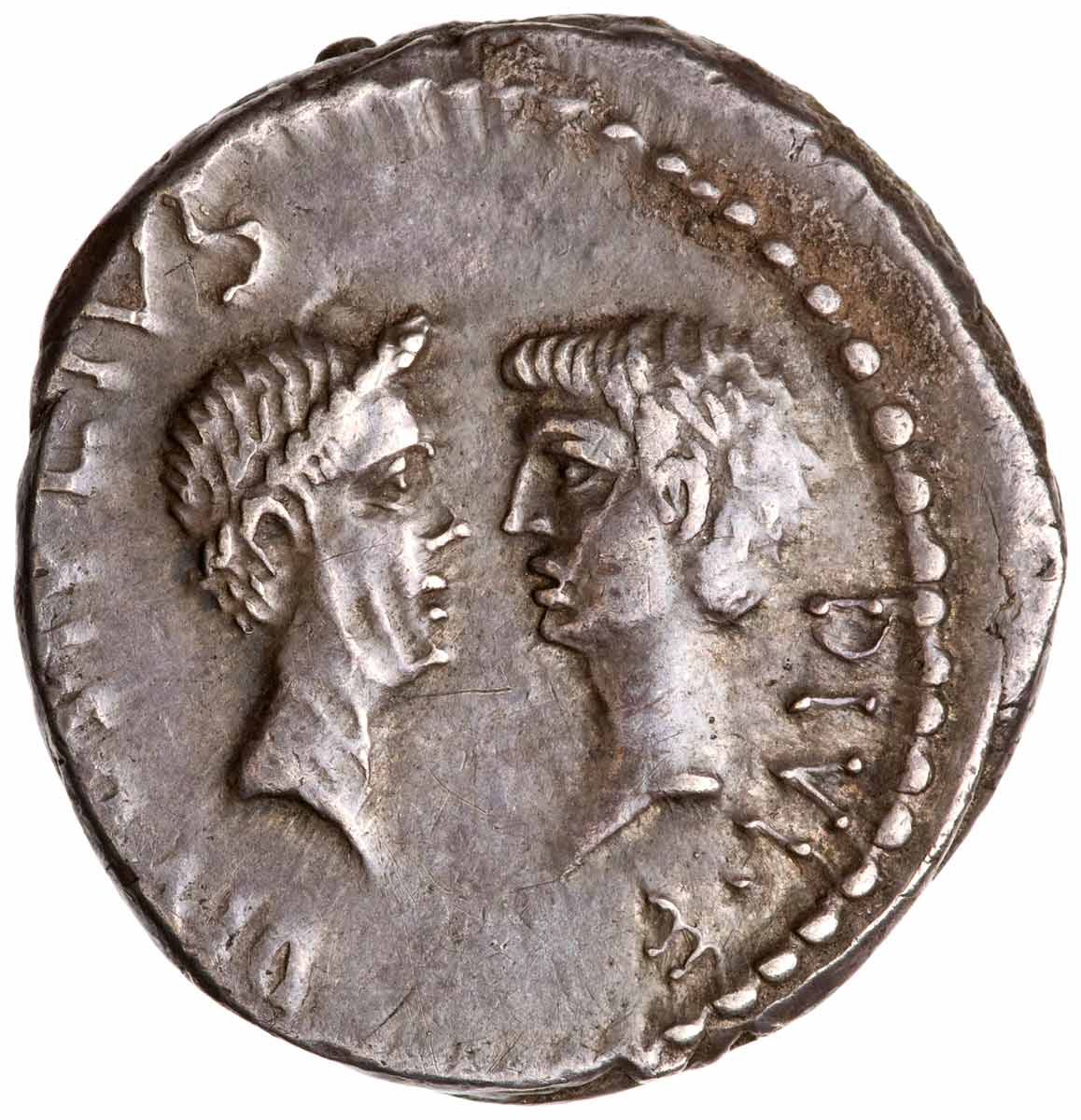
But to the prestigious man with no heir, such as Julius Caesar, adoption was essential to succession planning. In his will, he adopted his great-nephew Octavian, who became Gaius Julius Caesar Octavianus. While young, just 18-years-old at the time of his adoption, he was old enough to be a reliable heir. Caesar was also preparing him, with Caesar directing his military training and academic studies.
The Power of a Name
Roman elites placed a high degree of importance on their family name. Roman names were typically made up of three parts: the praenomen, nomen, and cognomen. The praenomen was a typical personal name given by the parents (e.g., Gaius). The nomen was the name for the gens, or clan, which we would commonly call a family name (e.g., Julius for the Julian gens). The cognomen was initially another personal name, like a nickname, but slowly came to be another hereditary name, signifying a branch of the clan (e.g., Caesar). The elite class was principally concerned with the nomen.
The nomen was a marker of lineage and social status. Those with old, prestigious names had ancestors who were consuls, senators, and governors. Some even linked their descent to the city’s founders or to gods. The Julian gens claimed to be descended from Venus through Aeneas. They were part of the history of Rome and thus had deep social networks. They were capable of mobilizing their connections for political and financial advantage.
The conflict between Mark Antony and Octavian following Caesar’s death was marked by Octavian’s attempts to claim his inheritance. Being part of the Julian gens gave him a stronger claim to Caesar’s legacy than Antony, who was “merely” one of Caesar’s allies and generals. Octavian was able to mobilize Caesar allies and veterans, and claim Caesar’s vast wealth.
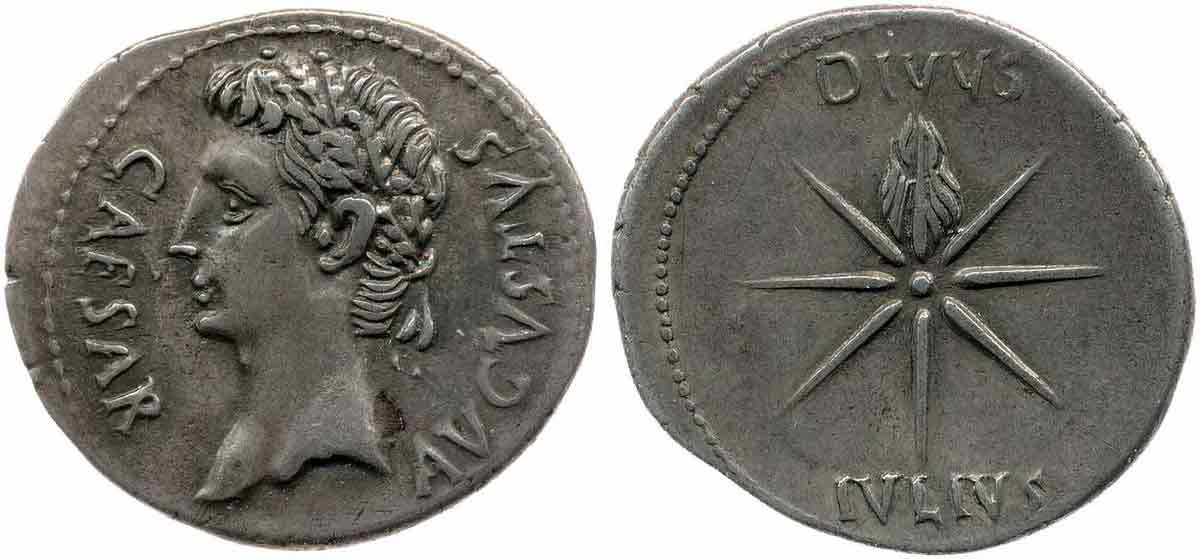
While rejected by Octavian due to its insinuation of his lower-status family of birth, his name Octavianus was an agnomen, or nickname, used by his political enemies. Romans also used honorific agnomen, such as Africanus, celebrating Publius Cornelius Scipio’s military successes in Africa. Following Julius Caesar’s was deification in 42 BC, Octavian adopted the title “divi filius” or “son of a god.”
Dynastic Problems
Family planning, especially for the elite class for which the transfer of property and wealth was of vital importance, was very difficult in the ancient world. Infant mortality was incredibly high, and there was no guarantee that a man would have a biological heir.
For the upper classes, marriage was also a political proposition, meant to foster alliances, and not necessarily to produce offspring. While the possibility of biological heirs was always a consideration, Rome’s system of adoption made it secondary to the alliance itself. Marriages were also often dissolved when better political opportunities presented themselves.
For the imperial family, the issue of inheritance was compounded by their unprecedented position at the center of the Roman state. Their power was embedded within the Roman “constitution” through recognizable magistracies and offices that were not hereditary. Yet the importance of family lines in Rome meant that power and influence were inherited. Therefore, they needed to devise a method of making those powers inheritable within the Roman system, passing control to an established figure who could inspire the confidence of the Senate, army, and people.
Succession was an issue that Augustus grappled with for much of his reign, and plagued the Roman Empire for centuries. Unclear succession left open the possibility of a challenge for power, which could plunge the Empire into civil war.
Adoption and the Foundation of Empire
Octavian, who later adopted the agnomen Augustus, became the first emperor of Rome. The Roman Republic ended when Julius Caesar, relying on his wealth and personal army raised from a decade of campaigning in Gaul, marched on Italy to secure his political interests. He became the overwhelming, sole power in Rome, as reflected in the Senate awarding him the title dictator for life.
While a lack of acceptance of this position among the Roman elite led to Caesar’s assassination, his power in Rome was real. He passed on the core of that power to his grand-nephew Octavian when he adopted him in his will. This gave Octavian the basis on which he would build the principate over the next 50 years.
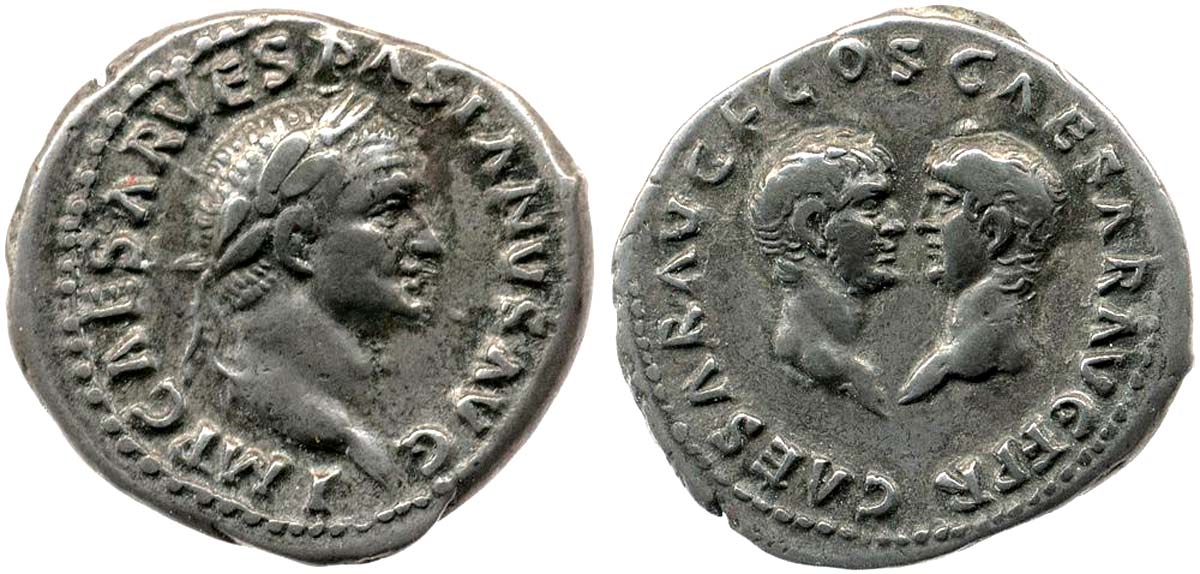
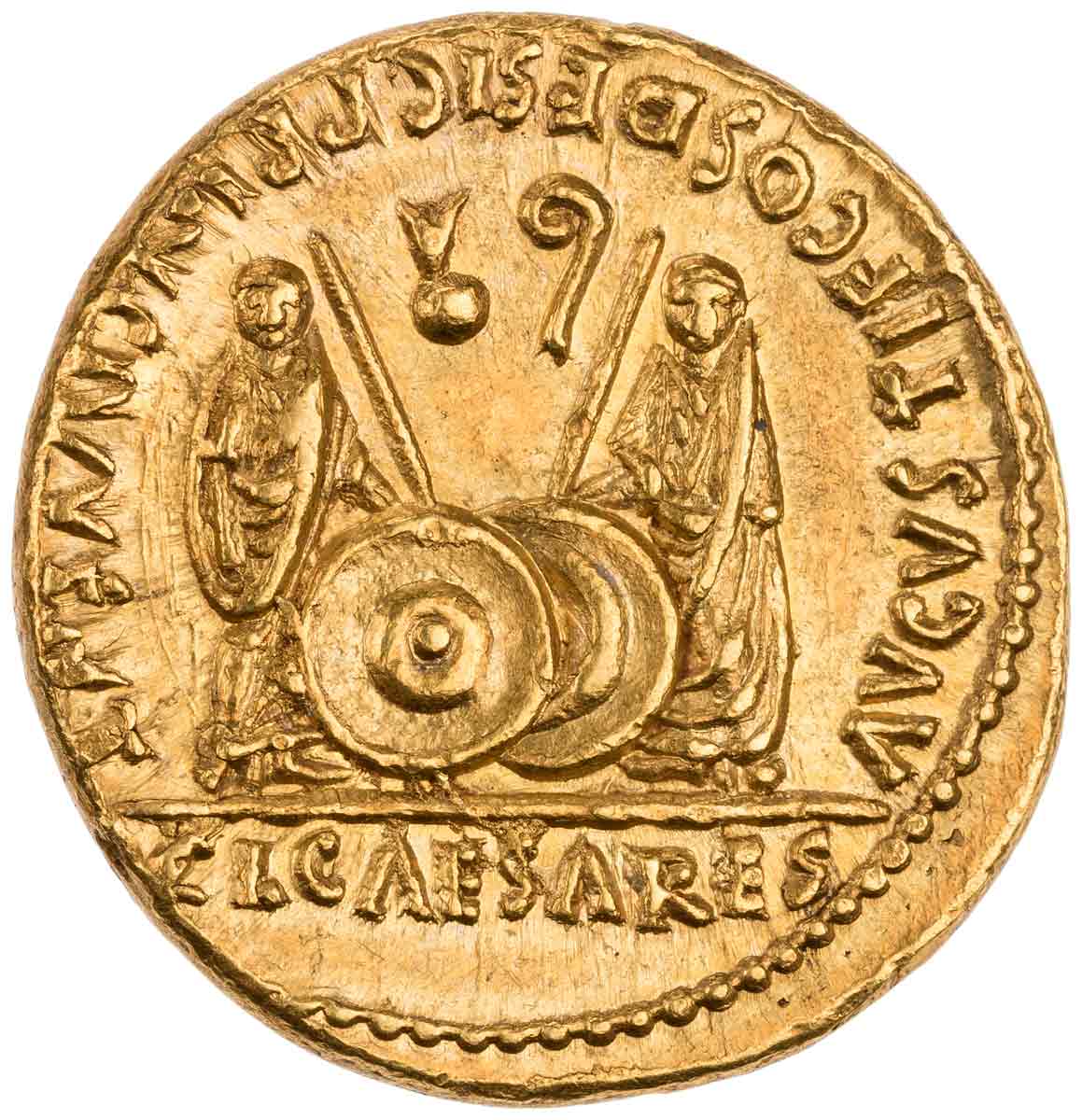
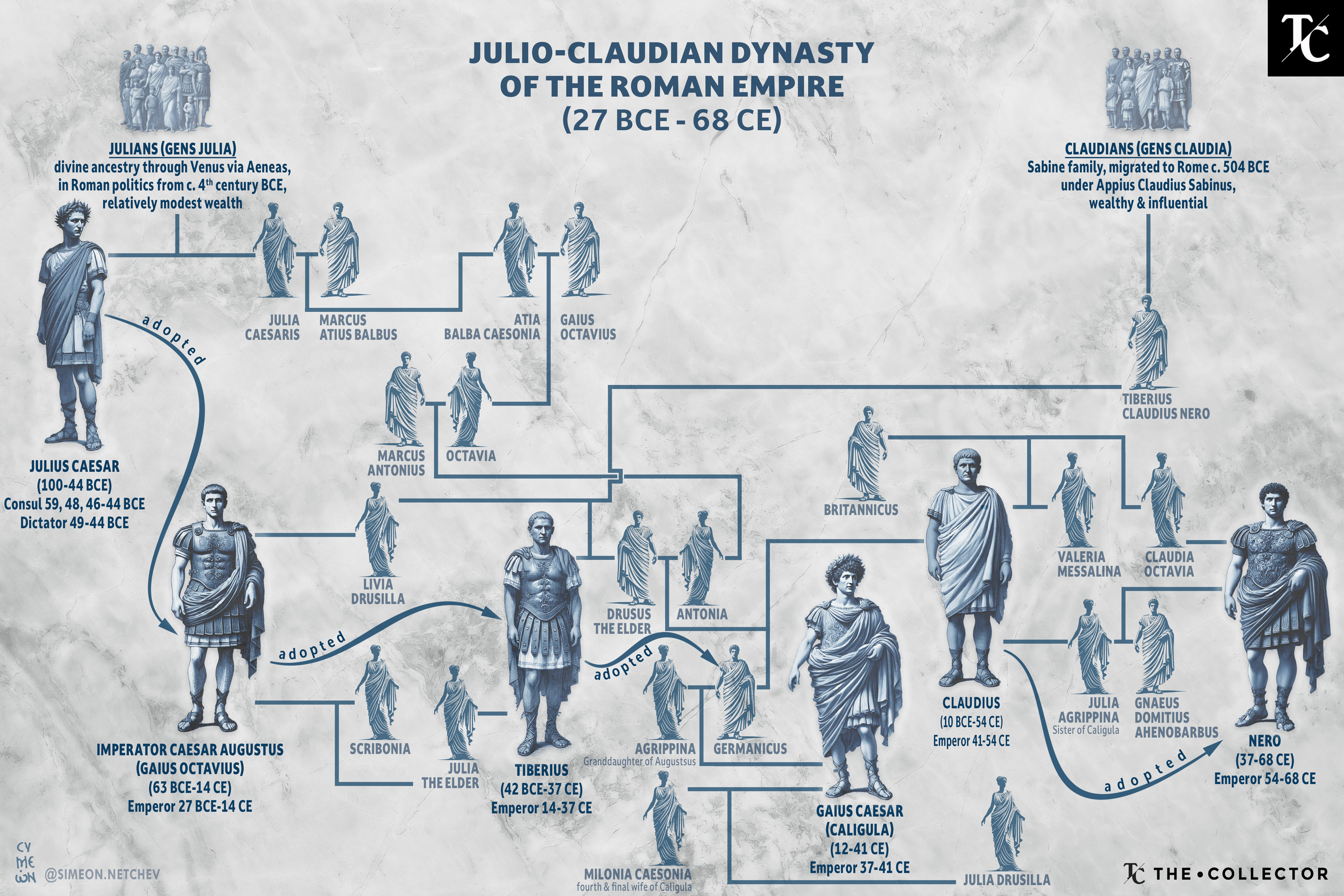
Augustus had his own succession problems. He married three times, but he only had one biological child, a daughter, Julia, with his second wife, Scribonia. He spent much of his life in search of an heir. First he chose his nephew Marcellus, but he died of illness in 23 BC. Next he looked to his friend Agrippa, whom he married to his daughter Julia, but he died in 12 BC. Augsutus adopted Julia and Agrippa’s sons, his biological grandsons, Gaius and Lucius Caesar, but they died in AD 4 and AD 2 respectively. Eventually he settled on his stepson via his third wife Livia, Tiberius, who succeeded as emperor as the “last man standing.”
Augustus’ heirs faced similar issues. No Julio-Claudian was succeeded by their biological son, but rather close surviving family members. The last Julio-Claudian emperor, Nero, was a greatgrandson of Augustus through his mother Agrippina, and adopted by his stepfather, the emperor Claudius. Nero died with no heir, the Empire was plunged into civil war.
When Vespasian emerged as the victor, his Flavian dynasty was unique in that he was succeeded by his biological son Titus, who died without a son but was succeeded by his biological brother Domitian, who took on his mantle as paterfamilias of the imperial household.
A Century of Peace: The Five Good Emperors
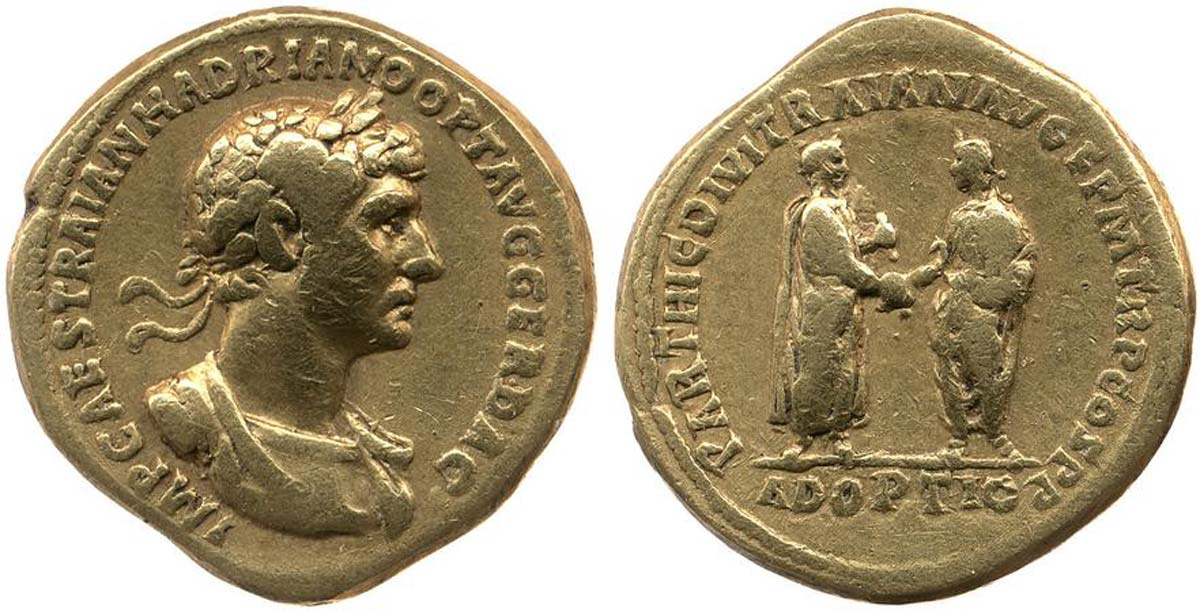
Following the death of Domitian in AD 96, the Empire enjoyed almost a century of prosperity overseen by five emperors who have come to be known as the Five Good Emperors. They were Nerva, Trajan, Hadrian, Antoninus Pius, and Marcus Aurelius. It was from this era that the modern idea of the meritocracy of Roman imperial adoption originated.
Nerva was chosen by the Senate to succeed Domitian following his assassination to avoid the civil war that followed Nero’s death. Nerva was considered to be a safe choice because of his age and his lack of children. Nerva only reigned for two years, but managed to stabilize power. He also faced a succession crisis, as he had to choose an heir who would be acceptable to the Senate, army, and people. He chose Trajan.
Trajan expanded the Empire with his conquest of Dacia, and he instituted a building program that promoted stability and prosperity. He cultivated cooperation with the Senate and also expanded the state-sponsored food support for children. Trajan was also childless and did not publicly designate an heir during his lifetime. After he died, Trajan’s nephew, Hadrian, was hailed by the Syrian army as the new emperor. He legitimized his position by claiming that Trajan adopted him on his deathbed, with the help of Trajan’s wife, Plotina.
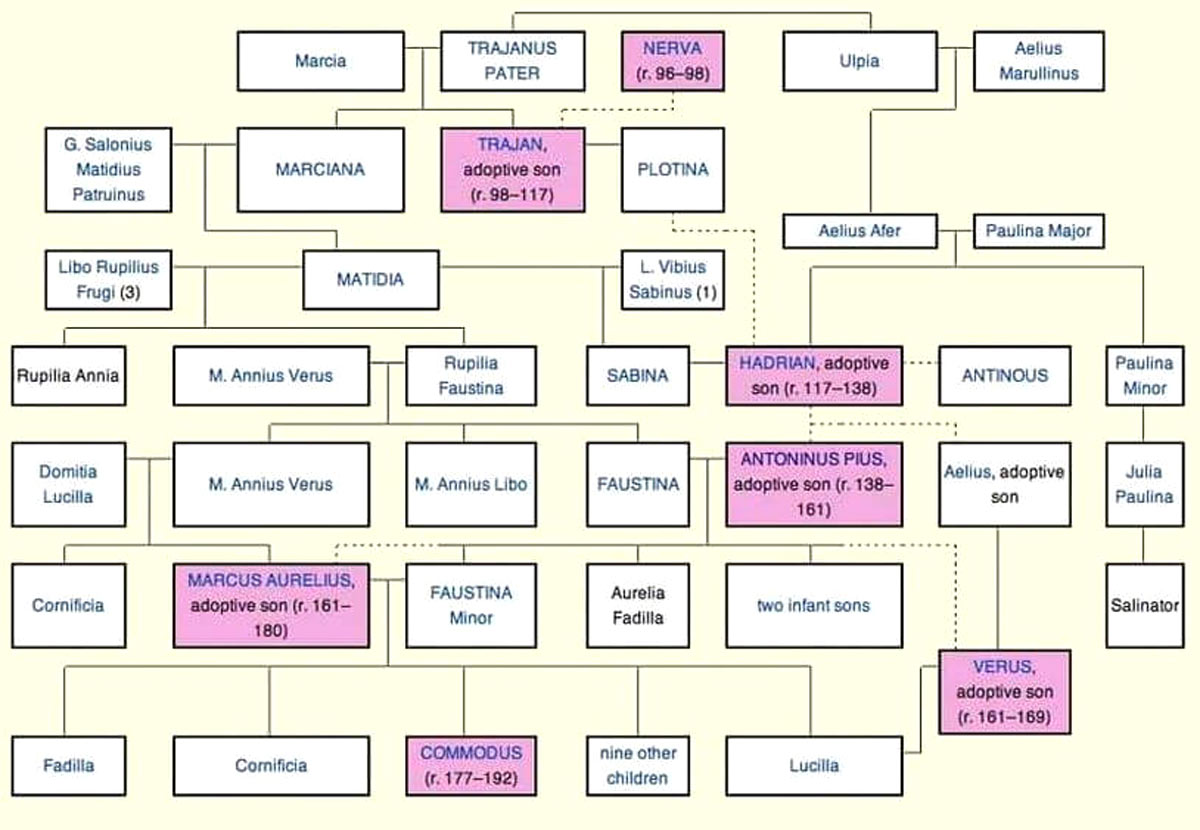
Hadrian consolidated the frontiers of the Empire, giving up some newly acquired territory in the East and building Hadrian’s Wall in Britain. He was also a noted philhellene, promoting Greek culture and arts. Like his predecessors, Hadrian was childless. He adopted Antoninus Pius as his heir, on the condition that Antoninus adopt Marcus Aurelius and Lucius Verus to further secure the line of succession. They were just 16 and seven years old respectively when they were adopted in AD 138.
Antoninus Pius is often seen as having presided over the highest point in Roman history, thanks to the stability created by his predecessors. He standardized legal practices and was a good steward of the imperial treasury. When he died after 23 years as emperor, power easily transferred to the now-adult Marcus Aurelius and Lucius Verus, who ruled as co-emperors. The pair worked in tandem to maintain stability within the empire and deal with frontier crises, until Verus died in AD 169, leaving Marcus Aurelius as sole emperor.
When reflecting on the prosperity of this period, many point to the fact that the Antonine emperors adopted their heirs, choosing the “best man” for the job rather than trusting in biology. This perhaps overstates the case, as the Antonines were all close family members, not unlike the Julio-Claudians. The emperors preferred to adopt adult men with proven experience, just as the elite had done for centuries. But they also prioritized close allies, connected through blood and marriage, and adopted children on occasion.
Biology vs. Merit: Commodus
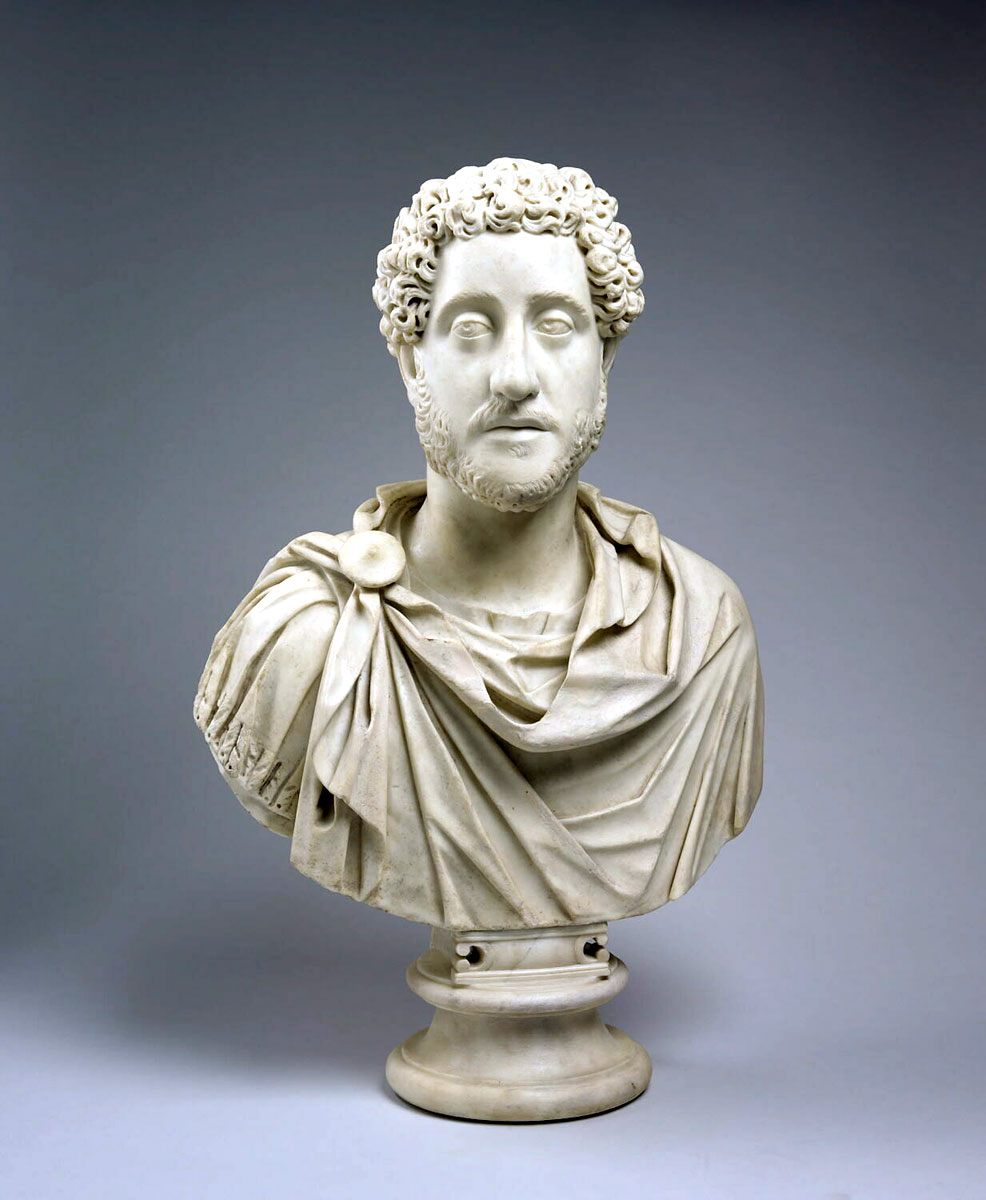
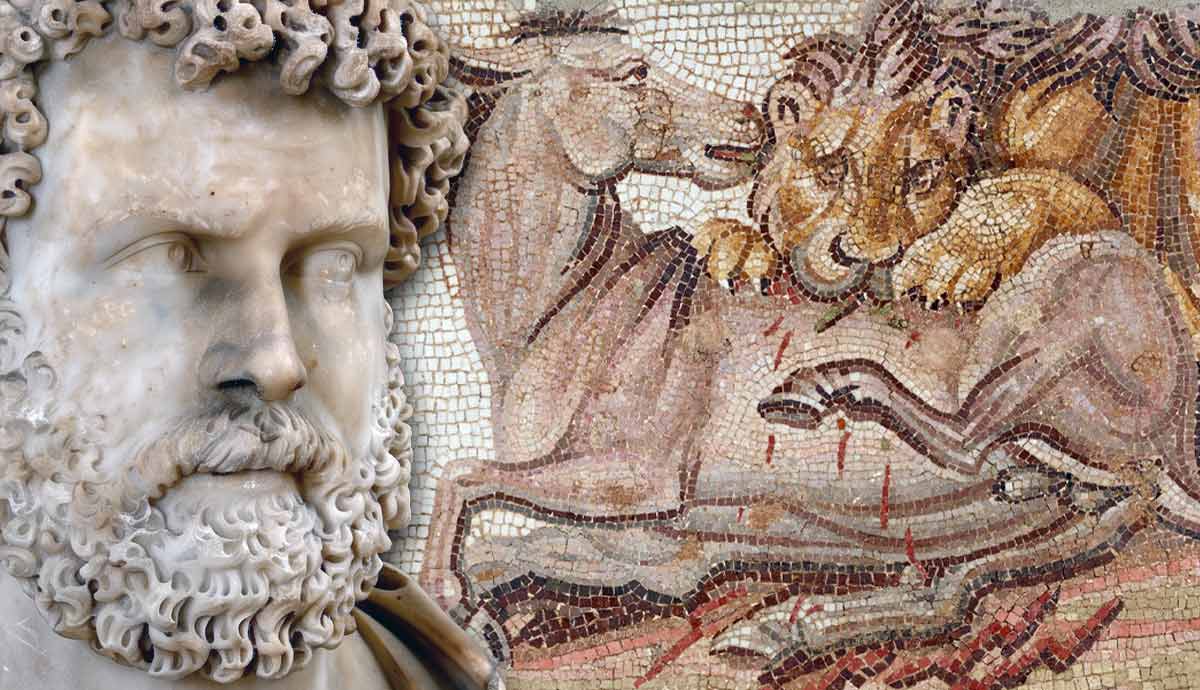
Marcus Aurelias broke the chain. In order to secure succession, he named his biological son Commodus as his co-emperor in AD 177 when he was just 15 years old. He became sole emperor in following his father’s death in AD 180 at age 19.
Commodus ended the northern Marcomannic Wars that marked much of his father’s reign so that he could return to Rome. This disappointed many senators, who supported the Empire’s expansion. His relationship with the Senate rapidly deteriorated, and his ruling style was characterized by self-aggrandizement. He had statues made of himself in the image of Hercules, and had even participated in gladiatorial combat, a profession which was seen as near to prostitution. Commodus was assassinated in AD 192, and his death triggered a succession crisis. After a century of peace, the Empire once again descended into civil wars.
The Roman historian Cassius Dio noted that the accession of Commodus saw the Empire, “…from a kingdom of gold to one of iron and rust.” This is often linked to a move from choosing the “best man” through adoption to choosing a biological heir. However, drawing a clean line between adoptive versus biological approaches to succession is challenging.
Adoption in the Roman World
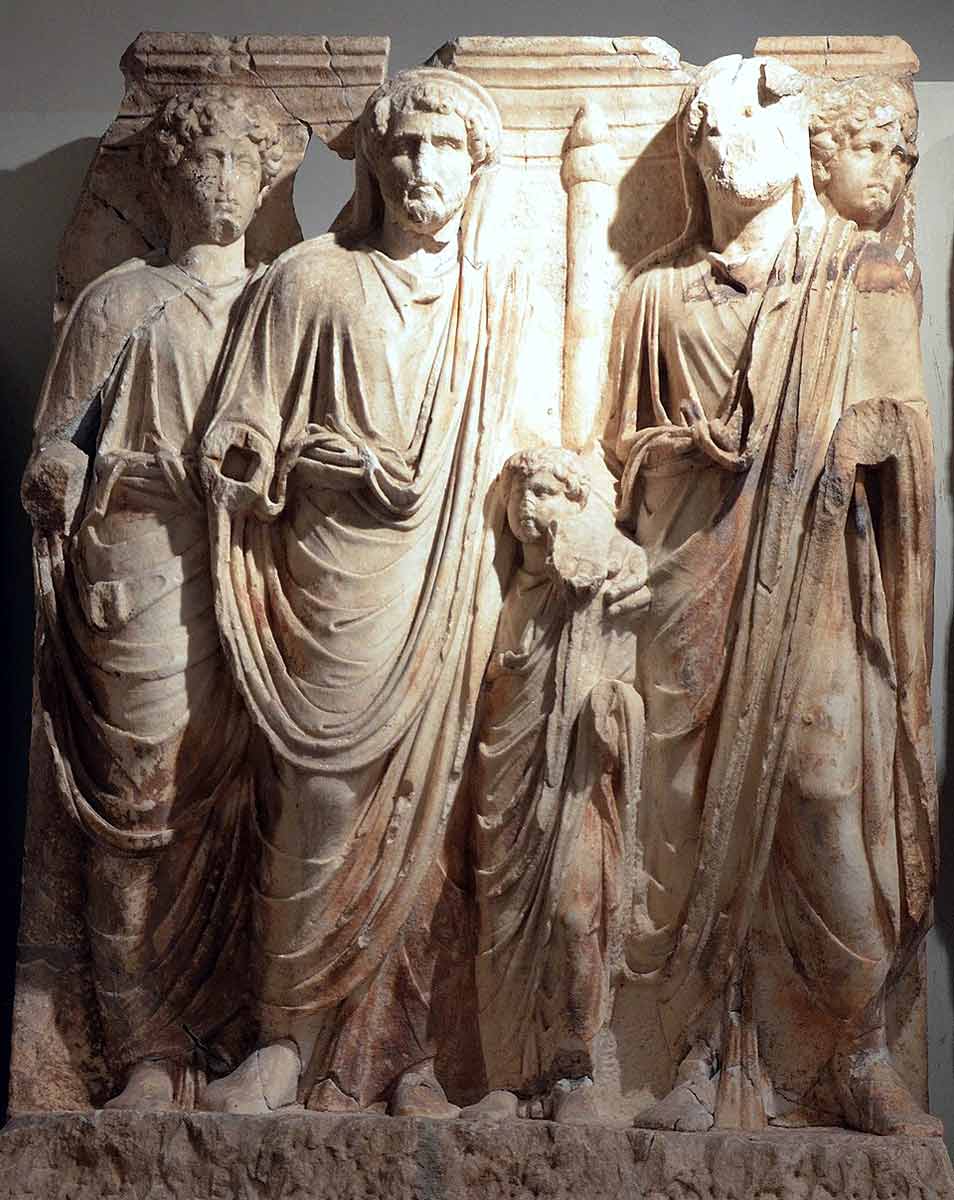
By the time of the emperors, it was already an established custom for elite Roman families to use adoption as a strategy to secure succession and continuity. It was also common for the paterfamilias of an aristocratic household to adopt an adult male heir, choosing a proven prospect over a youth who may not amount to anything.
The Roman emperors adopted this same strategy to secure smooth succession within the new imperial system. This was essential in a cutthroat world where misfortune and court politics meant that no Julio-Claudian emperor died with a biological male heir intact.
During the 2nd century AD, this also gave the appearance that imperial power was a meritocracy, passed on to the best choice rather than blood relatives. However, this is a simplification of a much more complex and uniquely Roman approach to family building.
Sources
- Garnsey, P., Saller, R., Elsner, J., Goodman, M., Gordon, R., Woolf, G., Hirt, M. (2015). “Family and Household,” The Roman Empire: Economy, Society and Culture (2nd ed.), pp. 151–172. University of California Press.
- Lindsay, H. (2009). Adoption in the Roman World. Cambridge University Press.