
During the Renaissance, artists, humanists, and patrons were trying to revive the culture of classical antiquity. In this attempt, they reinterpreted many myths. Sometimes they even ascribed religious meaning to the myths. Renaissance mythological painting is a visual testament to how early modern societies reinterpreted the past, and most of all classical antiquity. This reinterpretation was sometimes a dialogue, other times an emulation. Let’s explore who did it the best.
1. Sandro Botticelli’s “The Birth of Venus” — c. 1484–1486
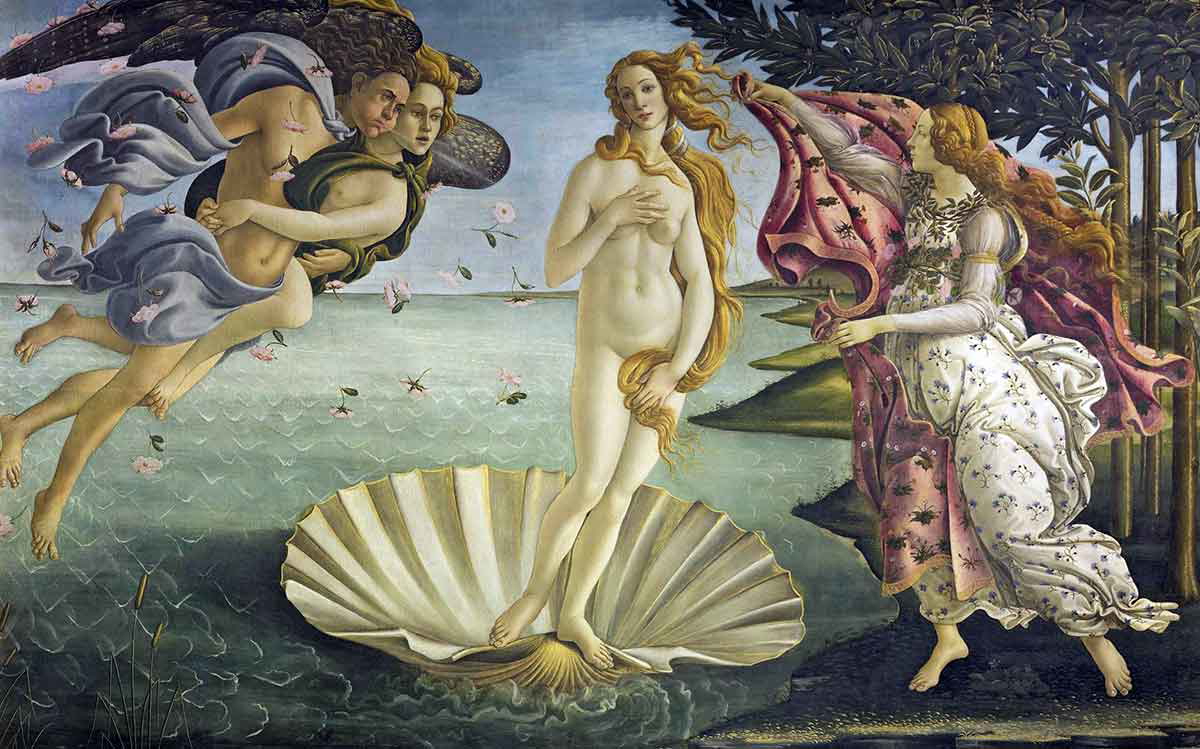
Without a doubt, the most recognizable and quintessential Renaissance mythological painting is The Birth of Venus by Sandro Botticelli (c. 1445–1510). Produced around 1485 in Florence, it can still be admired today at the Uffizi Galleries.
The painting depicts Venus emerging on the shore after her birth. The celebratory portrayal of Venus as a symbol of love, beauty, and fertility was potentially conceived by the poet Agnolo Poliziano (1454–1494). Botticelli represents the goddess fully grown and floating in a giant scallop shell. This type of portrayal, Venus Anadyomene (‘rising from the sea’), was associated with Apelles, the most famous ancient Greek painter. Botticelli was equally inspired by the iconography of Venus pudica.
The canvas is thought to have been commissioned by the Medici family, largely because of the orange trees prominently rendered in the composition. Called mala medica during the Renaissance, the orange tree was associated with the Medici dynasty because of its rarity, resilience, and similarly sounding name. The orange tree also appears in Botticelli’s other mythological masterpiece, Primavera.
2. Mantegna’s “Minerva” — 1502
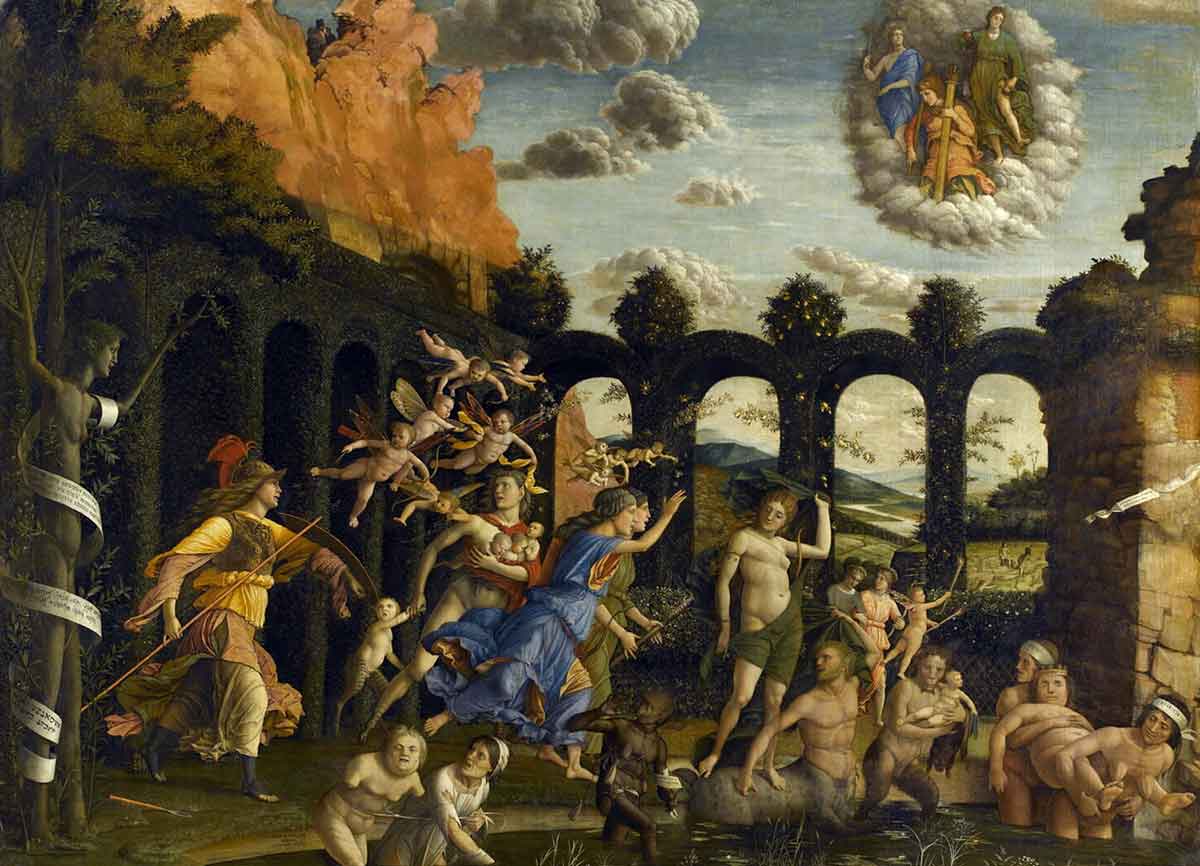
While The Birth of Venus became an icon of Renaissance beauty, Minerva Expelling the Vices from the Garden of Virtue demonstrates what the allegorical trajectory of Renaissance mythological painting looked like. The artwork by Andrea Mantegna (1431-1506) shows how intellectually ambitious this genre could become. Both the artist and his patron, Isabella D’Este (1474-1539), had a solid classical education and could read Latin. The painting was commissioned by Isabella for her studiolo, following Mantegna’s Parnassus.
Although the iconography is difficult to decode, the message is clear: virtue defeats vice. The marsh inhabited by vices, each identified by Latin inscriptions, is violently purified by Minerva. She intervenes just before Diana, goddess of chastity, is assaulted by a Centaur, the archetype of lust.
The painting is a cornerstone of Renaissance mythological art because mythology becomes a vehicle for Christian moral philosophy, humanism, and courtly culture.
Its audience was equally exclusive and intellectual, as visitors to Isabella’s studiolo were invited to decipher the visual puzzles she designed in collaboration with her court artists.
3. Raphael’s “The Triumph of Galatea” — c. 1512
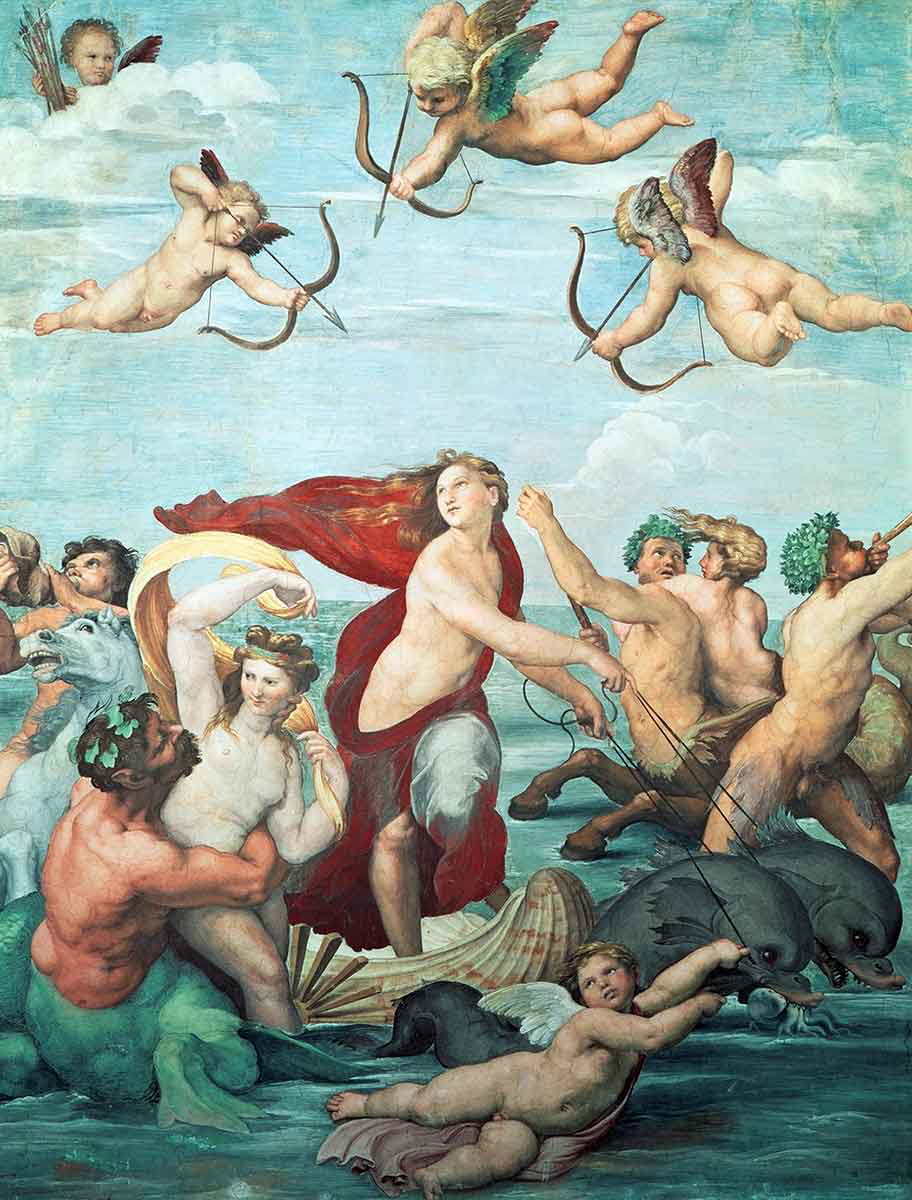
The Triumph of Galatea is the most seminal depiction of the Nereid Galatea and stands out on this list for being a fresco. Raphael (1483-1520) completed it around 1512 for the Villa Farnesina in Rome. The villa originally belonged to the Sienese banker Agostino Chigi (1466-1520), one of the Renaissance’s great patrons of the arts. Raphael’s frescoes in the Loggia di Galatea and Loggia di Psyche remain its main attractions.
The fresco decorates the villa’s open gallery. The original decorative program focused exclusively on Galatea, which explains why the frescoes present only her apotheosis rather than the full narrative. In the Triumph, Galatea escapes the jealous Cyclops Polyphemus, who desires her despite her love for the shepherd Acis. Raphael captures the precise moment she glides past him, evading his unwanted affection. Another myth surrounding the fresco claims that Galatea was modeled after Imperia Cognati, Chigi’s lover, known during the Renaissance as the queen of courtesans.
4. Correggio’s “Jupiter and Io” — c. 1530–1533
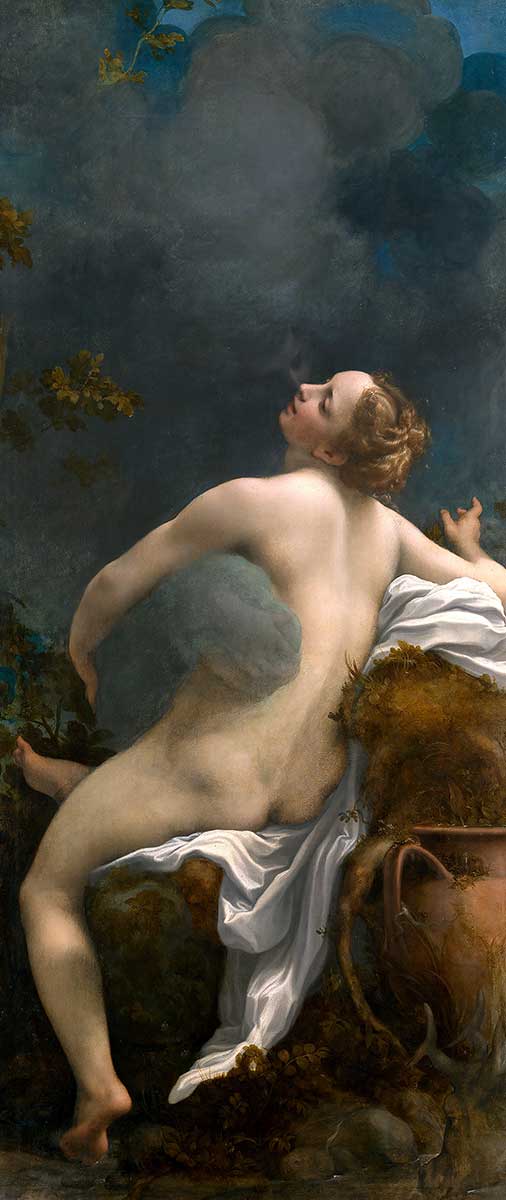
Jupiter and Io is considered the masterpiece of Antonio da Correggio (1489–1534). Painted around 1530, it formed part of a series depicting Jupiter’s loves as narrated in Ovid’s Metamorphoses. It was commissioned by Federico II Gonzaga, Duke of Mantua, possibly as a gift for Charles V, Holy Roman Emperor.
The painting depicts Jupiter embracing the river nymph Io while disguised as a cloud, designed to escape the jealousy of Juno. Other disguises adopted by Jupiter, the swan for Leda and the eagle for Ganymede, were also painted by Correggio.
Jupiter and Io is among the most erotically charged paintings of the Renaissance. Jupiter surrounds Io in a thick cloud, yet his hand and face remain visible as he embraces and kisses her.
5. Titian’s “Diana and Actaeon” — ca. 1556–1559
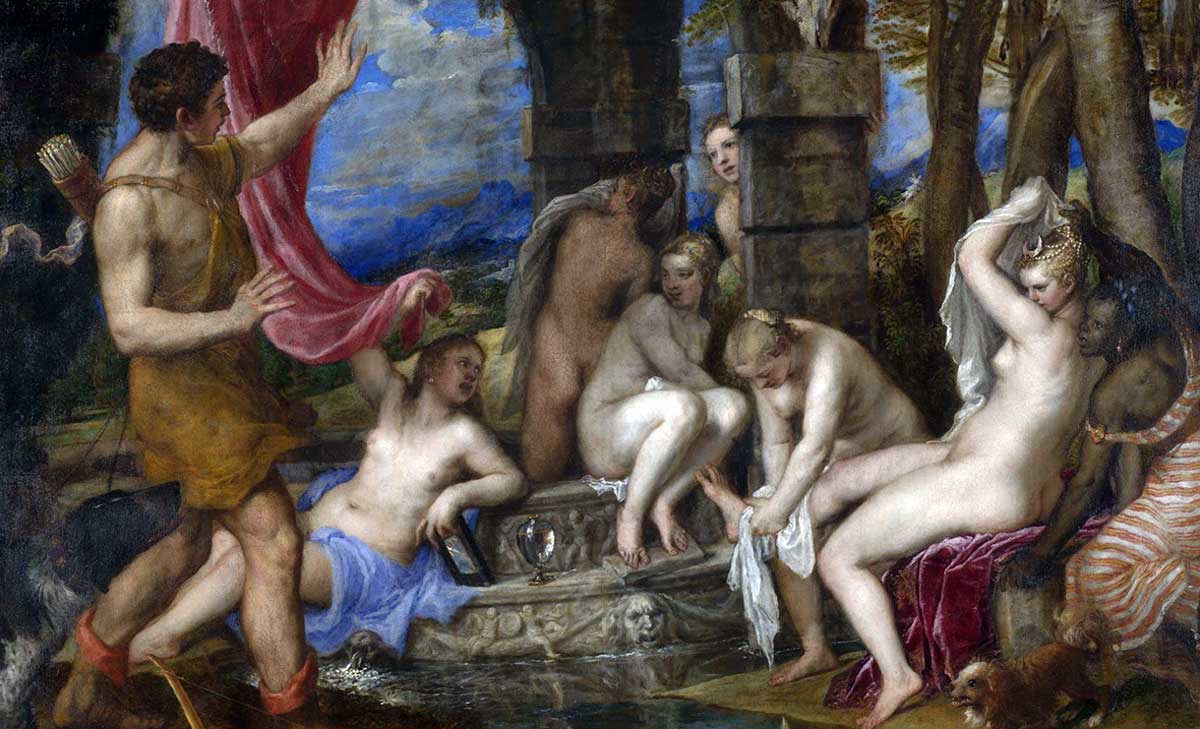
This canvas by Titian (1488/90-1576), depicting Diana and Actaeon, is part of the painter’s series of Poesie. Titian used this term for his mythological paintings because he considered them to be the visual correspondents of poems or poesie. Ovid wrote about how Actaeon, a noble young hunter, lost the trail of his hunting companions and ended up stumbling upon the goddess Diana. The goddess of the hunt, wild animals, and chastity was thus interrupted from her bath.
The nymphs accompanying Diana rushed to cover their furious chief. It is notable that the nymphs have different reactions upon seeing Actaeon burst in. Some are upset, some curious, some even intrigued.
The immense dramatism of the captured moment can be noticed in all visual elements of the painting. Titian’s work is brimming with the apprehension of this incident’s consequences.
We can see that Diana is already plotting her revenge against the young man, and Actaeon’s disarmed stance foreshadows his impending tragic end. Diana will hunt him as prey after turning him into a stag.
Visitors to the National Gallery can also admire the other masterpiece by Titian, which narrates the very death of Actaeon, as well as other mythological poesies made by his hand.
6. Bronzino’s “An Allegory with Venus and Cupid” — c. 1545
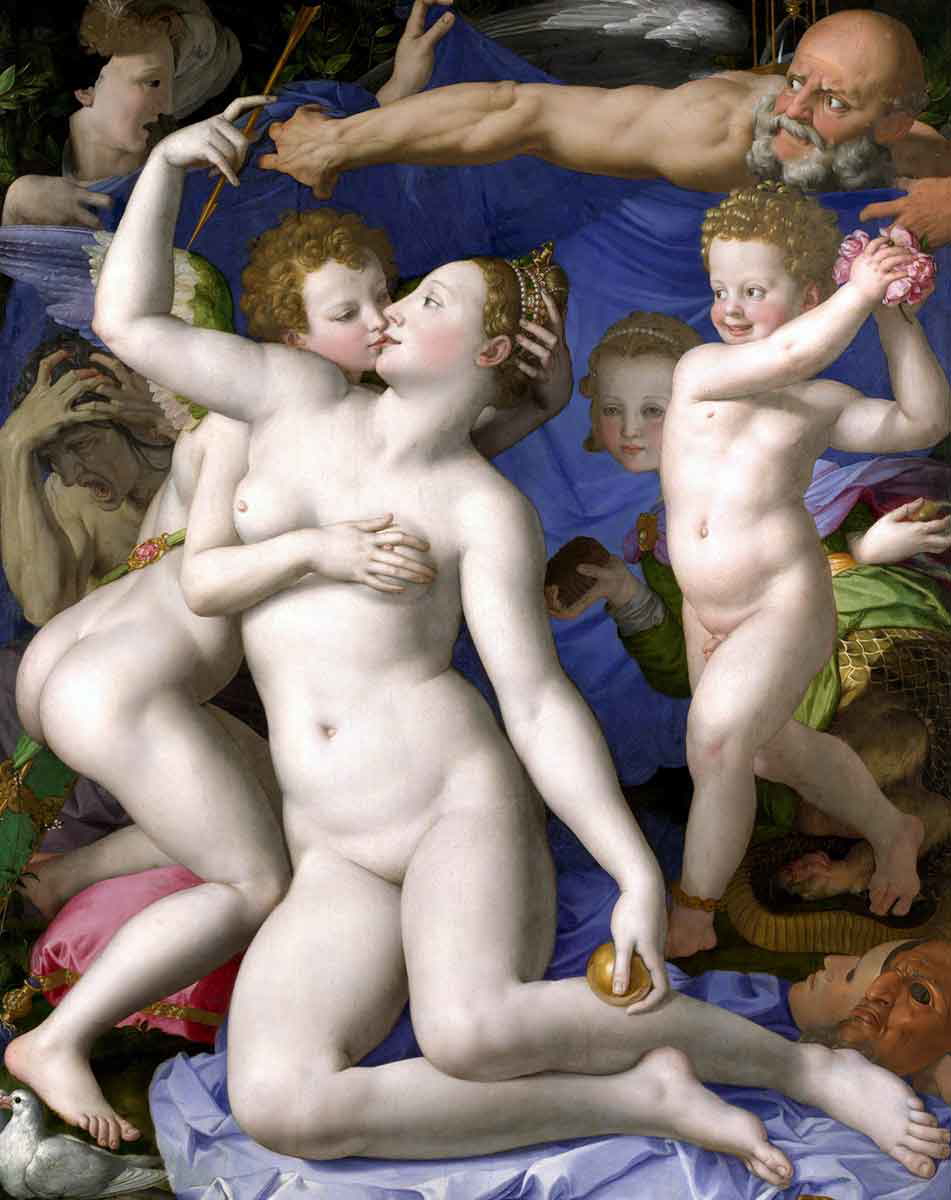
Agnolo Bronzino’s painting of Venus and Cupid, which can be enjoyed in the same National Gallery in London, stands in stark contrast to the theatrical masterpiece of Titian. This work boasts a brash eroticism and complex intellectual messaging at the same time. This clever and provocative image was fully tailored to the personality and fancy of the French King, Francis I.
Rumor has it that Francis was famously perverted, and Duke Cosimo I of Florence winked his way as he sent him this prized work by Bronzino, his most cherished court painter and portraitist. Bronzino composed a painting with contrasting connotations: while imagining a sexually explicit depiction of Venus and Cupid kissing, flanked by Pleasure and Play, there is also a moralizing double entendre at work, reminding ethically inclined viewers to ponder the less enticing faces of Love as well. Fraud, Jealousy, and Deceit are there to keep us morally on guard. While rendering all this with cheeky gusto, Bronzino is still a devout Christian who warns us that pleasure is often followed by pain.
7. Pieter Brueghel the Elder’s “Fall of Icarus” — c. 1555-1558
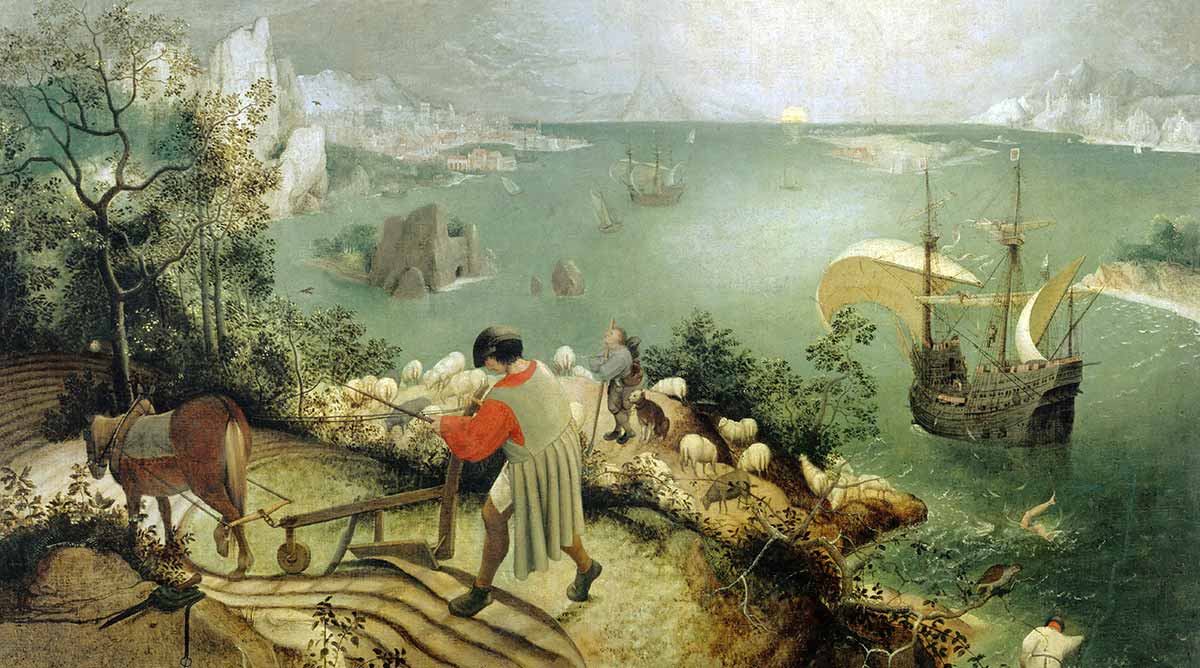
This work was either painted by Pieter Brueghel (c. 1525/1530-1569) or a close follower of his. This historiated landscape is a Northern Renaissance masterpiece that blurs the line between two genres of painting: landscape and mythological depictions. The work was inspired by the Greek myth of Icarus. In this tale, Icarus attempts to fly with the wax and feather wings his father Daedalus had built, but he flies too close to the sun. His wings melt, and he ends up being swallowed by the sea.
Following the principles of Mannerist inversion, the painting does not make this story the centerpiece. Instead, the viewers first witness a landscape filled with images of ordinary life: a farmer, a shepherd, and ships sailing peacefully.
This inversion gives pride of place to low topics over intellectual ones, such as mythical or biblical stories. The moral lesson behind this intentional overlooking of Icarus’ tragedy is meant to remind us that the world does not stop for any individual hardship. This simple and worldly figuration is what makes Landscape with the Fall of Icarus a much beloved Renaissance mythological masterpiece.