
Our ultimate reality is a question that physics and philosophy, especially metaphysics, approach with very different methods. Max Tegmark’s mathematical universe hypothesis (MUH) tries to integrate them, claiming that mathematics constitutes all there is. The hypothesis often gets dismissed as crackpot, but Tegmark presents it as a natural extension of mathematical Platonism, physical naturalism, and contemporary cosmological evidence. Let’s unpack it.
Pythagoras and Plato Treated Mathematics as the Key to Reality

The question of mathematics’ place in reality goes back to Pythagoras and Plato: was mathematics invented or discovered?
Pythagoras believed in the sacredness of mathematics and that mathematics made up the universe, so that by using it we could unveil the universe. Pythagoreanism had a more sacral element than a scientific or philosophical one, with certain numbers symbolizing certain universal traits or objects.
Plato wanted to know how true knowledge could exist in a constantly changing world, so he posited eternal, unchangeable Forms.
In the philosophy of mathematics, Plato’s ideas were put forward as Mathematical Platonism, which holds that mathematical objects are abstract and independent of us, so we discover mathematical truths rather than invent them. This conclusion follows from the fact that mathematical objects seem to exist outside time and space and independently of us, yet remain accessible through reasoning rather than the senses.
Mathematical Platonism is widely held in practice by those who use mathematics, as it is essentially mathematical realism.
Mathematical Platonism Struggles to Explain How We Know Abstract Objects
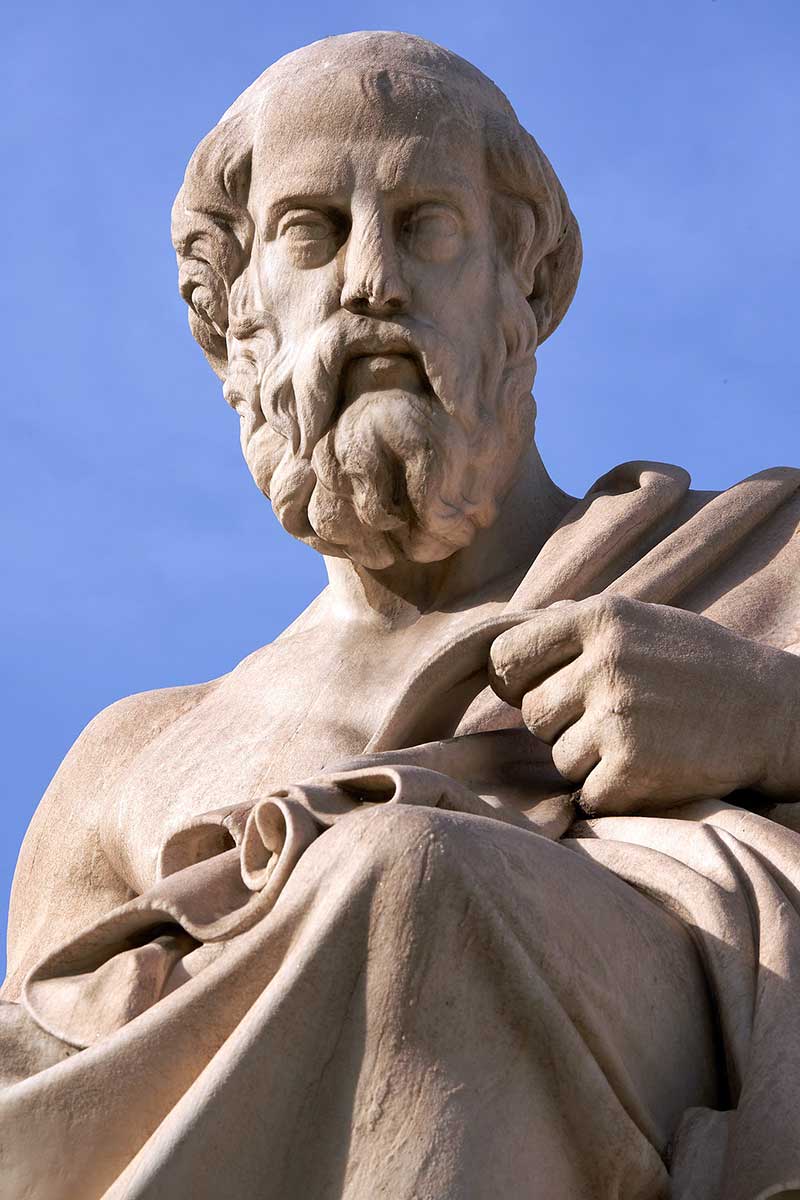
Accepting the mathematics of the world as real raises a dilemma: how do we discover mathematical knowledge if it is abstract? If it is not out in the world physically, how do we come to know these abstract objects?
This is the epistemological problem Benacerraf (1973) pressed against Mathematical Platonism: how could the physical or the mental interact with that which is outside of spacetime?
The typical solution is that mathematics is entirely invented by us and has no special truth or relation to the world; it is simply a way we understand it. Formalism and fictionalism are versions of this view.
It is generally not accepted, given mathematics’ strong correspondence to the world, its extraordinary capacity to explain it, and its capacity to describe reality independent of us. It would also make our mathematical proofs arbitrary, and so much of what we have based science on, which seems a rather unacceptable conclusion.
Without taking on these views, if mathematics deals with abstract objects as Platonists believe, how do we interact with them? We either have to extend our minds beyond the physical (and even the mental), which is unacceptable today and often approaches mysticism, or accept that abstract objects exist.
The reply could be that abstract objects are simply relationships between objects, relationships we can see with our intellect, and that these abstract relationships can then be said to be abstract objects.
Yet if we cannot interact with the abstract, whether it exists would not matter. On the other hand, if we can interact with it, it would severely change our metaphysical view.
Tegmark’s Mathematical Universe

Max Tegmark takes the Mathematical Platonist view and extends it to make everything mathematics. If all of reality is constituted by mathematics, then one can avoid the abstract-physical interaction problem.
He starts with what he calls the External Reality Hypothesis (ERH): an external physical reality completely independent of us humans (Tegmark, 2008).
This is the perspective of realism, which typically assumes an external reality, along with physicalism, the view that reality is made entirely of physical properties.
Everything in physics can be described mathematically, so Tegmark takes it to be a further simplification to say that everything is math, instead of that everything is physical and described by math. As Galileo put it, the world is a book written in the language of mathematics. Tegmark’s MUH states that our external physical reality is a mathematical structure (Tegmark, 2008).
What Is Real Is the Structure, Not the Mathematical Language

But describing something as something does not mean it is that. We can still consider the specific language of mathematics we use to be invented, but the mathematical relations, or structure, it describes are not. An example is pi, the ratio of a circle’s circumference to its diameter. Approximations like 3.14 and 22/7 are man-made and arbitrary, but the relation itself is universal and unchanging and cannot fully be written down finitely as a number.
So while the mathematical language we use is not universal, what it denotes is.
Mathematical properties, like quantity (cardinality) and symmetry, are as real and universal as fundamental laws. This contrasts with ordinary language concepts, which can denote completely abstract, arbitrary, or mind-dependent notions.
It is therefore not the language of mathematics that Tegmark takes to be real, as with numbers existing out there, but the mathematical structure: a set of abstract entities with relations between them. These entities have no intrinsic properties, unlike the physical ones we are used to.
This is a stark shift from physicalism, which takes things as they are in and of themselves to be real. Tegmark takes the relations, denoted by mathematical structures, to be real. The mathematical universe has only mathematical properties, and we are trying to approximate the correct description.
Tegmark essentially says there is one mathematical structure that we can describe in different ways (even mathematically), but they are just different words for the same relations, and these relations are the universe’s fundamental properties.
Tegmark’s Case Rests on Physics Being Mostly Numbers and Relations

There are about 31 fundamental dimensionless numbers in physics (Tegmark et al., 2006), not determined by measurement or arbitrary human choice, from which one may hope in principle to calculate the other constants of nature.
Some parts of physics, parts that have made empiricists notoriously skeptical, are those that can, or at least for now do, consist only of numerics: empty space, spin, or the wave function.
Physicists aim toward the ultimate goal of a theory of everything, a complete description of external physical reality. Such a description would have to be at least partly human mind-independent. In particular, it needs to tap into the world’s generalizing aspects, since describing the universe directly would require more than the atoms it contains.
Tegmark takes mathematics to be the ultimate non-human-dependent description.
Full-Blooded Platonism Says Every Mathematical Structure Exists

One could accept that the particular mathematical structure of our world is what is real, but that seems arbitrary. Why do certain abstract concepts exist but not others, if everything is composed of them? Instead, Tegmark takes the view Balaguer (1998) called full-blooded Platonism: all possible mathematical objects exist.
With this radical ontological extension, one can bypass the problem of Platonism. Mathematical structures become independent of the laws of physics, and what is not physically realizable becomes real.
This view still struggles to explain how we can “pick out” mathematical structures in this reality when they are abstract: how can we know of a possible mathematical structure that seemingly does not exist in our reality but is supposedly as real as the rest? There is also the question of why only a specific part of the structure is in our world, and what makes it different from the rest.
For Tegmark, the solution is that a greater mathematical structure exists, instantiated by parallel universes. Some parts of current mathematics may conflict with this, such as infinity, which complicates the hypothesis. Tegmark responds that infinity may not be part of the structure and that the structure may be confined to what is computable, a restriction he calls the Computable Universe Hypothesis (Tegmark, 2008).
The Core Assumptions Are Contestable, and the Extras Are Radical

One could challenge the assumption that physics can fully describe an external reality. This is not certain, though most natural scientists would probably be fairly certain.
Additionally, one can reject Mathematical Platonism in favor of its alternatives, an option most scientists may not take, and perhaps not most those working primarily with mathematics either. From the perspective of natural science, then, the core assumptions appear to stand on solid philosophical ground, though not one many actually stand on.
The other assumptions, that all mathematical structures are real and that they are instantiated in a multiverse, are much more radical, but they both solve crucial problems of Mathematical Platonism and may appear to be its logical conclusions.
If Everything Is Math, a Simulation and Reality Look Identical

A specific counterargument to Tegmark’s conclusion is that if everything is mathematics, we cannot distinguish a simulation from “reality.”
If there is a difference between the “real” Venus and a perfect simulation of Venus, this is not shown mathematically, since they are the same mathematical equation. So what is exactly the difference, and how would one prove it?
The question boils down to what is real. A simulation cannot interact directly with the world that created it, so we would call it not real. Yet if we accept abstract concepts as real, this distinction seems to crumble. The conclusion may not be so strange, since we still cannot distinguish between a real world and a simulation.
Tegmark Says the Hypothesis Is Testable, Critics Say It Is Not

Tegmark argues that the MUH is falsifiable: if it were false, physics would eventually hit a wall where mathematics stops being useful. Critics reply that MUH proponents could always say we simply do not know enough yet, so no observation needs to count against it, but that is not much of an argument.
Given its metaphysical nature, the MUH may not be testable, though some conceivable tests may pan out in the future; none currently. It would then stand where the many-worlds interpretation of quantum physics stands, and it may lose credibility with scientists when presented as a physical theory rather than mainly a philosophical one.
While there is no strong evidence against the mathematical universe, there is not much going for it either outside of some simplicity and neatness. One might argue that other metaphysical views, like physicalism, do not provide better proof of their correctness, and that they typically rely on arguments from parsimony in a similar way.
If one accepts mathematical Platonism and naturalistic physicalism, the mathematical universe seems, in many ways, the logical conclusion. The question, then, is what we gain from this ontological explosion.
Reference
- Tegmark, M. (2014). Our mathematical universe: My quest for the ultimate nature of reality (1. ed). Random House.