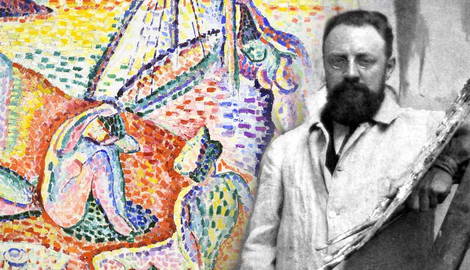

Notes of a Painter (1908) is a crucial text for understanding the artistic intentions of Matisse in the latter part of the first decade of the 20th century. Rather than a new departure, however, it was a crystallization of his intentions that would lead to a more simplified aesthetic dedicated to a purity of expression, fidelity to nature, and the relation of universal humanity. This could be achieved, Matisse thought, through a pictorial harmony of form and color.
The Year That Tamed the Wild Beast? Matisse in 1908
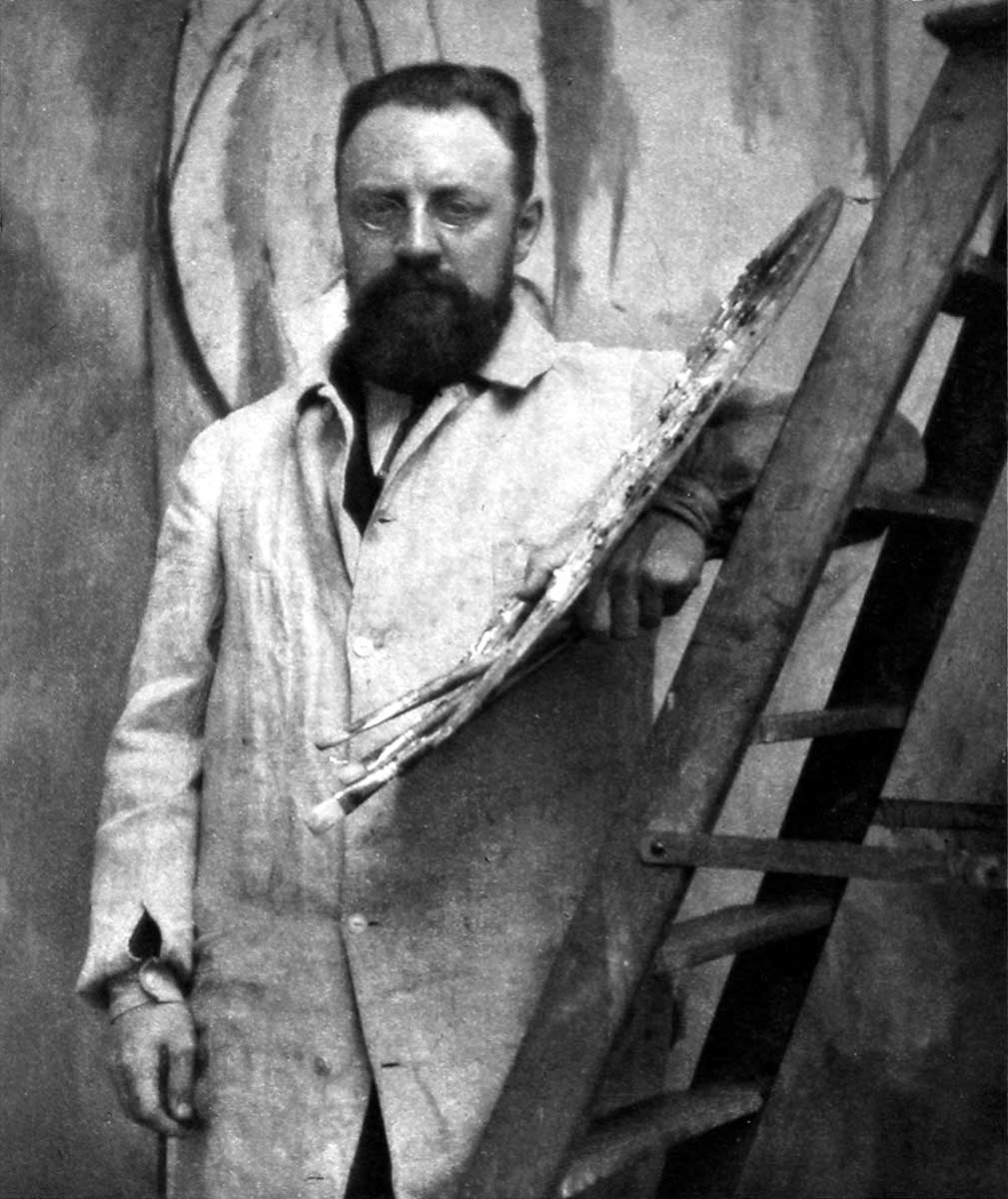
Henri Matisse (1869-1954) produced a written account of his art in the year 1908. His Notes of a Painter provides insight into his intentions and methods to achieve them. David Carrier has gone so far as to say that Matisse’s Notes “predicted his career,” and that it is only after 1908 that the vision outlined in the text was striven for and achieved. However, this article aims to show that the fundamental aims of Matisse’s art are evident in his work prior to that date.
Rather than the text being the departure point for a revolution, it is rather an elucidation on the part of the artist of what was imperfectly achieved beforehand and a projection toward his subsequent work that has a greater unity of purpose and aesthetic. As Matisse writes: “My basic idea has not changed, but my thought has evolved, and my modes of expression have followed my thoughts.”
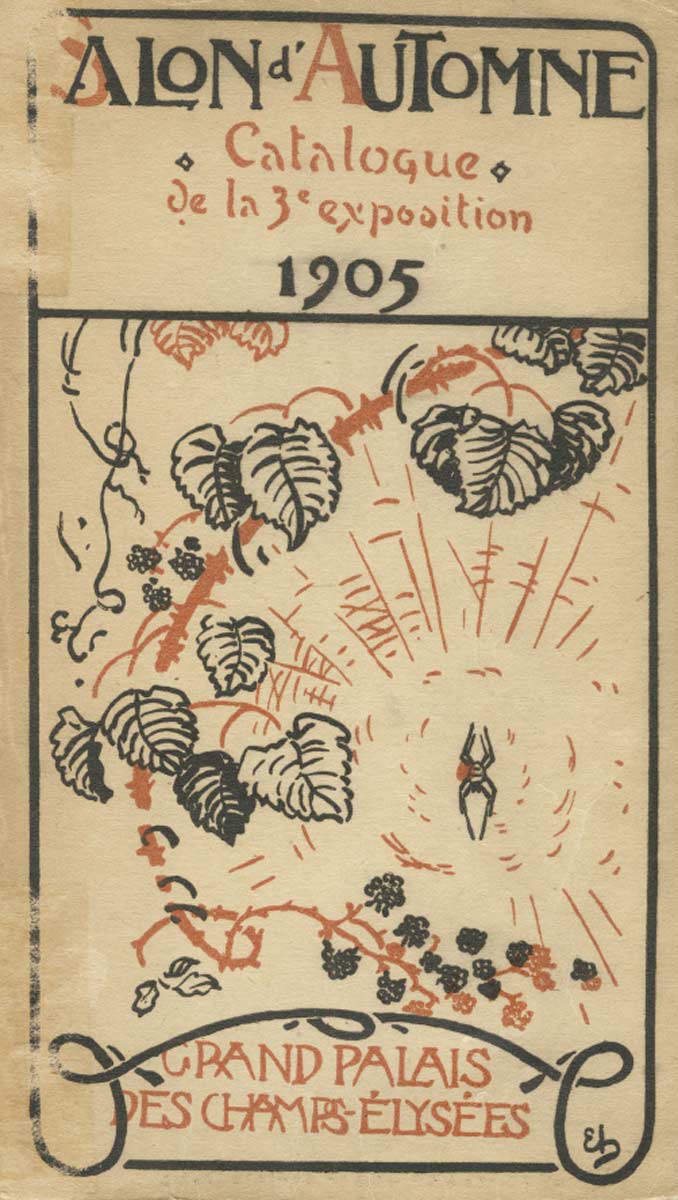
The circumstances that had named Matisse among the Fauvists (“wild beasts”) might not have happened. Contemporary art critic Louis Vauxcelles dubbed a classical sculpture at the Salon d’Automne of 1905 in Paris as “Donatello chez les fauves” (“Donatello among the wild beasts”). The Fauves were a group of a loose aesthetic affinity who prioritized the expressive power of color and distorted form. They opposed any kind of realist imitation and the fleeting effects of Impressionism. Henri Matisse, along with André Derain and Maurice de Vlaminck, was seen as a leader of the Fauves. The Fauvist moment did not last long, and in the case of Matisse, Vauxcelles’s moniker was a misnomer.
Despite his non-naturalistic color and distortions, Matisse was actually seeking what he would always seek: a serene and spiritual meaning beneath—or above—the merely physical. Certainly, there was a development as Matisse evolved his manipulations of tone and concern with the human figure, but this was a continuous process of experimentation. His Notes of 1908 is an important record of a process, not an epiphany.
Notes of a Painter
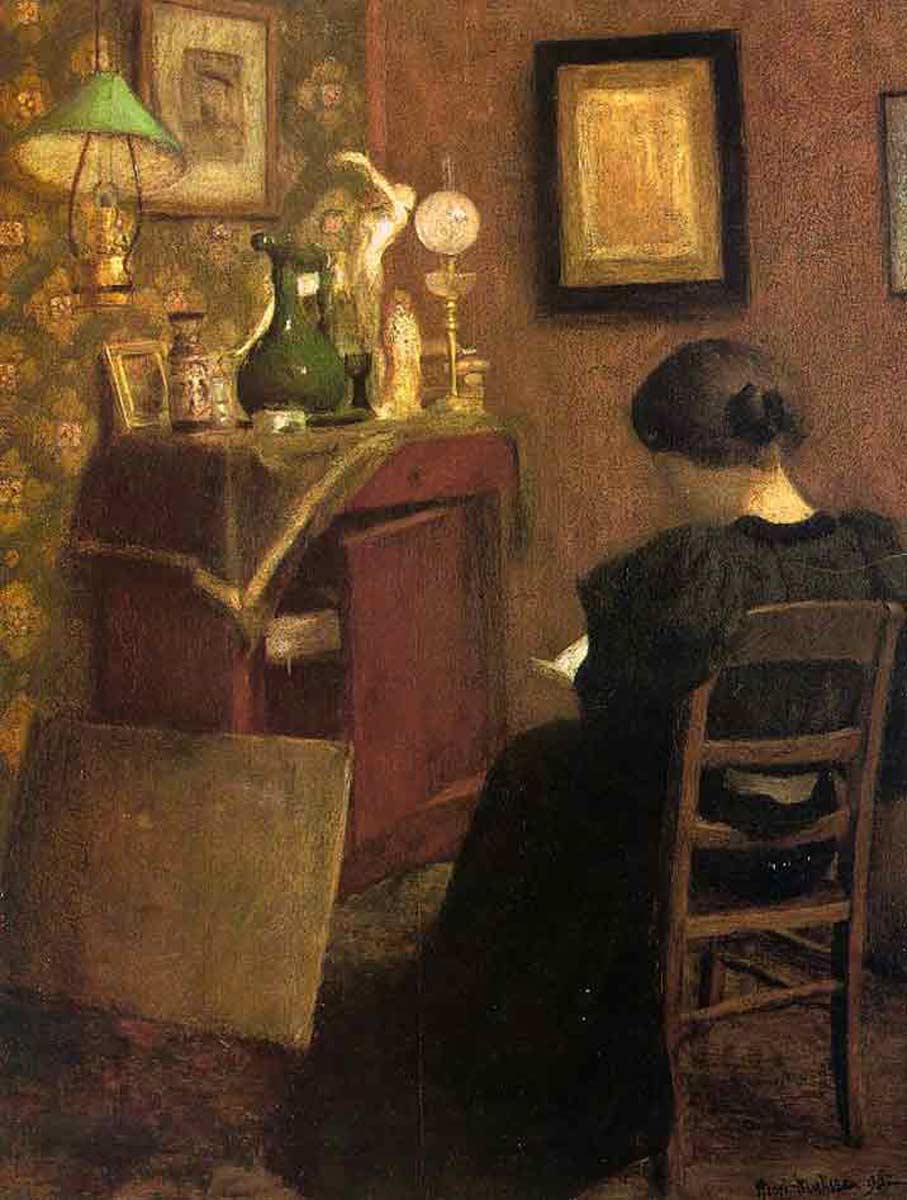
In 1908, Henri Matisse published his Notes of a Painter. It was a tentative undertaking on his part in the sense that he admits feeling a certain self-consciousness about venturing into a textual account of his opinions about his art and art in general. Yet, there is certainty in the text: the convictions he outlines in it are unshakeable. Instead of the text being seen as merely a premonitory of Matisse’s work after this date, it must be seen as a verbalization of his artistic intentions. These he had been trying to realize before 1908, in his so-called Fauvist period. However, he underwent a change of stylistic direction after the Fauvist period. It is arguable, therefore, that the production of Notes of a Painter aided Matisse in clarifying to himself his pre-existing aims and method. His aims, he says, are continuous: “My basic idea has not changed.” His Fauvist art contained these aims unchanged, we may infer, but in embryonic form.
1908, therefore, is less a definitive break with Matisse’s prior art and more a distillation of its perceived best elements, with the elimination of its excess—at least in intention. The text, a manifesto for a more simplified style, is informed by a philosophical adherence to universal humanism. It speaks of the active imitation of nature, and by “active” he means the filtering of the natural world through the active force of the individual personality. This provokes in Matisse what he calls “sensation.” By this “sensation,” he seems to mean both an “awe for life” and nature, and the visual and emotional impact of the compositional arrangement together with the harmony of colors.
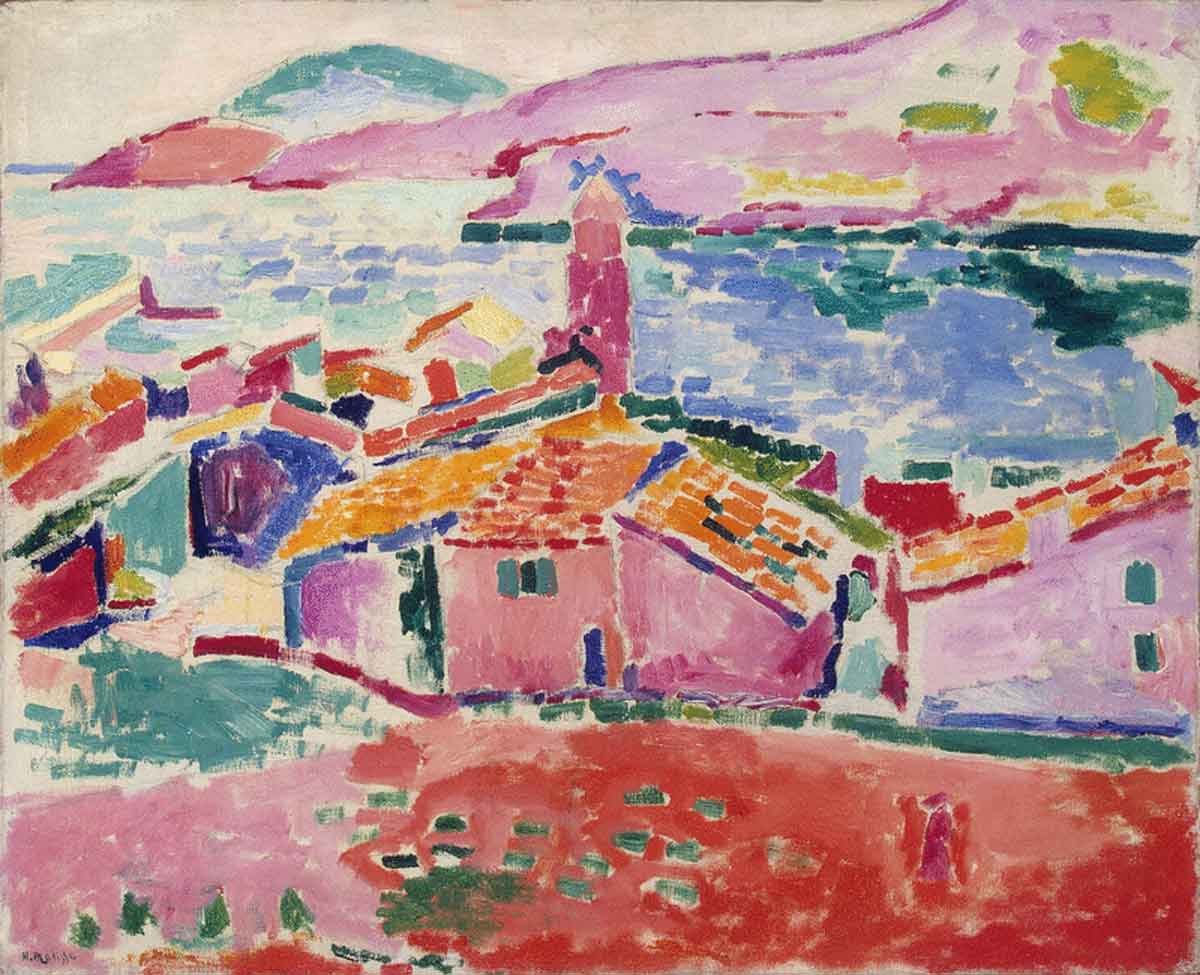
Matisse’s sole goal was “expression”: “My destination is always the same but I work out a different route to get there.” Perhaps the very writing of the text of Notes of a Painter is Matisse in the process of working out his artistic route. The solidity and durability of his “destination” in his mind contrast with the aesthetic of Impressionism, with which he associates “[c]harm, lightness, freshness — such fleeting sensations.” What he wants to achieve is permanence “by insisting upon…essential character, to risk losing charm in order to obtain greater stability.” The “fugitive sensations of a moment” he rejects in the name of a “condensation of sensations” and a “general conception” that is “more fully human.”
Matisse also writes of the artist’s relationship to nature. He advocates, rather than “servile” copying, an interpretation of it and submission of nature to “the spirit of the picture.” The ideal result will be “a harmony analogous to that of a musical composition.” These ends are to be achieved instinctively instead of scientifically. The painting will be complete when “all the parts have found their definite relationships.”
For Matisse, the human figure is paramount and partakes in the sublime. It “best permits me to express my almost religious awe towards life.” His painting obsessively explores the human figure but not only for itself—it is also a means or a vehicle for the expression of spiritual human essence, the constancy of which he seeks to mirror and inform in his art.
Before 1908, his efforts were fitful and irrational; after this date, he began to arrive at a visual language that helped him approach his dream of “an art of balance, purity, and serenity.” Yet, this was always the aim. The Notes of a Painter is not a revolution in Matisse’s thought but a moment of taking account, a crystallization of method in his mind rather than of intention.
Expressive Color
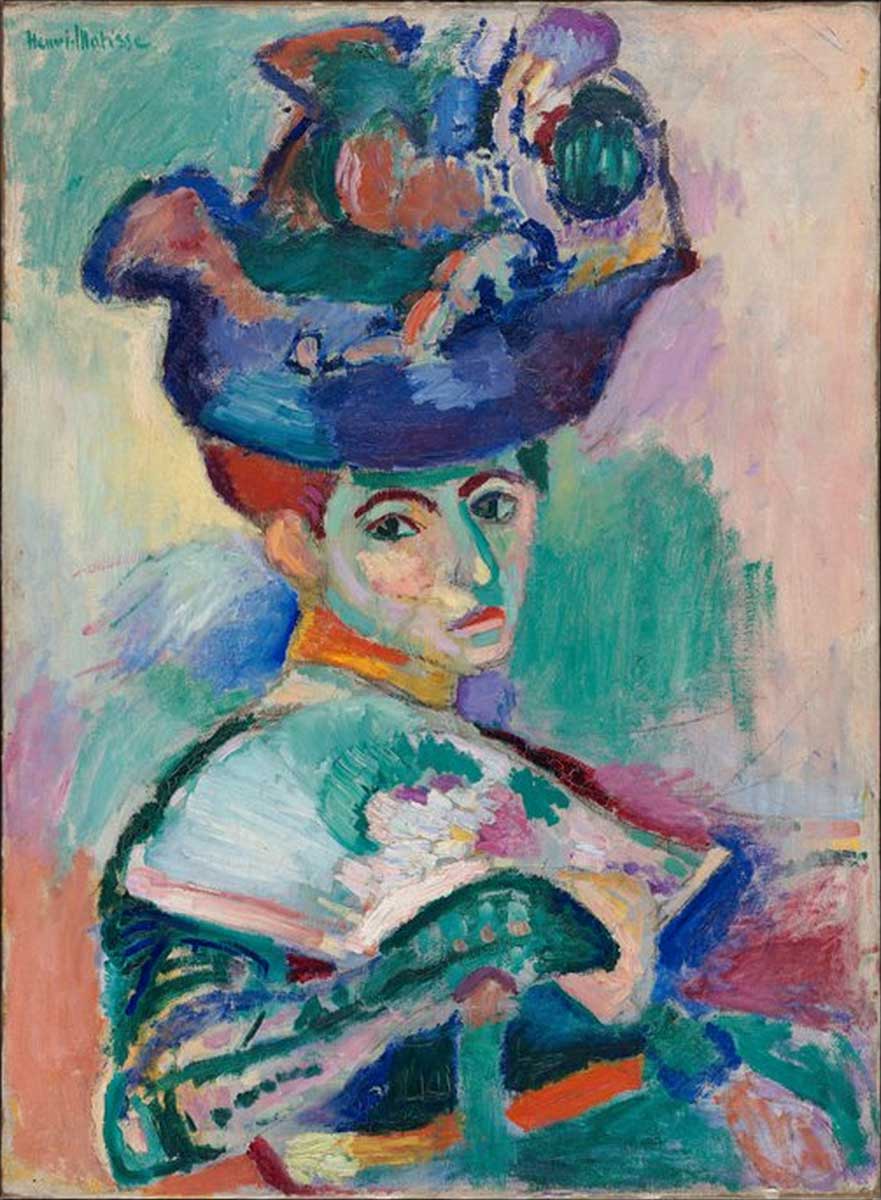
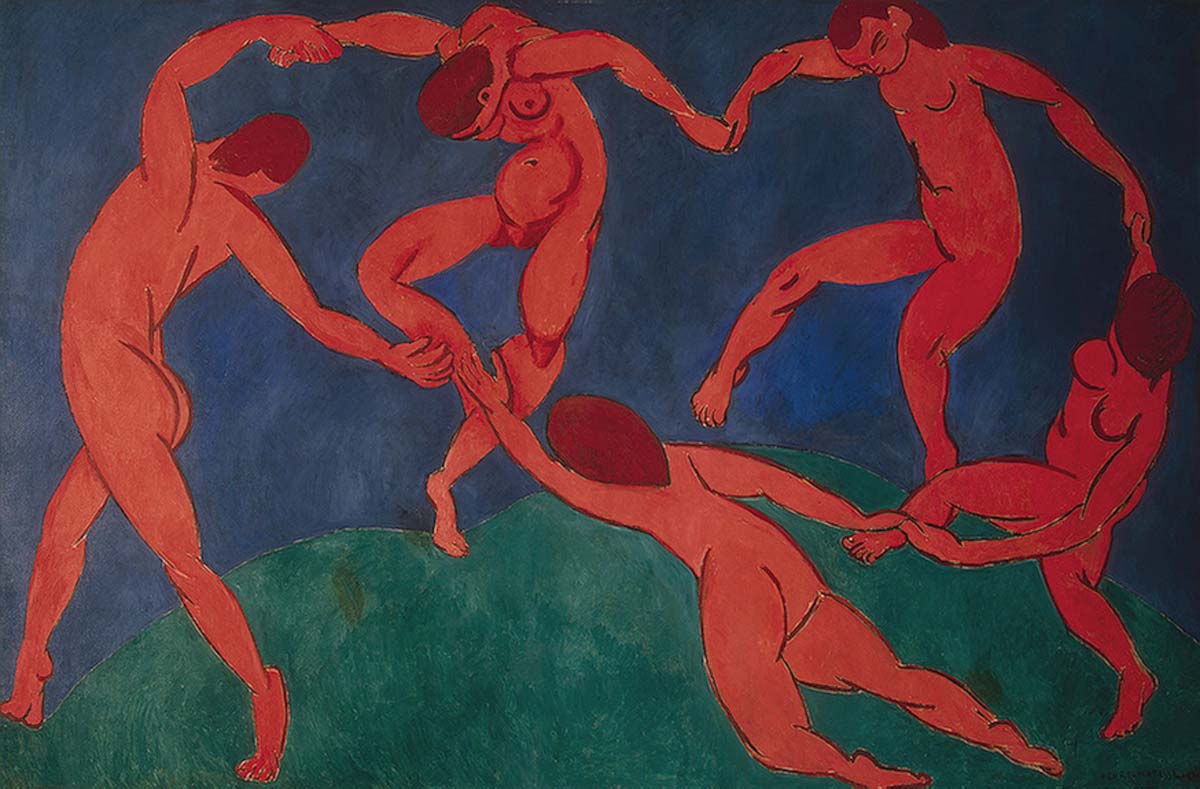
The year 1908 stands between two versions of Matisse. From the arbitrary use of non-naturalistic colors in Woman with a Hat in 1905, we can glean the imposition of the artist’s sensibility on the subject matter. Much later, at the beginning of the 1920s, came the two versions of Dance. In these later pictures, color is still not strictly realistic, but it is more certainly filtered from the observation of nature through sensibility. For example, the flesh tones and colors of the landscape and skies in the Dance image have their derivation from nature, however idiosyncratically rendered.
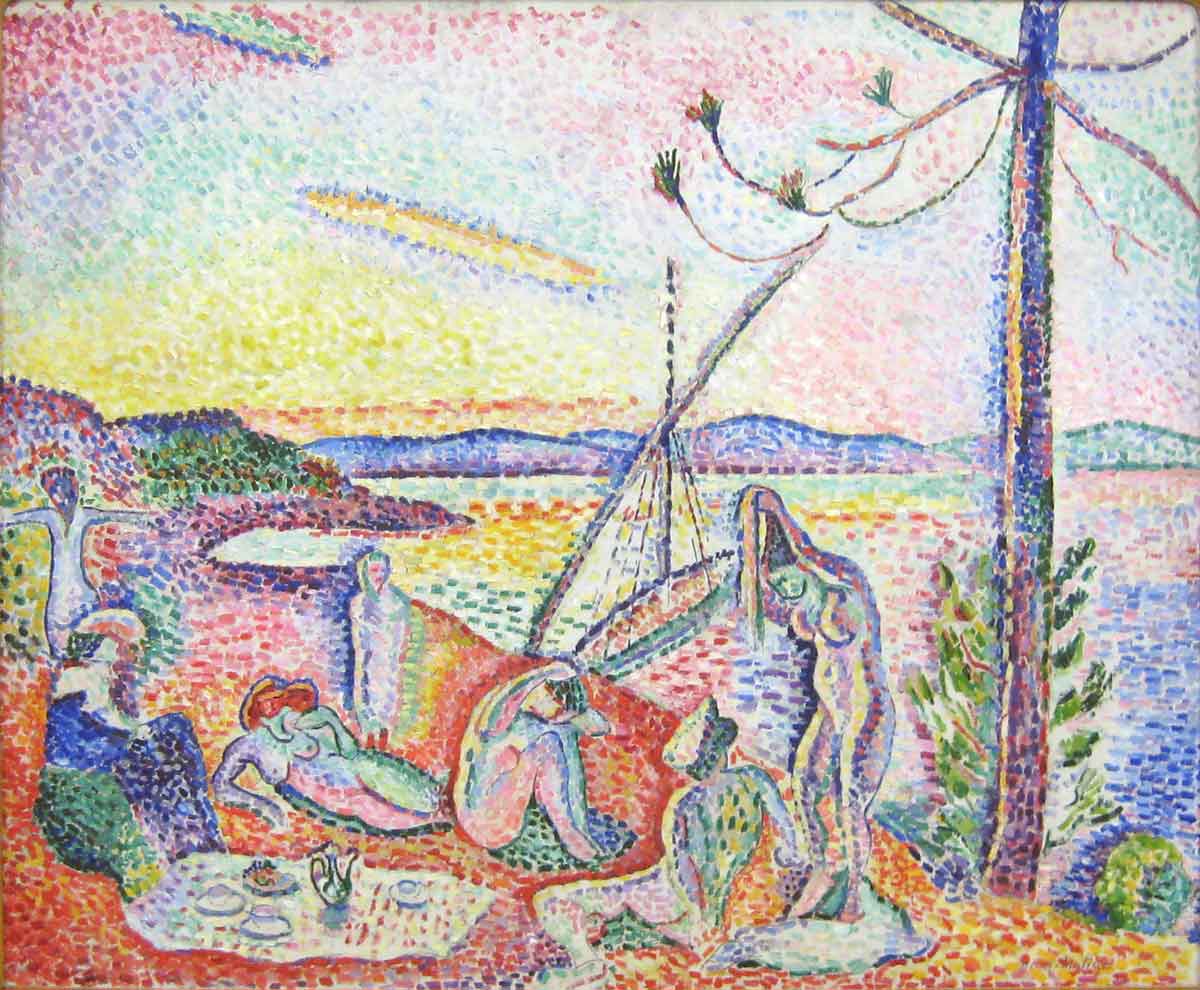
But we must be careful not to draw a simplified line of development for Matisse’s art of these years. The arbitrary colors of Woman with a Hat come a year later than the more holistically conceived Luxe, Calme et Volupté, which was painted in 1904. The earlier painting, Luxe, has a more “overall” effect of technique. Its colors and tones are blended and gradated with subtlety, from warm to cool—as in the intermingling of yellows and blues on the water, and of the purple, blues, pink, and reds on the land.
Luxe can be seen as a free play on the Divisionist technique advocated by the rigorous Neo-Impressionist Paul Signac, who was an early influence on Matisse. Unlike Signac, however, Matisse’s juxtaposition of colors is not scientific. It is rather driven by sensation, a concept that Matisse elaborated on in his Notes. Luxe is not evidence of Divisionism per se, only of its influence. Matisse’s dabs of color are of varying sizes and shapes, and sometimes swiped together, for example, on the tree and the figures.
If anything, Luxe can be seen as an emergence from artistic influences and as a counterpoint to the heavier, more gestural painting of Woman with a Hat a year later. Woman with a Hat displays an active creative sensibility that in terms of the likeness of Amélie, Matisse’s wife, is also receptive. But in terms of the piece’s colorism, Matisse’s sensibility refashions nature through an inner expression that dominates. The picture can be described both as naturalistic mimesis and an artistic volition at odds with imitation.
Essential Condensation
In Luxe, Calme et Volupté, the “fugitive sensations of a moment” that Matisse seeks to avoid by 1908 can be detected. The image has an all-over shimmer and the passing and varied gestural actions of the figures give an effect of diffuseness. This is paradoxical—the conception is divided between a pleasing and unifying gradation of color tones and a compositional abruptness. For instance, the background figure to the left facing out away from us, and the shrouded isolated figure of the left middle distance seems incongruous. The sole note of human engagement and compositional relation is the pair in the right foreground: the seated figure in a cap and the woman drying her hair. Matisse’s compositional diffuseness here is certainly intentional but seems to flout one of the main premises of his art: harmony.
The bodies of his figures in Luxe show jarringly different styles of drawing—from the standing woman’s classicized proportions to the figure on the left in the background with arms outstretched in the bare lines and simple contours of the “primitivism” that influenced the Fauves. Yet these bare lines do fit with another premise or goal outlined in Matisse’s Notes: that of “essential lines” uncovering essential characteristics.
The Synthesis of Nature and Sensibility
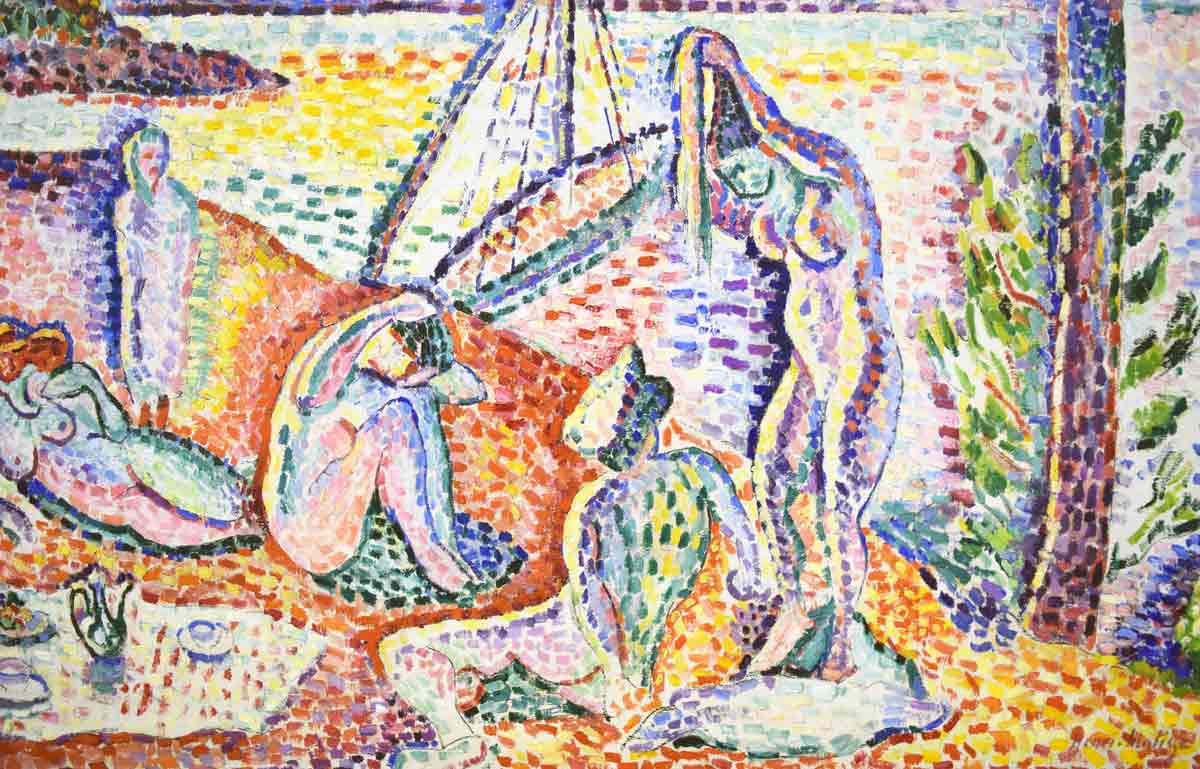
Before 1908, Matisse’s art seems to have been in flux. As noted, Luxe, Calme et Volupté did display some of the characteristics of the stated aims of the later Notes of a Painter, with its blended and gradated tones making for a harmonious effect. Matisse also writes in his Notes that he sought harmony in the sense of the relation between nature and artistic sensibility.
In Luxe there is a natural setting by the sea or a lake. Naturalistic too are the proportions of some of the figures, the morphology of the tree, and some of the color tones. The naturalistic color tones can be seen in the red and gold light reflecting from the water.
However, evidence of an “anti-naturalism,” and what can be ascribed to the artist’s sensibility, is in the exaggeration of tonal contrasts. The warmth or heat of color is heightened and also deepened through cold purple and blues in the effects of shadow. The proportions of some of the figures, for example, the left background figure with arms outstretched or the shrouded middle ground figure, are certainly non-naturalistic.
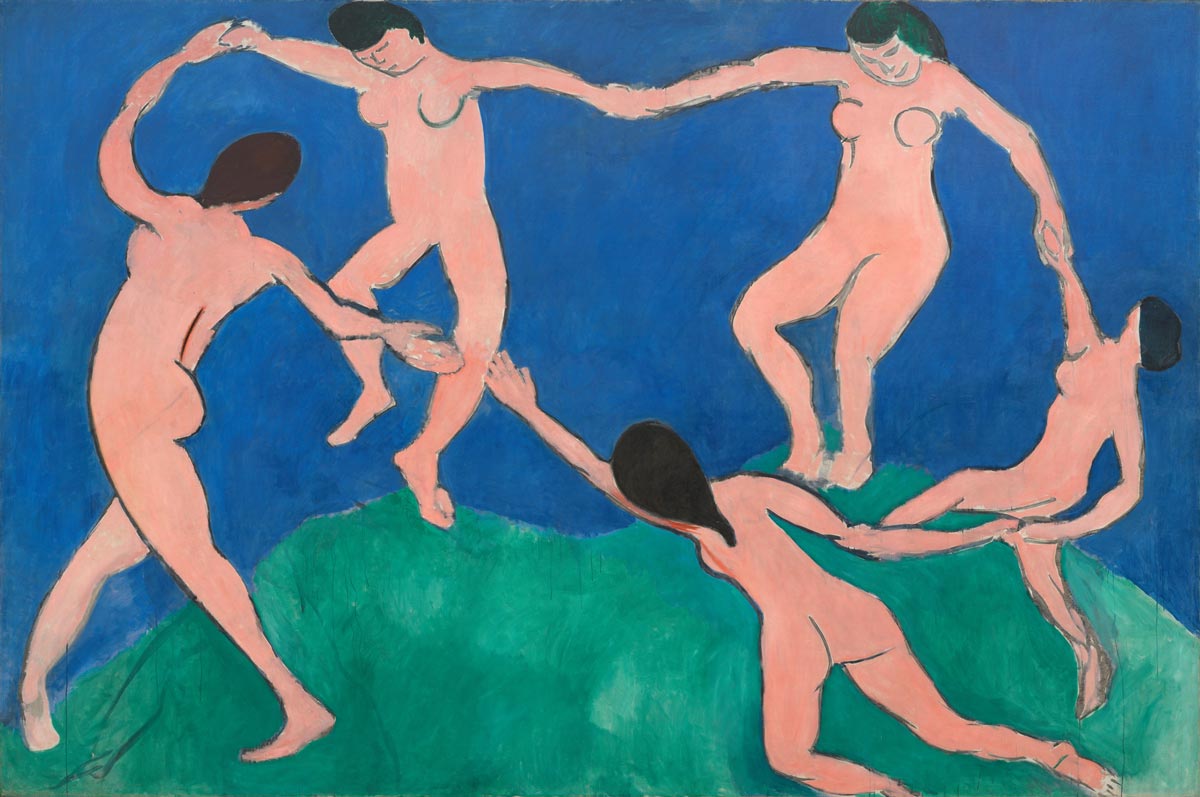
Matisse’s 1908 aim of revealing a “more fully human” essence beyond the means of naturalism is shown here. The figures are not individuated through the painting of their facial features—such features are attenuated and rudimentary. He is painting common humanity rather than a picture of individual people, a universalizing stability of mood that is in concert with his all-over application of paint in loose Divisionism and in his harmony of colors.
In Woman with a Hat of the following year, sensibility seems to dominate nature. This painterly domination through more overtly non-naturalistic colors and shapes exemplifies Matisse’s later expounded aim of the “decorative,” but not the harmonious. This is evident in the impossibly weighty and intricate forms of the hat. Yet, he achieves a likeness of Amélie linearly, if not tonally. The picture is bipartite: on the one hand, there is formal and linear mimesis, while on the other, there is a wild and riotous colorism.
Where in Woman with a Hat, nature and sensibility are juxtaposed without resolution, producing a jarring effect, the harmony of Luxe looks forward to the intentions of the Notes and beyond, to the later Dance images and Music (of 1909-10).
Dance I and II, and Music have a pared-back simplicity. They display a general flattening of tone and fewer colors. These effects match the subject matter and the themes of an original, primeval essence. The natural simplicity of the environment and the naked dancing women combine with Matisse’s sensibility and artistic volition, all of which are participants in the human impulse to express. That is plain as much in the act of dancing in the Dance pictures and the music-making in Music, as in Matisse’s harmonizing vision of them.
Figure and Spirit
Luxe and Woman with a Hat both have a trenchant physicality but in different ways. In Luxe the various styles of drawing the human figure—from the classical nude to the stripped-back and sketched outline—show Matisse’s concern with the body. Luxe’s idyllic, non-worldly scene is heavy with the variety of the human, especially the female, form. It seems that the only male, the seated figure of the left foreground—is fully clothed.
In Woman with a Hat, physicality is also in evidence but, beyond the form of Amélie being painted, physicality is more so in the manner of painting. The paint is applied in thick and rough strokes, the greens of the face intensifying the weightiness of flesh, being darker than natural flesh tones. The huge and heavy hat—both extensive and in dark hues—also contributes to a general freighted effect. In Luxe the manner of painting, with its loose and light dabs of mostly warm colors, is light and contrasts with the physicality of its figures. But in Woman with a Hat, everything is of a solemn weight, even down to Amélie’s expression.
Matisse wrote in 1908 that painting the human figure “best permits me to express my almost religious awe towards life.” These two paintings of 1904 and 1905 reveal Matisse still searching for a form for the human figure that would radiate this sense of awe.
Being Outside Time
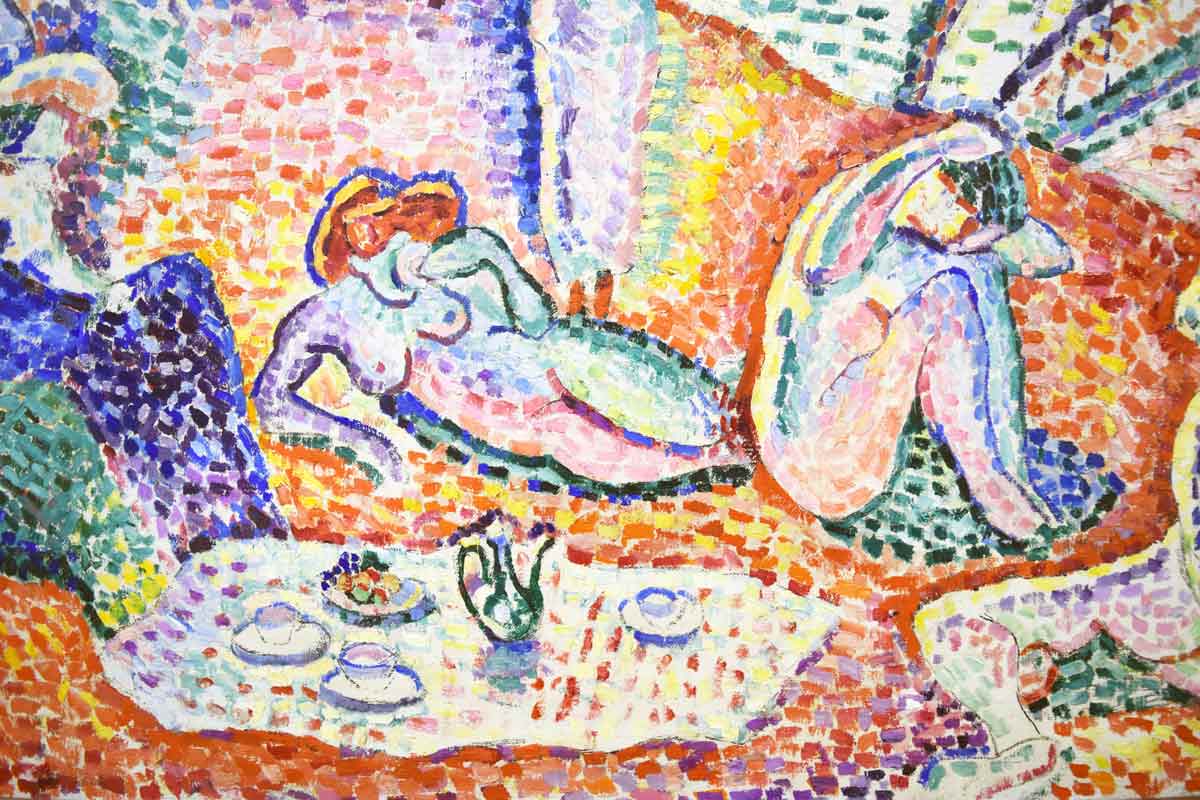
As outlined, Luxe has various human forms but the overall effect of the painting technique is a unifying factor that works to portray, as well as the idyllic scene, the bliss that the envisioning of it invokes in the sensibility.
In Woman with a Hat, the human form is largely obscured by its accoutrements. Amélie’s likeness is at least formally painted, and the graceful lines of her raised right arm are compositionally prominent. However, this 1905 picture seems to be a regression or a detour in Matisse’s quest for a universal and essential concept of the figure, especially when compared with Luxe from 1904. Also working against his stated aim of capturing the human essence, the “deep gravity which persists in every human being,” in Woman with a Hat are the very adornments he paints—from hat to fan.
A look at Matisse’s later work, after 1908, shows an evasion of the contemporary social environment. We can see that his search to portray the essence of humanity comes to entail, perhaps necessarily, the unbinding of his subject matter from any temporal locality. Indeed, in Luxe, he experiments with this ahistorical sense of being but in an inconsistent way in terms of the depiction of the human figure.
In his Notes of 1908, Matisse elucidates both his aim in this direction and his future means to achieve it: he hits on the idea of a “general conception” and the “condensation of sensations” that he craves.
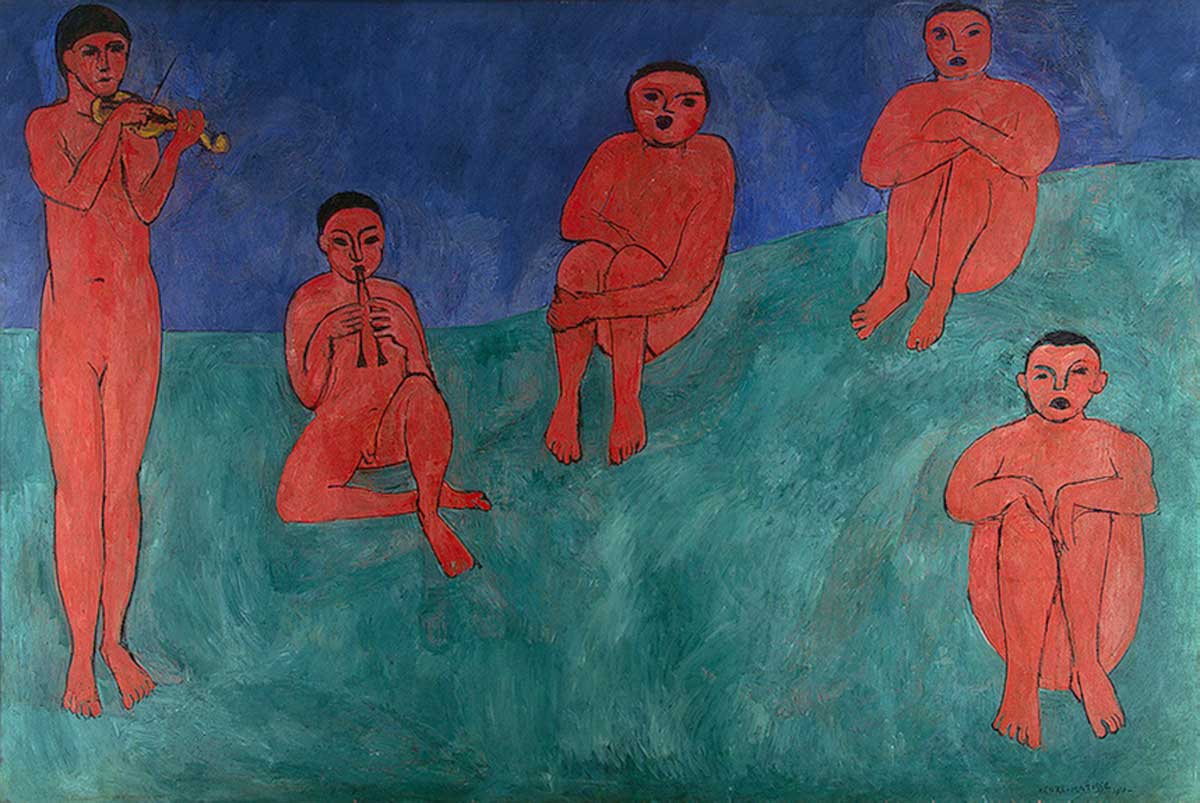
So, in the subsequent works, Dance I and II, and Music, he brings these aims to fruition. These later works shear away the extraneous, the incidental, and the inessential. In the Dance pictures, he does so through the medium of a purified rhythm. This rhythm unifies the subject matter and the method of painting. Matisse is painting not so much figures dancing as motion itself embroiling the figures in dance. The elongated and linked arms especially are like ribbons taken by the fervent wind of motion. Each woman is drawn in a “primitivist” style, with rudimentary features.
Matisse has developed here a thematic of incorporation or de-individuation (also evident in a limited way in Luxe in 1904). In the Dance images, this incorporation is exercised to the point where the women are only distinguishable from each other by their momentary positions in the chain of movement. Facially and tonally, they are interchangeable. A primeval and essential humanity is portrayed in a primeval and barely adumbrated landscape.
Again, like in Luxe, the setting can be construed as idyllic in these images of 1909 and 1910—a vision of a lost, golden age, or an ahistorical relic of a fantasy of nostalgia. This time, though, there is a concentration (“condensation”) of gestural uniformity, unified action, and human essence. In Music, there is a further reduction to a perceived essence, and it establishes a pure being, with the only activity the playing and singing of the inaudible strains of a universal humanity.
Bibliography
Harrison and Wood, Art in Theory: 1900-2000.