
When Cleopatra VII died in 30 BC, Octavian permitted her burial alongside Mark Antony in a grand royal monument. Over two millennia later, their tomb remains undiscovered because ancient Alexandria’s royal quarter sank into the sea. Modern underwater excavations have failed to find the tomb in the heart of the submerged city, which has led modern excavations to shift thirty miles west to Taposiris Magna. Will archaeologists ever piece together Cleopatra’s final resting place?
The Tragic Fall of Cleopatra and Mark Antony in Alexandria
In the civil war that rocked the Roman Empire following the death of Julius Caesar, Cleopatra VII, queen of Egypt, threw her lot in with Caesar’s well-established general, Mark Antony. Unfortunately for her and for Egypt, she chose the wrong side. Alongside his friend and general Agrippa, Octavian decisively defeated Antony and his Egyptian allies at the Battle of Actium in September 31 BC. Antony and Cleopatra fled back to Alexandria, where Octavian followed a year later with his legions.
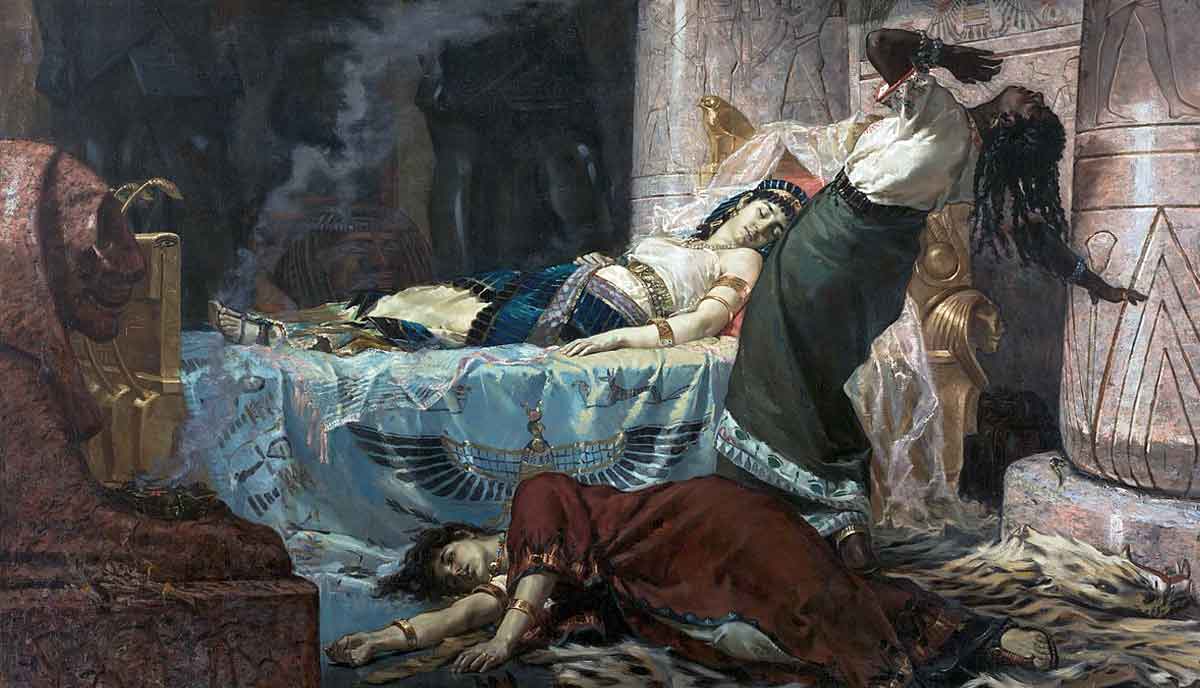
In August 30 BC, Antony’s remaining forces defected, and he received false news that Cleopatra had committed suicide inside the fortified, two-story mausoleum that she had built for them in the Egyptian tradition. He stabbed himself and had his body carried to the Mausoleum, where Cleopatra was still alive with two maidservants, Charmion and Iras. Octavian immediately dispatched an officer to capture Cleopatra alive for him to display in his triumph. While the soldiers disarmed Cleopatra, she was unwilling to be a trophy of war.
Cleopatra pretended to cooperate with Octavian, but asked permission to make a final libation at Antony’s tomb. Once granted, she bathed and dressed in full royal regalia. Legend has it that she then killed herself inside the tomb either by allowing herself to be bitten by a cobra or by taking poison. She earlier dispatched a note to Octavian with the request to be buried beside Antony. While Octavian was angry to have lost his prize, he agreed to the request.
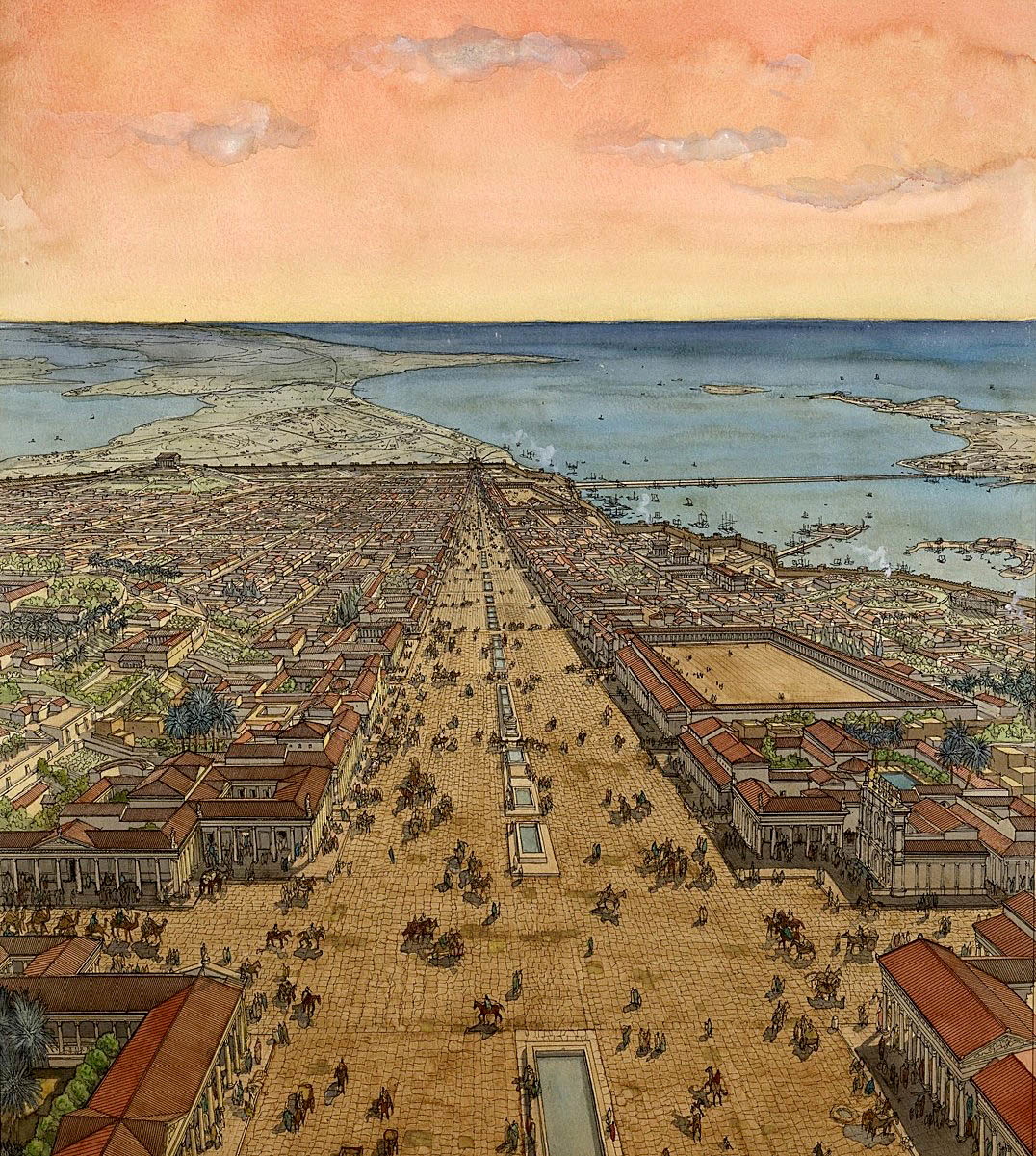
Octavian granted the request for his own reasons. He had framed the war not as a civil conflict, but one against an Egyptian queen who had bewitched Antony to abandon his nation. Burying him alongside the queen forever tied Antony to that narrative. He still paraded an effigy of Cleopatra on her couch with a snake clinging to her arm in his triumph. The act also allowed Augustus to show his Clementia as a statesman and appease the Egyptian population who mourned the death of their queen. On the flip side, he also ordered the execution of Cleopatra’s son with Caesar, Caesarion, removing him as a rival. He claimed Egypt not just for Rome, but as his own personal province.
Both Plutarch and Cassius Dio describe Cleopatra’s tomb. It was not just a burial place, but a heavily fortified, multi-story royal vault they say was located in the royal quarter of Alexandria, along the coast, adjacent to the Temple of Isis. They say that the lower entrance featured massive wooden or bronze doors secured by sophisticated internal locking mechanisms. Once closed, they could not be forced open from the outside without heavy siege equipment. They also record that one of the upper levels had a large window or balcony, which was how the Roman soldiers breached the tomb originally. It also served as a royal treasury, where Cleopatra had stored her wealth, but Octavian took this with him.
How Natural Cataclysms Submerged the Ptolemaic Royal Quarters
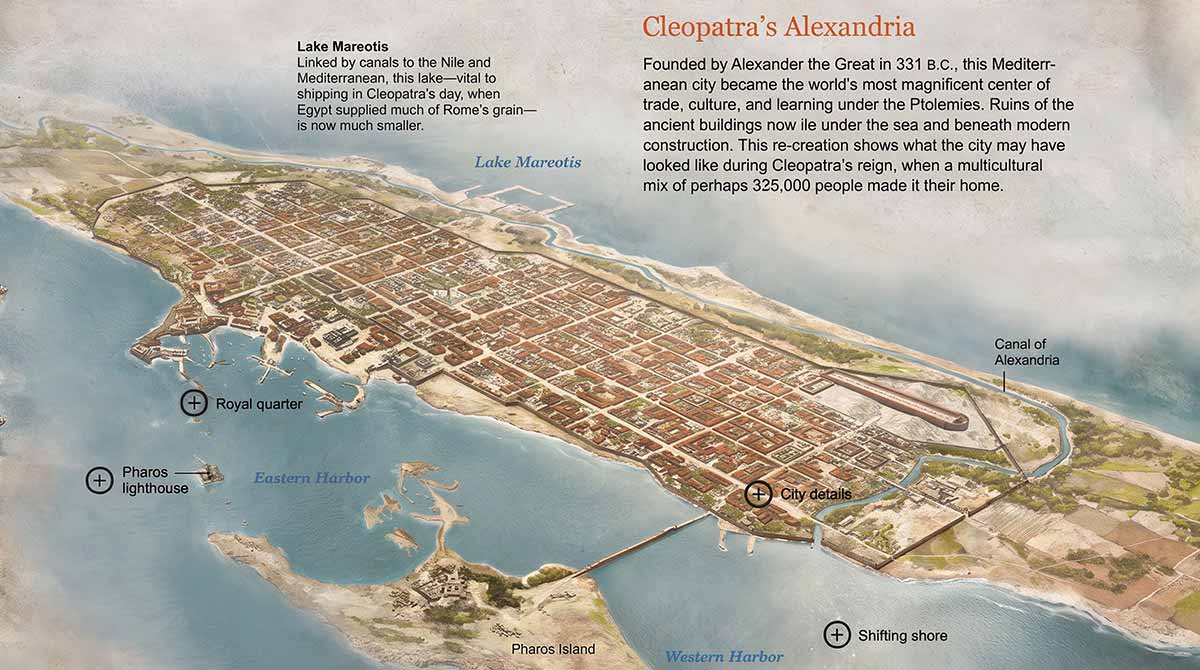
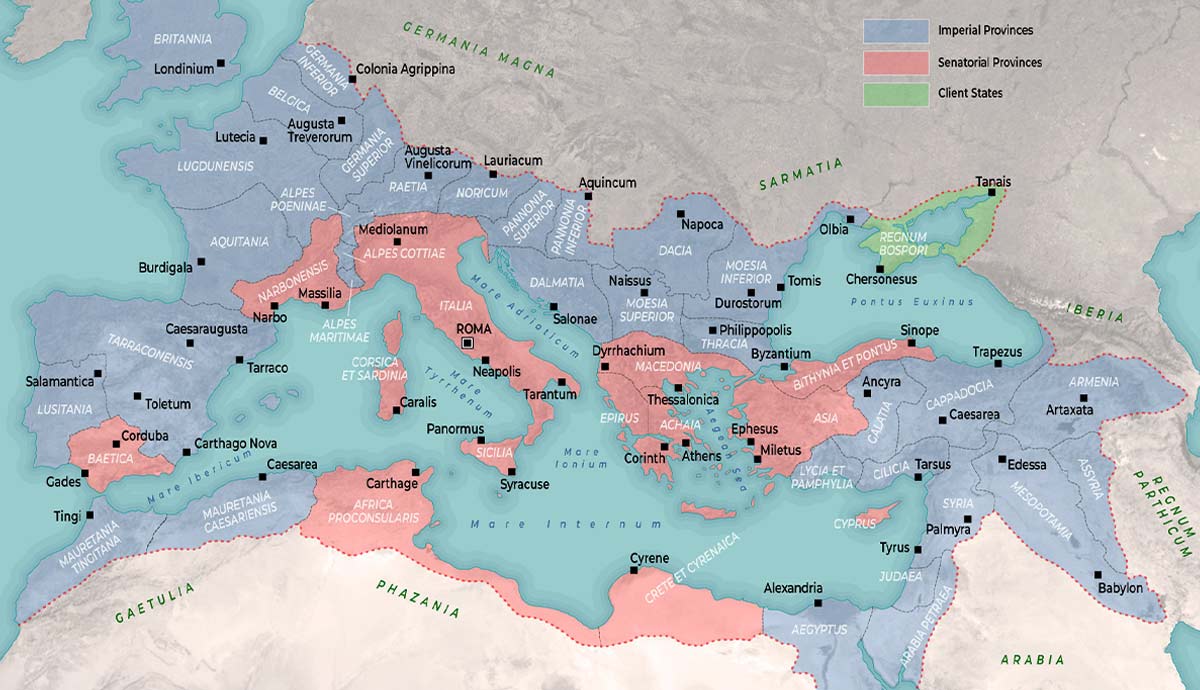
While the location of the tomb is recorded by ancient authors, that part of Alexandria was lost in antiquity. Alexandria’s royal quarter was built on reclaimed land in the Nile Delta that extended over soft, unconsolidated Holocene sediments. Heavy Ptolemaic monuments were built on top of this fragile ground, and the heavy stone structures gradually started sinking into the liquefying ground and slowly sliding down the coastal shelf towards the sea.
On July 21, AD 365, an 8.0 to 8.5 magnitude earthquake struck the Hellenic Subduction Zone off the southwestern coast of Crete. The event was so violent that Crete was uplifted vertically by around nine meters in a few minutes, sending shockwaves across the Mediterranean. When the seismic waves hit Alexandria, the coastal promontories that held the royal quarter slumped into the sea.

The Roman historian Ammianus Marcellinus witnessed the event (Res Gestae 26.10.15-19). He said that the Mediterranean temporarily pulled away from Alexandria’s shores, leaving ships lodged in the harbor bed. But moments later, a tsunami slammed into the coast, breached the harbor walls, carried heavy ships over the city walls, and tore down the already weakened stone complexes of the Ptolemies. Many of the buildings were permanently washed into the bay.
While parts of the royal quarter did not slide into the sea on that fateful day, they were likely further damaged by major earthquakes in the 8th century and in 1303, which damaged the famous Lighthouse of Alexandria. Whatever survived was lost to urban development over the centuries, with the royal quarter used as a quarry for building stones during the Islamic and Ottoman periods. In the 1800s, Muhammad Ali Pasha chose Alexandria as an important center in Egypt’s modernization. In his building boom, multi-story residential blocks, grand administrative buildings, and paved avenues were built directly on top of the city’s ruins.
Mapping the Sunken Palaces of the Portus Magnus
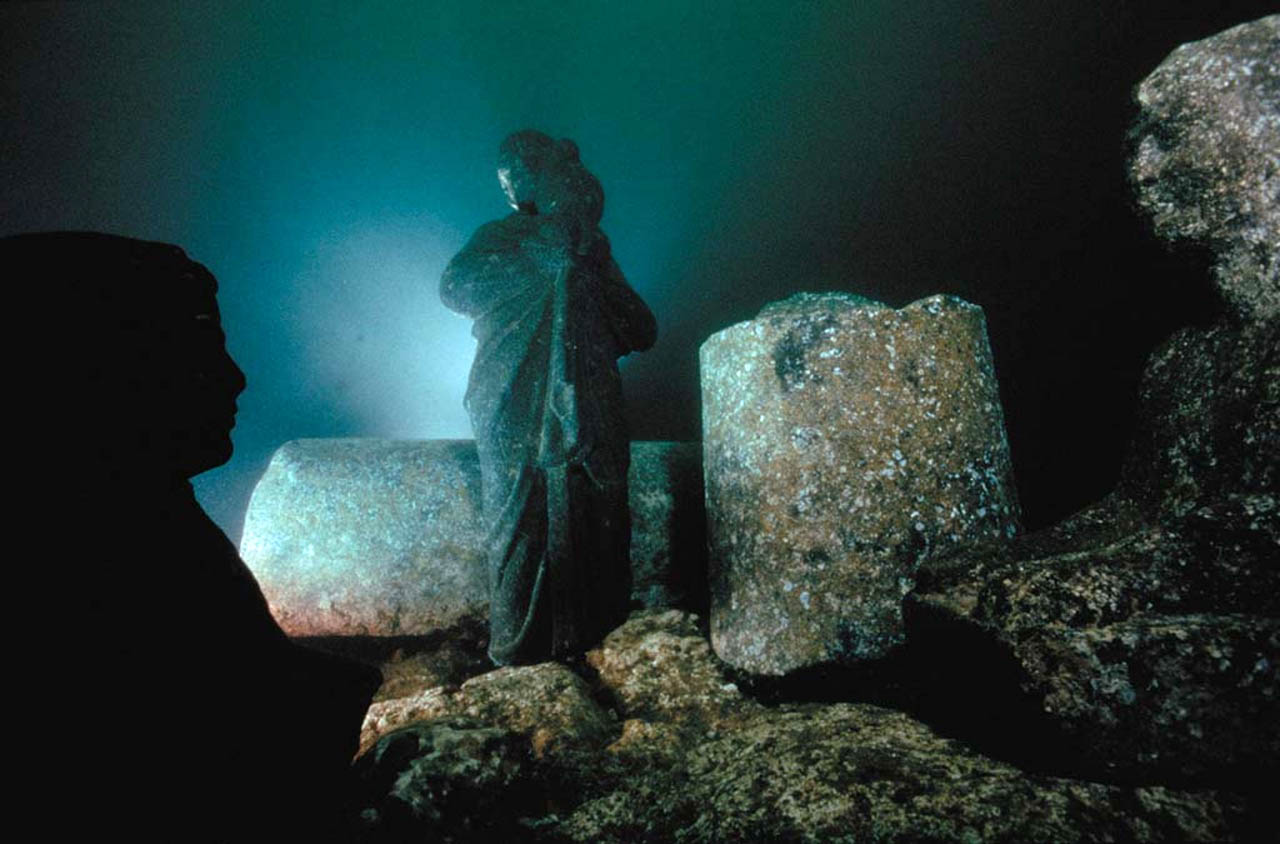
In 1992, French underwater archaeologist Franck Goddio, working with the Egyptian Antiquities and the European Institute for Underwater Archaeology, began a systematic survey of the ruins in Alexandria’s modern Eastern Harbor with the main aim of mapping the ancient Portus Magnus and royal quarter.
This was a monumental task, as urban sewage, maritime traffic, and sediment churn mean that visibility is extremely low. Normal diver surveys are not possible. Therefore, Goddio and his team mapped the topography electronically before attempting any excavations. They used Nuclear Magnetic Resonance Magnetometry, which detects micro-variations in the Earth’s magnetic field, detecting submerged stone, iron features, and ancient ceramic deposits. They also used Multi-Beam Bathymetry, which is high-frequency acoustic imaging that can generate models of the seabed.
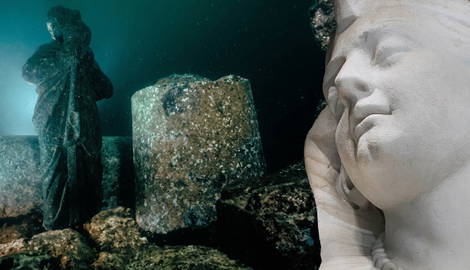
This mapping identified targets for challenging underwater excavations, revealing some remarkable finds. Strabo described a small royal island off the main palace district called the Island of Antirhodos. Goddio discovered it about five meters below the surface with imported Greek marble floors. Elsewhere, archaeologists discovered a long stone jetty and the submerged foundations of the Timonium, the isolated sanctuary that Mark Antony built after his defeat at Actium. As well as dozens of shipwrecks, divers have also recovered a colossal red granite statue of an unidentified Ptolemaic pharaoh, a colossal statue of the goddess Isis, and a black sphinx with the facial features of Ptolemy XII Auletes, Cleopatra’s father.
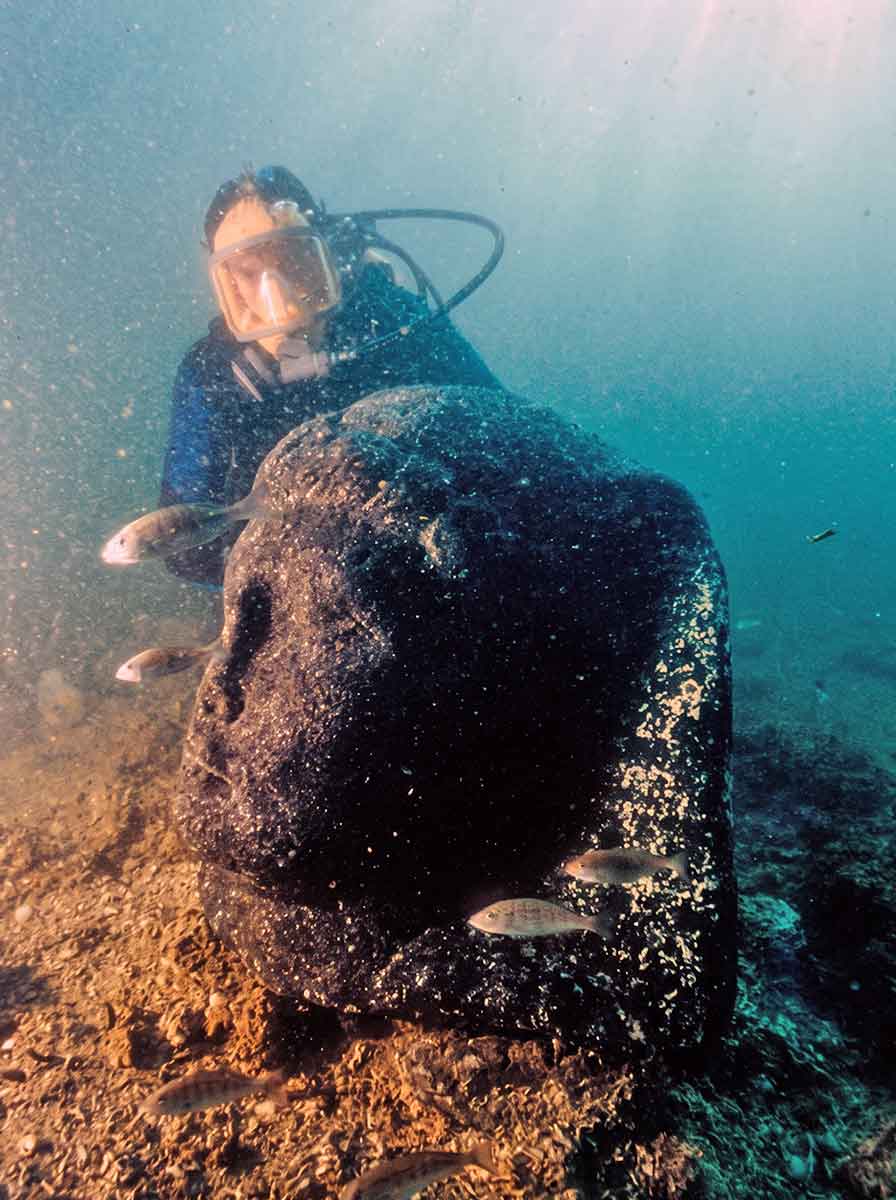
What hasn’t turned up is any sign of Cleopatra’s tomb. One reason could be that the tomb, despite its fortress-style construction, was torn apart by the tsunami. This would have left it a pile of disordered rubble, indistinguishable from the dozens of other destroyed temples and buildings lying beneath the sea. Archaeologists can not excavate each individual underwater block, buried two to four meters under marine clay and organic sludge. When even one block is removed, underwater suction quickly fills in the pit.
Because of the haste with which the tomb was built, and the likelihood that it was quickly overlooked or even defaced during Roman occupation, it may have had few epigraphic inscriptions or other indicators of the purpose of the building. Without discovering a royal cartouche of Cleopatra or a funerary stele of Antony, archaeologists have no hint where to focus their expensive and challenging underwater search for the tomb.
Why Kathleen Martinez Shifted the Search to Taposiris Magna

Another reason that Goddio and his team may not have found Cleopatra’s tomb may be that it is not there. While Plutarch and Cassius Dio both say that the tomb was located in the royal quarter, they were both writing centuries later.
In recent years, Kathleen Martinez, a Dominican criminal lawyer turned archaeologist, has suggested that the tomb may have been located inland at Taposiris Magna, or the “Tomb of Osiris,” an ancient temple complex located about 45 kilometers west of Alexandria. She has led excavations there since 2005.
Her hypothesis is based on royal theology and propaganda under Cleopatra, marking herself as Isis and Anthony as Osiris, with a tomb designed to manifest their reincarnation as the gods.
According to the Egyptian myth, Osiris was the rightful pharaoh of Egypt, but he was killed by his jealous brother Seth, and his body was cut to pieces and cast around Egypt. Isis, with the help of her sister and Seth’s wife Nephthys, recovered the pieces and magically restored Osiris to life, impregnating herself with his seed to give birth to Horus. But Osiris was not completely reborn and could not return to the world of the living, so Isis created the underworld for Osiris, creating the afterlife.
Throughout her 21-year reign, Cleopatra always presented herself as Thea Nea Isis, the new goddess Isis and her living incarnation on earth. She dressed in the sacred robes of Isis and presented herself breastfeeding her son Caesarion, just as Isis is presented breastfeeding her son Horus. While Mark Antony was associated with Dionysus, the Greek god of wine and ecstatic fertility known as Bacchus to the Romans, in Egypt, Dionysus was associated with Osiris.
Martinez argues that when she was defeated by Octavian, she designed her immortality by orchestrating the burial of herself and Anthony inside the sanctuary of Osiris, at Taposiris Magna, one of the places in Ancient Egypt where Isis was believed to have buried a piece of her dead husband. There, she sent Anthony to the realm of the dead and then followed him there. Martinez suggests that this may be why Octavian allowed the burial, because it was on the periphery of the city and not the heart of the capital.
Crucial Discoveries Inside the Subterranean Complex of Taposiris Magna
Excavations at Taposiris Magna have lent some support to Martinez’ theory. While Egyptologists previously thought that Taposiris Magna was little more than an unfinished third-tier regional temple, Martinez’ excavations have revealed an extensive Ptolemaic center.
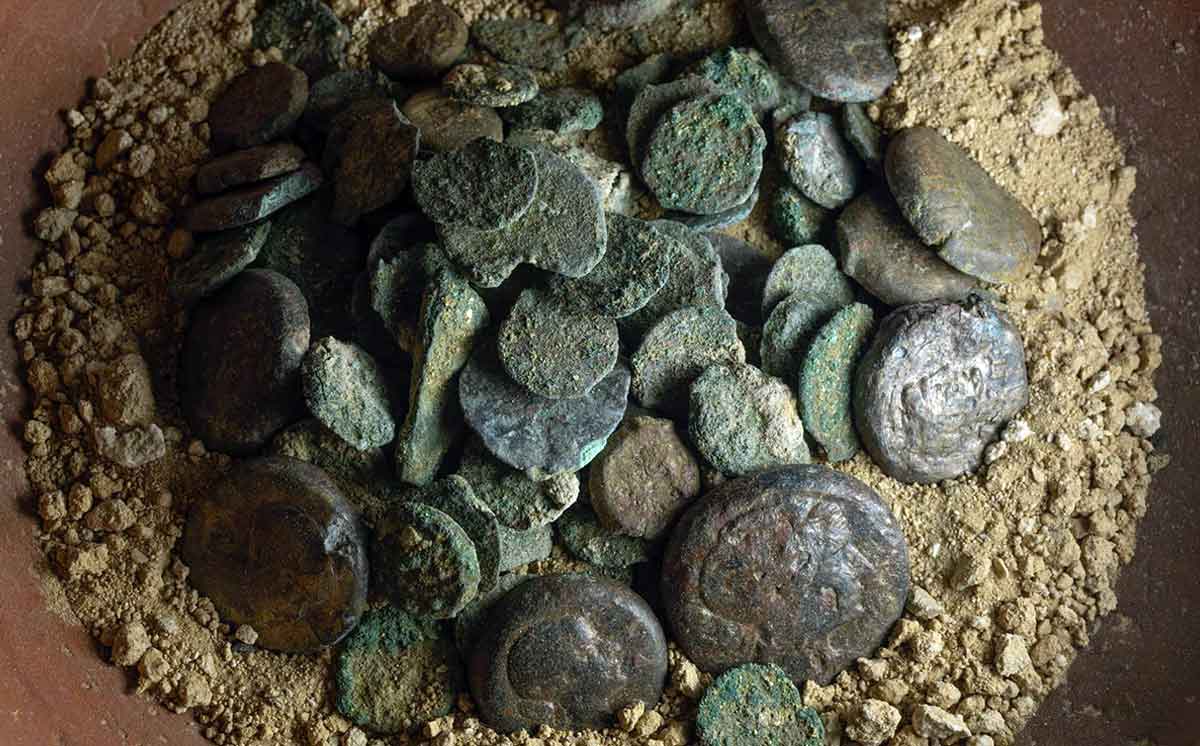
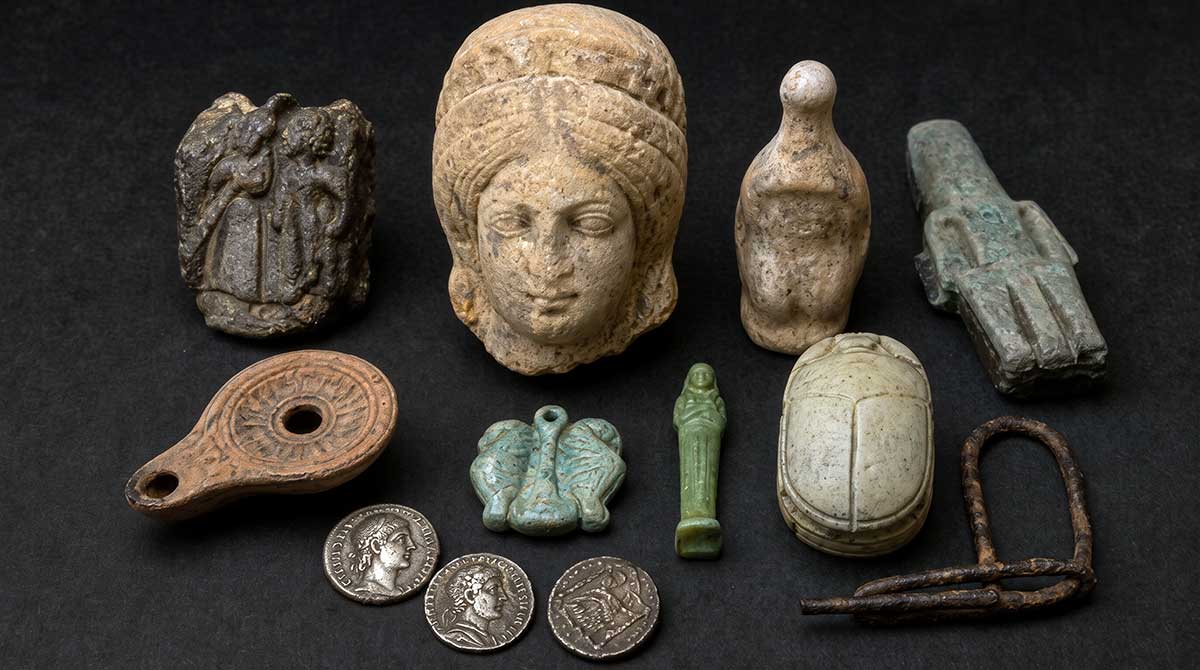
Excavators have found evidence that the temple was founded and expanded by Ptolemy IV Philopator (221-204 BC), associating it with the Ptolemaic dynasty. They have also uncovered a hoard of more than 200 bronze coins minted in Alexandria bearing the portrait of Cleopatra VII, which would be unusual for a regional center unless it enjoyed direct royal favor. They have also found statues of Isis, amulets, and male portrait busts, including one with a cleft chin and hooked nose reminiscent of images of Mark Antony.
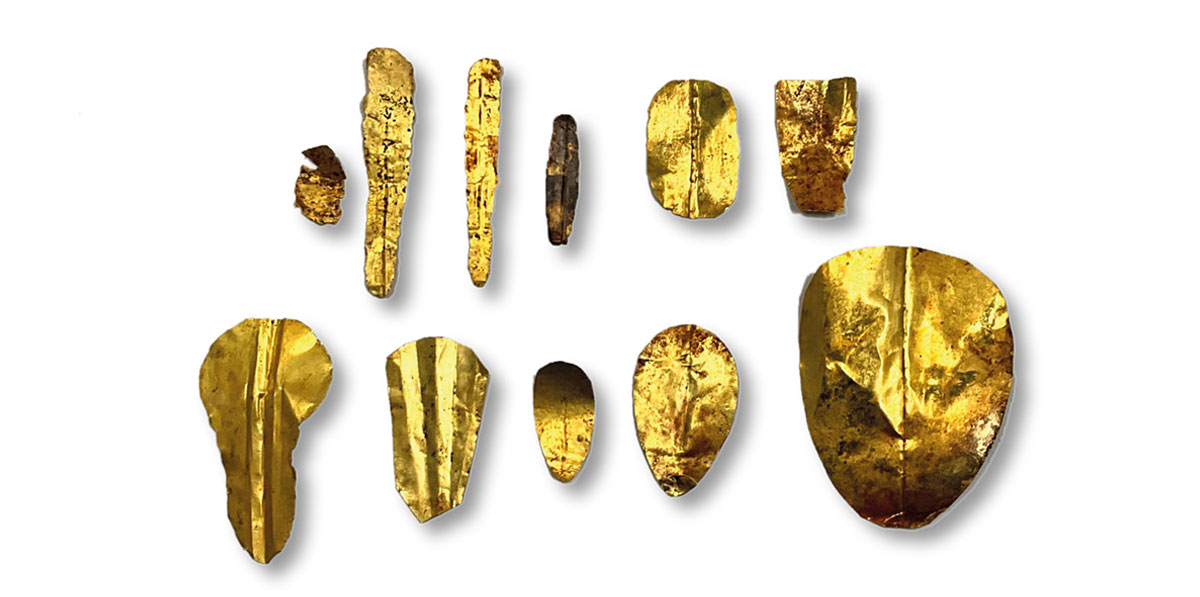
Outside the temple, the team discovered a cemetery of rock-cut shaft tombs dating to the Ptolemaic and early Roman periods. Several mummies were buried with gold foil tongues, a ritualistic funerary practice that was designed to enable the dead to speak to Osiris in his court in the underworld. The mummies were also buried facing the temple, indicating the importance of Taposiris Magna as a sanctuary of Osiris.
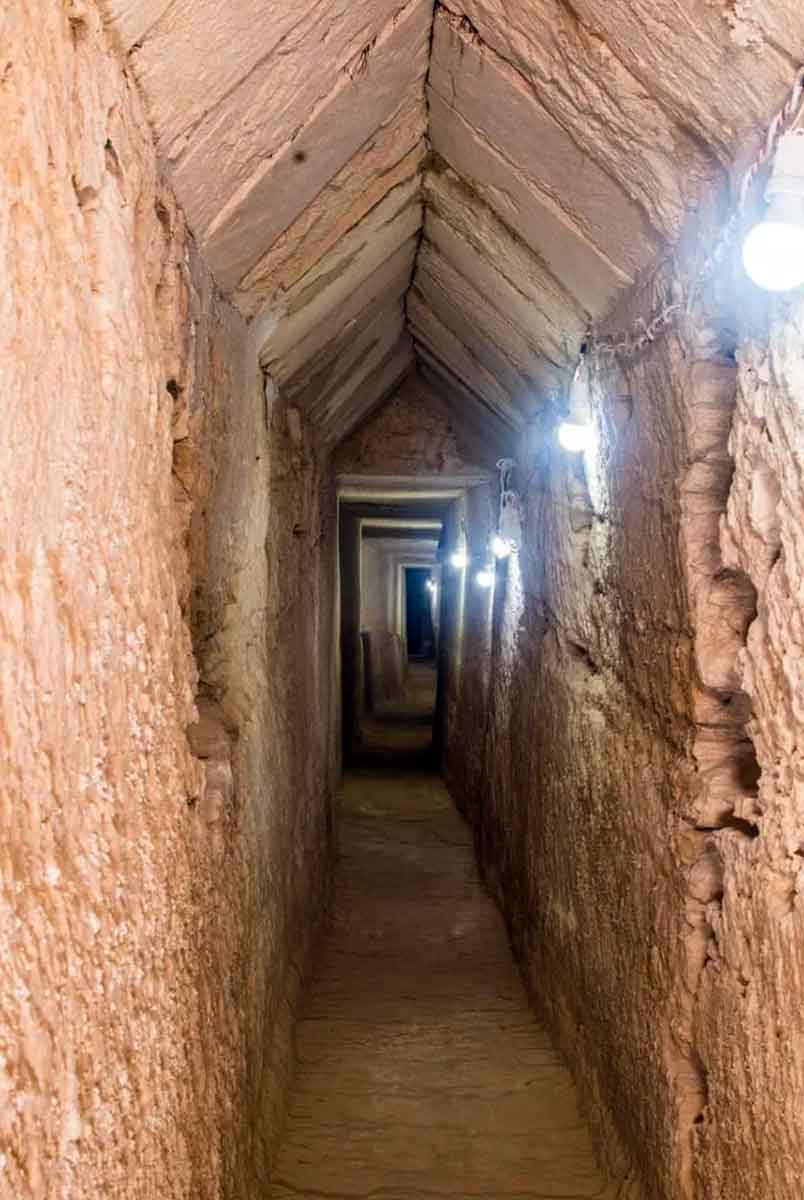
Perhaps most interesting, in 2022 Martinez found a rock-cut tunnel 13 meters beneath the temple foundations measuring 1,305 meters long and two meters high. Cut straight into the limestone bedrock, parts of it run beneath the water table, leading in the direction of Alexandria’s now submerged royal quarter. Could this be the connection between Taposiris and Cleopatra’s supposed tomb in the royal quarter?
What Modern Technology Reveals About the Unfinished Hunt
Martinez’ discoveries at Taposiris Magna are fascinating in their own right, and the connection with Cleopatra is tantalizing, but is it realistic when it contradicts the explicit evidence of the written sources? Critics of her theory argue that Taposiris was rather a major cult center of Osiris where Alexandrian elites sought to be buried, without requiring the presence of Cleopatra herself.
While the latest non-invasive surveying technology is being used to potentially pinpoint the location of the tomb both under the sea and under the earth, some scholars believe it may never be found. Some suggest that while Octavian allowed the burial, he certainly took the wealth held in the treasury. Considering the Roman occupation of Egypt, the tomb would have quickly lost its importance and may have been repurposed.

If it had been allowed to stand, it could have been destroyed when the Roman emperor Aurelian recaptured Alexandria from Queen Zenobia of Palmyra in AD 272, during which he systematically burned the royal quarter to prevent future rebellions. If it survived that, it was almost certainly destroyed following the outlawing of paganism at the end of the 4th century AD, which saw Christian patriarchs lead the destruction of surviving pagan monuments.
Like so many other lost tombs in antiquity, including that of Alexander the Great also in Alexandria, Cleopatra’s tomb may never be found.